
Collectors: 10 Fashion History Books to Start Your Curated Library

For most readers, one book earns the first spot on the shelf, but where could you start if you were to begin curating your own fashion library. Let us take for instance: The Fashion Book from Phaidon - an A–Z reference that makes sense of nearly two centuries of style in a single, browsable volume. Pair it with The Dictionary of Fashion History for precise terminology, and The Cambridge Global History of Fashion once you’re ready for deeper scholarship.
A curated shortlist, buying guidance, and Vivien Lauren’s own library recommendations follow.
The Fashion Book from Phaidon, mentioned earlier, is ideal for beginners, offering over 500 entries that cover nearly two centuries of style in a browsable format.
An academic series like The Cambridge Global History of Fashion provides essential global context and challenges Eurocentric narratives by including trade and regional dress traditions.
For technical insights, Fashion in Detail from the V&A reveals garment construction, seams, and methods through high-quality photography and line drawings.
Curated bibliographies from Vivien Lauren focus on craftsmanship, designer monographs, and well-printed titles that hold collector’s value over time.
When purchasing, prioritize updated editions, high-resolution images, and sources citations, especially for reference and exhibition catalogues, to ensure relevance and quality.
Table of Contents
Fashion History Books: The Curated Shortlist Every Collection Needs
A proper library on fashion’s past should feel like a wardrobe, really. You need staples you reach for constantly, a few showpieces that reward slow looking, and one or two rigorous pieces that hold everything together with real intellectual structure. The ten titles below are organized by what they do best, not by publication date or prestige.
Starter and visual survey
The Fashion Book (Phaidon) — The Fashion Book’s revised edition features more than 500 entries spanning nearly two centuries, updated to include figures like Virgil Abloh and Rihanna alongside the historical greats. This is the single best entry point if you’re choosing only one title, and it suits anyone who wants quick, reliable identification without academic density.
Fashion, Annotated (DK/Penguin) — Organized chronologically and paired with expert annotation on every spread, Fashion, Annotated walks readers from ancient dress to contemporary runway pieces. It suits visual learners who want context alongside imagery rather than dense prose, and its annotated format makes it genuinely useful for casual browsing.
A–Z and reference
The Dictionary of Fashion History (Bloomsbury) — With 384 pages and 191 color illustrations, this dictionary gives precise, citable definitions of costume terms and movements. Students and serious researchers will find it indispensable; casual readers may find it drier than the visual surveys, but that precision is exactly the point.
Academic and global history
The Cambridge Global History of Fashion — This multi-volume academic series covers the ancient world to the present, with dedicated chapters on global trade, colonialism, and regional dress traditions that most Eurocentric surveys skip entirely. Cambridge University Press positions this series as the corrective to fashion histories that treat Paris and Milan as the only origin points, and readers serious about scholarship should treat it as essential rather than optional.
Construction and technical study
Fashion in Detail: 1700–2000 (V&A) — The V&A’s Fashion in Detail series covers centuries using both color photography and specially commissioned line drawings, revealing seams, boning, and construction methods that photographs alone can’t show. Anyone studying garment making, or curious about how a Victorian bodice actually worked, needs this on the shelf.
Biographies and memoirs
A well-chosen designer biography does something reference books cannot: it shows how one person’s decisions reshaped an entire industry. Look for titles that blend personal narrative with cultural analysis rather than pure hagiography, since that combination is what turns a life story into genuine history of fashion literature rather than fan material.
Memoirs from designers who lived through pivotal decades, particularly the postwar rebuilding of Parisian couture or the 1960s youthquake, add texture that academic surveys tend to flatten. Read one alongside our piece on the 1920s and its stylistic upheaval to see how individual voices and broader movements reinforce each other.
Exhibition catalogues and monographs
Museum exhibition catalogues, especially those tied to major retrospectives, often contain scholarship and photography unavailable anywhere else, since curators had direct access to garments in storage. These tend to go out of print quickly, so buy them when you see them rather than waiting.
Editorial outlets including Vogue’s annual gift roundups regularly spotlight monographs and catwalk books that collectors are actively seeking, which is a reasonable signal of what’s holding value on the secondhand market.
A focused monograph on a single house, Chanel’s evolution or the founding of haute couture as an institution, gives you the depth a general survey cannot. Our guide to understanding haute couture’s origins makes a useful companion read before diving into house-specific monographs.
How to Choose Fashion History Books for Your Own Library
The right book depends on what you’re actually trying to do: identify a garment quickly, cite a term correctly, or understand how colonial trade routes shaped what we now call “global fashion.” Match the book to the task before you match it to your coffee table.
A balanced starter library benefits from deliberate variety rather than five versions of the same coffee-table survey. Consider building around this mix:
One visual survey for quick browsing and inspiration (The Fashion Book fits here)
One A–Z or dictionary-style reference for accurate terminology
One focused academic or global history for depth and context
One biography or memoir for narrative and human texture
Before buying, ask three concrete questions. Is this an updated or revised edition, given how quickly contemporary designers get folded into new printings? Are the photographs high resolution, particularly for garments where texture and construction matter? Does the book cite its sources, or does it read like unattributed marketing copy dressed up as scholarship?
Pro Tip: Check a book’s edition history before buying a reference title. Fashion moves fast, and a dictionary or A–Z guide printed a decade ago will be missing an entire generation of designers who now define the conversation.
Types of Fashion History Books, and When Each One Earns a Spot
Not every fashion book is doing the same job, and confusing the categories is the fastest way to end up disappointed with a purchase.
Reference works exist for accuracy and quick lookup. You consult them, you don’t necessarily read them cover to cover.
Coffee-table and photographic surveys prioritize visual impact and browsability, ideal for inspiration but weaker on rigorous context.
Academic multi-volume histories trade browsability for depth, often organized thematically rather than chronologically.
Biographies and memoirs deliver narrative and personality, showing fashion history through one person’s decisions.
Exhibition catalogues capture scholarship tied to a specific collection or retrospective, often unrepeatable once a museum’s show closes.
Line drawings matter more than most beginners realize. A photograph shows you what a garment looked like; a commissioned line drawing shows you how it was built, which is why technical study benefits so heavily from titles that include both. Scholarship has also shifted meaningfully toward global perspectives in recent years, so when comparing two similar-looking academic titles, favor the one that explicitly addresses trade, colonialism, or non-Western dress traditions rather than treating European ateliers as the whole story.
Vivien Lauren’s Fashion Library: A Curator’s Eye on Designer Books
Vivien Lauren Fashion Library
A general bookstore shelf mixes fashion history indiscriminately with celebrity memoirs and seasonal trend guides. Vivien Lauren’s curation works differently: every title is selected with the same eye for craftsmanship and provenance that shapes our handbag and leather goods collections.
We prioritize catwalk books and house-specific monographs over generic “best of” compilations.
We favor titles that document construction and material, not just finished silhouettes.
We treat a well-printed book as a collector’s object, worthy of the same scrutiny as an heirloom bag.
What you want | Where to look |
Designer catwalk books | Vivien Lauren’s Fashion Library |
Craftsmanship-focused monographs | Vivien Lauren’s Fashion Library |
General A–Z or academic reference | Independent booksellers, museum shops |
Collectors browsing our Fashion Library will find the curated catwalk and designer titles positioned alongside the same handcrafted pieces they came to admire.
Buying Smart: Editions, Secondhand Copies, and What Holds Value
Buy revised or updated editions of survey and reference titles whenever possible. Fashion moves too fast for a decade-old dictionary to stay current, and publishers routinely fold in contemporary designers when they reissue.
Check the ISBN and photo credits before buying; museum-published titles like the V&A series typically list printing details that signal quality.
Buy exhibition catalogues and limited monographs new or quickly, since they tend to go out of print and appreciate on the secondhand market.
General reference and A–Z titles are safe to buy used, since accuracy matters more than pristine condition.
Library copies work well for academic multi-volume sets you want to sample before committing to a purchase.
Why Most Fashion Book Lists Get the Basics Wrong
Most roundups of essential fashion books read like SEO exercises: ten titles, one paragraph each, no real distinction between what a reference book does and what a coffee-table survey does. That flattening does readers a disservice, because a beginner who buys three visual surveys in a row ends up with a lovely shelf and no actual framework for understanding how fashion history connects to trade, class, or colonialism.
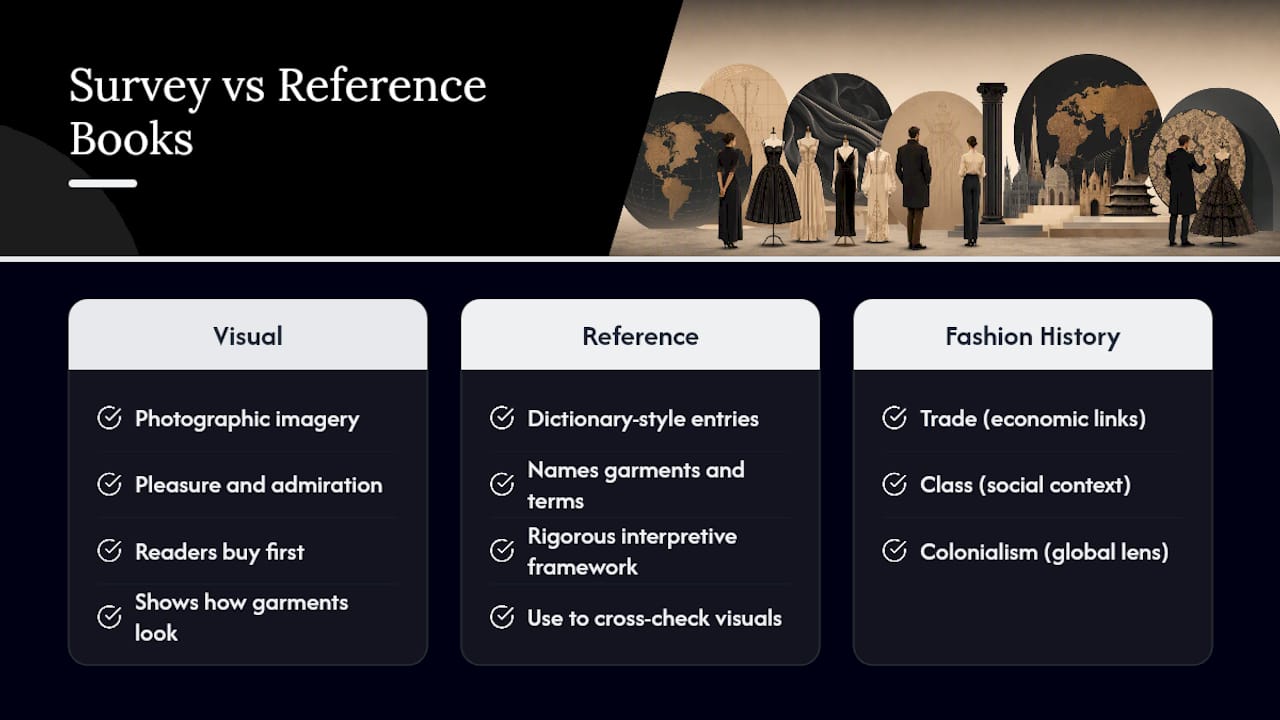
The gap I keep seeing is a lack of balance. Readers gravitate toward the prettiest book on the table, understandably, but skip the dictionary-style references that would let them actually name what they’re looking at. My honest recommendation: buy one visual survey and one rigorous reference at the same time, not sequentially. You’ll retain far more if you can cross-check a garment’s name in The Dictionary of Fashion History the same week you’re admiring it in a photographic survey.
Start with breadth before you chase rare exhibition catalogues. The global academic titles matter more than most beginner guides admit, because fashion history taught only through a European lens is an incomplete history.
— Vivien Lauren.
Bring the Same Curation Home With Vivien Lauren
Vivien Lauren approaches designer books the way we approach every handbag and scarf in our collection: with an eye for craftsmanship, provenance, and lasting value rather than fast trends. If the shortlist above left you wanting curated catwalk books and house monographs in one place, rather than hunting across a dozen sellers, our Fashion Library gathers exactly that selection alongside our Italian-crafted leather goods and accessories.

Every piece in a curated collection, from handcrafted bags to books in a library, is chosen with a standard: made to last, worth returning to. Browse the current Fashion Library selection, and if you’re shopping the wider collection, orders over £80 ship free within the UK. Start with one title, or one bag, and see what earns a permanent place in your collection.
Sources
FAQ
What is the best book on fashion history?
For most readers, The Fashion Book from Phaidon is the strongest starting point, since it covers nearly 200 years of style across more than 500 entries in one browsable volume. Readers wanting academic depth should move to The Cambridge Global History of Fashion once they’ve built a foundation.
What is the 3-3-3 rule in fashion?
Definitions of this rule vary across styling sources and it isn’t a recognized fashion history framework, so no single canonical version exists. It’s more commonly used in wardrobe-minimalism advice than in historical scholarship, so treat it as a styling concept rather than a fashion history term.
What are the top fashion books for beginners?
Beginners benefit most from a mix: The Fashion Book for quick visual identification, Fashion, Annotated for chronological context, and The Dictionary of Fashion History for accurate terminology as they start naming what they see.
How can I learn about fashion history as a beginner?
Start with one visual survey and one reference book read side by side, then add a focused biography or monograph once you have a working vocabulary. Vivien Lauren’s Fashion Library curates designer catwalk books and monographs for readers ready to go deeper into a specific house or era.
Are Italian fashion books worth seeking out separately?
Books focused on Italian ateliers and craftsmanship traditions add valuable context missing from general surveys, particularly around leatherwork and tailoring techniques passed down through generations. They pair well with a broader academic history rather than replacing one.
Recommended
This fashion piece has been authored and brought to you by Chloe. For Vivien Lauren. Vivien Lauren. Luxury. Craftsmanship that's Proudly Italian. Vivien Lauren. Proud To Style.
