
Sustainable Fashion Shopping Workflow for Women
- Sammy Li
- 9 hours ago
- 9 min read

TL;DR:
Starting with a wardrobe audit reveals what you already own and helps identify actual needs, reducing impulse purchases. Combining certification checks like GOTS and OEKO-TEX ensures supply chain integrity and chemical safety, guiding authentic sustainable buying. Applying cost-per-wear analysis and deliberate delays shifts choices toward longevity and environmental mindfulness.
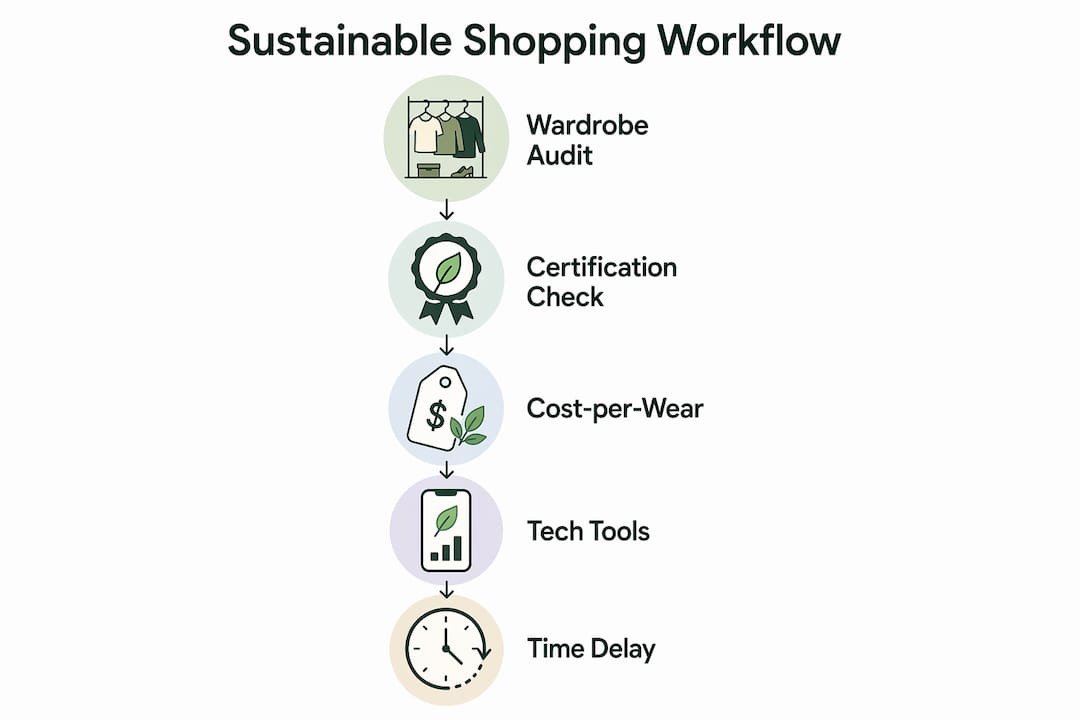
A sustainable fashion shopping workflow is a structured process that guides you through mindful purchasing decisions to minimize environmental impact and maximize garment lifespan. For women who value both elegance and ethics, this workflow replaces reactive, impulse-driven buying with a deliberate sequence: wardrobe audit, certification check, cost-per-wear analysis, and timed delay. The result is a wardrobe that grows with intention, not accumulation. Tools like EcoThread, certifications such as GOTS and OEKO-TEX Standard 100, and behavioral rules like the 48-hour delay each play a distinct role. Together, they form the ethical fashion purchasing guide that conscious luxury shoppers deserve.
How does starting with a wardrobe audit improve sustainable shopping?

The most sustainable purchase is the one you never make. Shopping your own wardrobe first is the single most effective step in any green wardrobe planning process. Before you open a single retailer tab, open your closet.
A wardrobe audit means sorting every item by how often you actually wear it. Divide pieces into three groups: worn regularly, worn rarely, and not worn in over a year. This exercise reveals duplicates, forgotten gems, and genuine gaps. Most women discover they already own pieces that satisfy the “need” they were about to spend money on.
Once you have mapped your wardrobe, write down the specific gaps. A structured pre-shopping inventory reduces impulsive buying, helps you spot duplicates, and focuses your attention on true wardrobe needs. That list becomes your shopping brief. You do not browse without it.
The behavioral step that reinforces the audit is the 48-hour delay rule. When you find an item you want, add it to a saved list rather than your cart. Wait 48 hours before returning to it. Delaying nonessential purchases improves conscious shopping by letting urgency fade and clarifying whether the item truly fills a gap. The desire to buy often dissolves on its own.
Common pitfalls to avoid during the audit:
Keeping items “just in case” without a specific occasion in mind
Counting capsule basics you own but never actually style
Skipping outerwear, shoes, and bags from the inventory
Auditing only once a year rather than seasonally
Pro Tip: Photograph every item during your audit and store the images in a phone album. When you are tempted by something new, scroll through your album first. Seeing what you already own, visually and at a glance, is a powerful deterrent to redundant purchases.
What certification checks should be included in a sustainable fashion workflow?
Certification literacy is the skill that separates genuine sustainable shopping from greenwashing. Different eco-labels answer different questions, and assuming one label covers everything is the most common mistake conscious shoppers make.
GOTS (Global Organic Textile Standard) covers the entire organic textile supply chain, from raw fiber to finished fabric. It addresses farming practices, processing chemicals, and labor conditions. OEKO-TEX Standard 100, by contrast, tests the finished product for harmful substances. It tells you the garment is chemically safe to wear. It does not tell you how the fiber was grown or who made it.
The Responsible Wool Standard (RWS) certifies animal welfare and land management practices for wool production. Each of these certifications answers a specific question. Pairing GOTS with OEKO-TEX Standard 100 gives you both supply chain integrity and finished product safety. That combination is far more meaningful than either label alone.
Certification | What it covers | What it does not cover |
GOTS | Organic fiber, processing, labor | Chemical safety of finished garment |
OEKO-TEX Standard 100 | Chemical safety of finished product | Farming, labor, or supply chain |
Responsible Wool Standard | Animal welfare, land management | Fiber processing or garment safety |
Verifying the exact OEKO-TEX standard matters because OEKO-TEX operates multiple schemes. OEKO-TEX Standard 100 is not the same as OEKO-TEX MADE IN GREEN or STeP. Checking the specific scheme prevents misreading a label’s scope entirely.
Your certification checklist at the point of purchase:
Identify which certification is displayed and look up its exact scope
Confirm the standard version, not just the logo
Check whether the brand lists its certified suppliers or just claims the label
Pair certifications where possible for a fuller sustainability picture
Pro Tip: Most certification bodies maintain public databases. GOTS and OEKO-TEX both offer online search tools where you can verify a brand’s certificate number directly. A brand that cannot provide a certificate number is a brand worth questioning.
How to apply cost-per-wear analysis in your shopping decisions
Cost-per-wear is the price of a garment divided by the number of times you realistically expect to wear it. A $400 Italian wool coat worn 200 times costs $2 per wear. A $60 trend piece worn four times costs $15 per wear. Cost-per-wear at the point of purchase increases the likelihood of choosing higher-quality options with lower environmental impact. The math makes the ethical choice feel obvious.
Applying cost-per-wear before buying follows four steps:
Note the retail price. Write it down or keep the product page open.
Estimate realistic wear frequency. Be honest. A gala gown worn once a year for five years is five wears, not fifty.
Divide price by projected wears. Anything above $10 per wear deserves serious scrutiny.
Factor in durability signals. Certifications, country of manufacture, fabric weight, and construction details all affect how long a piece will actually last.
Considering garment durability shifts choices toward greener options and better value simultaneously. A piece made with certified materials and traditional craftsmanship, like the handwoven leather goods and Italian-made dresses at Vivienlauren, carries a cost-per-wear that improves with every season you keep it. Warranty information and care instructions also belong in this analysis. A brand that offers repair guidance signals confidence in its product’s longevity.
Extending garment life by nine months can reduce carbon, water, and waste footprints by approximately 20–30%. That figure reframes cost-per-wear as an environmental metric, not just a financial one.
What role can technology and apps play in supporting a sustainable shopping workflow?
Digital tools now bring sustainability data directly into the shopping moment, which is exactly where it needs to be. Browser extensions like EcoThread offer personalized feeds and real-time sustainability scores while you browse retailer pages. The key distinction is that these tools support your decision. They do not automate it.
EcoThread’s approach illustrates the right model. It provides a sustainability breakdown on the product page itself, lets you save items for later review, and integrates style preferences with sustainability scoring. You see the information, you pause, and you decide. That pause is the entire point.
Features worth looking for in any sustainability tool:
Real-time sustainability scores displayed on retailer product pages
The ability to save items to a personal list rather than a cart
Transparency about the scoring methodology
Style preference filters that do not override sustainability criteria
Tool type | Primary function | Best used for |
Browser extension (e.g., EcoThread) | Real-time sustainability scoring | Evaluating items during active browsing |
Wardrobe apps | Cataloging owned pieces | Pre-shopping gap analysis |
Brand certification databases | Verifying eco-labels | Point-of-purchase certification checks |
The risk with any digital tool is over-reliance. A high sustainability score does not replace your wardrobe audit or your 48-hour delay. Technology works best as a filter, not a final authority. Keep the decision manual, and use the tool to surface information you would otherwise have to research yourself.
Pro Tip: Before installing any sustainability browser extension, check whether its scoring methodology is publicly documented. Tools that explain their criteria are far more trustworthy than those that display a score without explanation.
How to incorporate time delay and shopping lists into your workflow
Behavioral delay is the most underrated tool in any conscious consumer shopping habit. Delaying discretionary purchases by 48–72 hours and using pre-planned lists reduces impulse buying and waste. The mechanism is simple: urgency fades, and what felt necessary at 9 p.m. on a Tuesday often feels optional by Thursday morning.
A structured approach to delay and list management:
Build your shopping list from your wardrobe audit. Only items that fill a documented gap belong on it.
Apply a 48-hour delay for items under $150. For higher-value pieces, extend the delay to 72 hours or longer.
Return to the saved item with fresh eyes. Ask whether it still fills the gap, whether it pairs with at least three things you already own, and whether the cost-per-wear calculation holds.
Use sales and promotions only for pre-listed items. A discount on something you did not need is not a saving. It is a spend.
The shopping list also protects you during sale seasons. When you have a written brief, you enter a sale with purpose. You are not browsing. You are checking whether a specific item on your list is now available at a better price. That distinction changes the entire psychology of the experience.
Pro Tip: Keep your shopping list in a notes app with the date you added each item. If an item has been on the list for more than three months without a purchase, ask whether you truly need it or whether the desire has simply become a habit.
Key takeaways
A sustainable fashion shopping workflow succeeds when it begins with wardrobe utilization, applies certification literacy, and uses behavioral delay to replace impulse with intention.
Point | Details |
Wardrobe audit first | Inventory your closet by wear frequency before browsing any retailer. |
Certification scope matters | GOTS covers supply chains; OEKO-TEX Standard 100 covers chemical safety. Pair them. |
Cost-per-wear as a filter | Divide price by realistic wears to favor durable, lower-impact pieces. |
48–72 hour delay rule | Wait before buying nonessential items to let urgency fade and clarify true need. |
Technology supports, not decides | Use tools like EcoThread for information, but keep every purchase decision manual. |
Why I think most sustainable shopping advice starts in the wrong place
Most ethical fashion purchasing guides begin with fabric scores and certification checklists. I understand the appeal. Certifications feel concrete. They give you something to check. But the deeper I have gone into this practice, the more convinced I am that the wardrobe audit is where everything begins, and almost no one does it thoroughly enough.
The uncomfortable truth is that the most sustainable garment is the one already hanging in your closet. Vivienlauren’s philosophy of slow fashion and handcrafted Italian quality aligns with this perfectly. A piece made with generational craftsmanship, designed to be worn for decades, renders the question of “should I buy this?” almost irrelevant if you already own something that serves the same purpose.
What changed my own shopping behavior most profoundly was not a certification database or a browser extension. It was photographing my wardrobe and sitting with the images for a week before any purchase. The visual record made redundancy impossible to ignore. I stopped buying variations of things I already owned. I started buying with genuine intention, and the pieces I chose since then have been worn far more than anything I bought impulsively before.
The technology tools are genuinely useful, particularly EcoThread’s approach of surfacing sustainability data without automating the decision. But they work only if the behavioral foundation is already in place. A delay rule, a written list, and a clear gap analysis make every other step in the workflow more effective. Without those, even the best certification knowledge becomes a way to justify purchases rather than evaluate them.
Luxury fashion and sustainability are not in tension. They are natural allies. Quality, longevity, and craftsmanship are the original sustainable fashion values. The workflow simply makes those values explicit at every stage of the buying process.
— Vivien Lauren.
Vivienlauren’s curated collection for the conscious fashion lover
Vivienlauren curates women’s fashion with the same principles this workflow is built on: quality over quantity, craftsmanship over trend, and longevity over novelty. Every piece in the collection, from elegant occasion dresses to handmade Italian leather bags, is designed to earn a permanent place in your wardrobe rather than a seasonal one. The handwoven leather bucket bag, made in Italy using techniques passed down through generations, is precisely the kind of piece that rewards a cost-per-wear analysis. When you shop with a clear wardrobe brief and a practiced eye for quality, the Vivienlauren collection offers exactly the kind of considered, timeless pieces that a sustainable wardrobe is built around.
FAQ
What is a sustainable fashion shopping workflow?
A sustainable fashion shopping workflow is a structured sequence of steps, including wardrobe auditing, certification checks, cost-per-wear analysis, and purchase delays, that guides ethical buying decisions and reduces environmental impact.
How does the 48-hour delay rule work?
The 48-hour delay rule means saving a desired item to a list rather than buying it immediately, then returning after two days to assess whether the purchase still aligns with a genuine wardrobe need.
What is the difference between GOTS and OEKO-TEX Standard 100?
GOTS certifies the organic textile supply chain from fiber to fabric, while OEKO-TEX Standard 100 certifies only that the finished garment is free from harmful chemicals. They answer different sustainability questions.
How do I calculate cost-per-wear?
Divide the item’s price by the number of times you realistically expect to wear it. A $300 dress worn 60 times costs $5 per wear, making it a far more sustainable choice than a $50 dress worn twice.
Can apps replace a manual sustainable shopping workflow?
Apps like EcoThread provide useful real-time sustainability data, but they work as decision-support tools, not replacements for a wardrobe audit, a shopping list, or a deliberate purchase delay.
Recommended
This fashion piece has been authored by Sammy Li. For Vivien Lauren. Luxury. Craftsmanship. That's Proudly Italian. Vivien Lauren. Proud To Style.
