
The Draped Midi Dress: A Guide to Timeless Italian Elegance
Updated: Aug 1
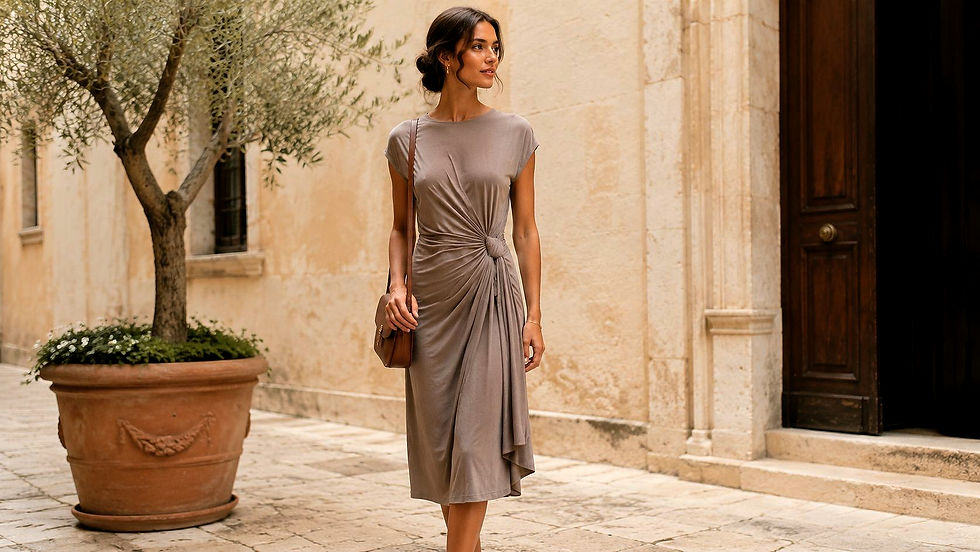
If you're looking for one dress that can do more than one job. It needs to feel polished enough for a lunch meeting, graceful enough for a gallery afternoon, and elegant enough for dinner without asking you to change your whole mood, your shoes, or your posture. That search often ends with compromise. A dress is either beautiful but restrictive, or practical but forgettable.
The draped midi dress solves that problem with unusual intelligence. It doesn't rely on noise, excess, or trend-chasing. It relies on line, movement, and fabric. That is why it feels so aligned with Italian style at its best. A woman wears the dress. The dress never wears the woman.
In fashion, women's apparel has long held a central place. The global women's apparel market generated 53% of all fashion retail spending in 2018, and fashion's scale remains immense, with over 100 billion garments produced annually by 2014, reflecting a 400% increase in clothing consumption compared with two decades prior, according to global fashion industry statistics compiled by FashionUnited. In a crowded world of clothes, the pieces that last in memory are usually the ones with restraint.
The Enduring Allure of the Draped Midi Dress
There is a familiar wardrobe moment. You stand in front of the rail and reject one dress for being too severe, another for feeling too casual, and a third because it only works with very high heels. Then your hand lands on a draped midi dress. Suddenly, the decision becomes easy.
It works because it understands proportion. The silhouette has softness, yet it still looks composed. The length has modesty, yet it never feels matronly. The drape adds movement, which gives life to the body even when the palette is restrained. Olive, espresso, ivory, black, deep navy, warm stone. In these shades, the dress becomes a quiet luxury piece rather than a passing novelty.
Italian elegance has always favoured this kind of intelligence. The idea isn't to impress through complication. It's to create an effect of ease through precise choices. A draped midi dress speaks that language fluently. It can feel refined with a heel, modern with a flat sandal, and cultivated with a precisely cut coat.
If you enjoy building a wardrobe around pieces that move between occasions, this perspective aligns beautifully with a considered view of versatile midi dresses as a wardrobe essential.
A great dress should give you presence without demanding effort.
Why women return to it
Some garments are useful. Others are elevating. The draped midi dress belongs in the second category because it flatters without looking as though it is trying to flatter. That distinction matters.
It brings calm to dressing: You don't need elaborate styling to make it work.
It respects movement: Walking, sitting, dining, travelling. The silhouette remains elegant.
It suits real life: It can live in a wardrobe that values work, evenings, celebrations, and culture.
Its enduring appeal comes from that rare balance of practicality and poetry.
The Art of Draping What Defines This Elegant Silhouette
You are getting dressed for a dinner that begins with an aperitivo and ends well past midnight. You want poise, ease, and enough freedom to move beautifully through the evening. In these circumstances, the draped midi dress earns its reputation. In the Italian view, it is not a clever trick of fabric. It is design with manners.

At its most technical, the silhouette combines two ideas. The hem falls between the knee and the ankle, and the fabric is shaped through gathers, folds, pleats, or twists so it follows the body with softness rather than stiffness, as outlined in this midi dress guide from Aza Fashions. At its most poetic, draping creates sprezzatura in cloth. It looks easy because the construction is intelligent.
The drape itself
A good drape behaves like good architecture. It guides the eye, distributes visual weight, and creates harmony between structure and air.
That is why placement matters so much. Side ruching can draw the waist inward without a hard, corseted effect. Diagonal gathers can lengthen the torso because the eye follows the line across the body instead of stopping at one point. A draped cowl or soft neckline brings attention upward, toward the face, the neck, and the collarbone. Each choice changes the reading of the silhouette.
The difference is subtle, but powerful.

Practical rule: If the folds seem heavy or random, the pattern cutting is weak. If they fall with calm, the dress was designed with skill.
Why the midi length feels so cultivated
Midi length has a rare kind of balance. It offers more presence than a knee-length dress, yet it keeps the movement and practicality that many long dresses lose. You still see the ankle, the shoe, the pace of the walk. In other words, the lower half of the look remains alive.
That living line matters in European dressing. A pointed pump sharpens the profile. A slender sandal softens it. A fine boot gives the silhouette more graphic force. If you want a clearer sense of where different hems visually land, this dress length guide for comparing midi proportions is useful.
One detail often confuses shoppers. Where exactly should the hem sit? A simple visual test works well. The most flattering placement usually avoids cutting across the fullest point of the calf, because that can interrupt the line of the leg and make the dress feel heavier than it is.
Fabric is part of the design
Fabric does not merely support draping. It decides whether draping succeeds.
Silk jersey gives a liquid effect and catches light softly, which is why it feels at home in evening settings. Viscose blends skim the body with less ceremony and work well from day into night. Fine crepe holds shape more firmly, so the drape reads cleaner and more controlled. Stretch blends offer comfort and recovery, which is helpful for travel or long events when a dress needs to keep its shape after hours of wear.
Fabric | Effect on the body | Best mood |
|---|---|---|
Silk jersey | Fluid, sensual, softly luminous | Evening, dinner, events |
Viscose blends | Relaxed movement, gentle skimming | Day-to-night elegance |
Fine crepe | Cleaner line, more structure | Work, city dressing, formal lunches |
Stretch blends | Comfort with shape retention | Travel, long days, polished practicality |
Italian design has always treated cloth as character. A draped silhouette in a resistant fabric can look forced. In a supple one, it breathes.
What to look for at first glance
Before trying one on, study the dress as an object.
First, read the side seam. Many of the smartest draped dresses hide their engineering there, where gathers are anchored and tension is controlled. Next, look at the folds. They should descend with intention, not balloon outward. Finally, check the hem. Even on a hanger, a well-cut skirt suggests motion.
If you are shopping online, those same checkpoints help you judge photographs more critically, and the ultimate virtual changing room guide can help you assess proportion before you buy.
That is the art of it. The best draped midi dress never begs for attention. It holds shape, movement, and grace in the same gesture.
How to Choose Your Perfect Draped Midi Dress
Choosing well starts with honesty. Not harshness, not body anxiety, just honesty. The best draped midi dress doesn't disguise you. It collaborates with your proportions.
Italian women's fashion often prioritises midi-length silhouettes that fall just below the knee or at mid-calf, a threshold shaped by silhouette and print balance, often paired with draped necklines that evoke both Sicilian nobility and contemporary Milanese elegance, as described in this Italian style reference. That sensibility is useful because it begins with line, not labels.
Choose by body balance
Different draping placements create different visual effects. That's good news, because it gives you control.
If your hips are fuller: Try side draping placed slightly above the natural waist. It draws the eye upward and creates a longer line through the skirt.
If your midsection is where you want softness: Look for diagonal gathers or a wrap-style front. These create movement across the torso instead of a fixed horizontal emphasis.
If you have an hourglass shape: A defined waist with controlled draping keeps your shape visible while preserving elegance.
If your frame is straighter: Twists, cowl details, and soft gathers can introduce dimension and femininity without excess volume.
If your bust is fuller: Favour open necklines, draped necklines, or clean V-shapes so the top of the dress feels balanced rather than crowded.
Some women find it easier to judge this visually before ordering. If you want help comparing silhouette and fit cues online, the ultimate virtual changing room guide offers a useful way to think about digital try-on tools without reducing style to guesswork.
Don't ask whether the dress suits a category. Ask whether the drape creates harmony from shoulder to hem.

Choose by occasion
The same silhouette can behave very differently depending on cloth, colour, and finish. A wise choice begins with where you'll wear it.
For work and professional lunches
Keep the palette disciplined. Think navy, charcoal, espresso, black, ivory, or muted olive. Fabrics with some structure tend to look more authoritative, especially when paired with simple jewellery and a leather tote.
For evening and formal dinners
Choose richer surfaces and more expressive draping. A fluid fabric in deep jewel tones, black, or soft metallic neutrals can feel ceremonial without becoming theatrical. Let the dress carry the atmosphere.
For daytime elegance
Lighter materials and softer shades feel natural. You want movement, not weight. Mid-calf lengths are especially graceful for museum visits, lunches, and travel days when you still want polish.
A quick decision table
Situation | Best choice | Avoid |
|---|---|---|
Office or lunch meeting | Solid colour, refined drape, clean neckline | Overly glossy fabric |
Wedding guest or dinner | Fluid cloth, elegant draped waist or neckline | Excessive ornament |
City daywear | Soft neutral, relaxed drape, comfortable shoe pairing | Hemlines that cut at the widest calf point |
If you're uncertain about proportion, a clear dress length guide can help you judge where the hem should fall in relation to your height and footwear.
Styling with Sprezzatura An Italian Approach to Elegance
The secret to styling a draped midi dress well is that it shouldn't look over-styled. Italian elegance lives in control, but it must never look stiff. That is the essence of sprezzatura. Care taken until it disappears.
A draped dress already contains movement, shape, and suggestion. You don't need to add noise. You need to protect its line.
Start with the shoe
Shoes decide whether the dress reads as urban, romantic, or ceremonial.
A sharp slingback or stiletto gives the midi line precision. Fine leather loafers create cultured ease, especially with long sleeves or a higher neckline. Slim sandals keep the look open and effortless in warmer months. The common rule is simple. The shoe should support the length, not compete with it.
For evening: Choose a sleek heel with a clean vamp.
For daytime city dressing: A refined loafer or low heel works beautifully.
For summer occasions: Minimal sandals preserve the fluidity of the skirt.
Use fewer accessories, but choose better ones
A draped silhouette doesn't need a crowd of accessories. It benefits from one or two excellent ones.
Think of a sculptural earring, a fine gold chain, a beautifully made leather bag, or a soft pashmina in a tonal shade. Here, luxury becomes visible through restraint. You are building a mood, not a display.
The most elegant accessory is often negative space. Leave room around the neckline, the wrist, the waist.
A useful principle is to choose one focal point only. If the dress has a draped neckline, keep the jewellery quiet. If the waist detail is the star, carry a bag with clean architecture and avoid fussy belts.

Layer with intention
Outerwear should lengthen or frame the dress. It should never interrupt it awkwardly.
A well-cut blazer makes the draped midi dress feel modern and metropolitan. A trench gives it cinematic practicality. A cashmere cardigan softens it for travel or daytime refinement. The proportions matter more than the category. Cropped layers can work, but only if they meet the waist in a purposeful place.
An elegant formula
Try this combination when you want the effect of effortlessness:
A neutral draped midi dress
A structured outer layer
One polished handbag
One piece of jewellery
Shoes that elongate rather than dominate
For more inspiration on this polished but easy approach, this guide to styling luxury dresses for effortless elegance offers a useful visual reference.
What to avoid
Italian style is confident enough to edit. The wrong additions can undo the beauty of the drape very quickly.
Keep | Reconsider |
Fine leather accessories | Heavy, overly embellished bags |
Clean footwear lines | Chunky shoes that fight the hem |
Soft layering pieces | Bulky jackets that crush the silhouette |
Tonal styling | Too many competing colours |
When the styling is right, the dress seems to fall into place on its own. Of course, it doesn't. That is the art.
Ensuring a Flawless Fit and Lasting Quality
A draped midi dress can be exquisite on the hanger and disappointing on the body if the fit is wrong. Because the silhouette is fluid, many women assume it's forgiving enough to ignore details. It isn't. Draping only looks luxurious when the structure beneath it is sound.
Technical specifications often include a length of around 123.5 cm (48.62") for a size UK 12, together with a concealed zip and comfort stretch fabrics that help maintain a slim fit while allowing the fabric to drape gracefully. Neutral colours are also considered especially suitable for work or semi-formal wear in a retail context, as shown in this asymmetric draped midi dress specification from & Other Stories.
Fit checkpoints that matter
Start at the top. If the shoulders are wrong, the drape below won't fall properly. The dress should sit cleanly at the shoulder line without pulling, slipping, or collapsing.
Then move to the waist area. Even when the waist isn't tightly defined, the draping should still appear anchored. If the gathers pull too hard, the fabric will strain. If they sit too low or too loose, the dress can look tired rather than fluid.
Shoulders: They should feel stable and smooth.
Bust: The fabric should skim, not flatten or gape.
Waist drape: It should create shape without bunching.
Hip line: The skirt should move, not cling in patches.
Hem: It should fall cleanly and remain balanced when you walk.
If you have to keep adjusting the dress while standing or sitting, the fit isn't finished.
How it should feel
A well-cut draped midi dress feels lighter than it looks. You should be able to sit, walk, and turn without the draping twisting out of place. That is where stretch blends and well-positioned zips matter. They aren't merely technical details. They make elegance wearable.
A concealed zip is especially important in cleaner silhouettes because it preserves the uninterrupted line of the garment. Lining also matters. When present, it helps the dress glide over the body rather than catch against hosiery or underlayers.
Caring for the drape
Care begins before washing. Read the fibre content, then handle the dress according to its temperament. Soft, draped fabrics dislike rough treatment.
Use a padded hanger for storage so the shoulders keep their form. If the fabric is delicate, hand washing or a gentle cycle in a protective bag is usually wiser than aggressive machine washing. Never wring the dress. Press out moisture in a towel, then dry it carefully so the drape can settle back into shape.
For steaming and pressing, patience matters. Work lightly from the inside when possible, and avoid flattening sculptural folds that are meant to remain dimensional.
Frequently Asked Questions on the Draped Midi Dress
The best questions about a draped midi dress usually begin after a woman has already understood the silhouette. They are the practical questions. Will this still flatter me now? Will linen lose its shape? Will a midi overwhelm a petite frame? These are sensible concerns.
Vogue has noted that draping remains a dominant elegant trend for 2025, yet many buyers report care anxiety around maintaining fluid drapes. With the shift toward sustainable luxury and linen's prominence in 2026, a notable unresolved concern is how to maintain the shape of linen-based draped midis, since current guides don't fully detail fabric-specific pre-wash or ironing methods, according to Vogue's dress trend coverage.
Can a draped midi dress flatter a post-pregnancy shape?
Yes, especially when the drape is placed diagonally across the waist or softly gathered at the side rather than concentrated at the centre front. That placement creates movement and gives the body room without turning the dress into shapeless volume.
Look for fluid fabrics, a stable shoulder line, and a waist treatment that defines gently instead of gripping. The goal is elegance with ease.
What if I have a fuller bust?
Choose openness at the neckline. Soft V-shapes, draped necklines, and clean wrap effects usually create better balance than very high, crowded necklines paired with heavy gathering. You want the upper body to feel elongated and calm.
A fuller bust often benefits from drape that starts below or beside the bust, not directly across it.
How can petites wear a draped midi dress without feeling overwhelmed?
Keep the scale of the drape controlled. Too much volume can dominate a shorter frame. Cleaner silhouettes with one clear draped feature usually work better than dresses with multiple twists, ties, and gathers.
Footwear matters too. A pointed shoe or a sandal that leaves the foot visually open can help the line feel longer and lighter.
How should I care for a linen draped midi dress?
Linen is beautiful because it has character, but that same character makes drape maintenance more delicate. Wash gently, avoid rough twisting, reshape while damp, and press with care so the folds stay intentional rather than crumpled.
Because detailed linen-specific drape care remains underexplained, caution is wise. Test any pressing method on an inconspicuous area first, and store the dress where the folds can hang freely rather than being crushed in a crowded wardrobe.

Vivien Lauren offers a refined destination for women who want elegant dresses, Italian-crafted accessories, and polished wardrobe pieces that feel timeless rather than temporary. If you're ready to bring this kind of graceful, wearable sophistication into your own wardrobe, explore the curated collections at Vivien Lauren.
This fashion piece has been written for you by Sammy Li. On behalf of Vivien Lauren. Vivien Lauren. Luxury. Craftsmanship. That's Proudly Italian. Vivien Lauren. Proud To Style.
