
The New Minimalists: Dropping Logos for True Luxury
True Luxury reaches beyond the Logos. It is about Heritage and Craftsmanship.
Many luxury consumers now prefer subtle branding that emphasizes craftsmanship, material quality, and distinctive brand codes over visible logos. This shift reflects a maturation of taste, favoring authenticity, exclusivity, and design literacy, which build deeper emotional loyalty. While explicit branding remains valued in certain contexts, the future of luxury leans toward understated, thoughtful elegance rooted in genuine quality.
There is a quiet confidence moving through the upper echelons of fashion right now, and it does not announce itself with a monogram. The New Minimalists: why today’s luxury consumer is dropping explicit branding has become one of the defining conversations in high-end style, as luxury consumers dropped from 400 million in 2022 to around 340 million in 2025, forcing an entire industry to reconsider what exclusivity actually looks like. For the fashion-conscious woman who has moved beyond the thrill of a visible logo, this shift is not merely a trend. It is a statement of refined taste, one that speaks volumes precisely because it whispers.
Table of Contents
1. Why today’s luxury consumer is dropping explicit branding
3. The minimalist branding strategy: how the best brands pull it off
4. Minimalist branding vs. explicit luxury branding: a head-to-head view
5. When minimalism shines and when explicit branding still earns its place
7. The future of quiet luxury: sustainability, identity, and what comes next
Key takeaways
Point | Details |
Quiet luxury is a values shift | Modern luxury consumers reject overt logos in favor of craftsmanship, material quality, and subtle brand codes. |
Brand codes replace logos | Signature colors, silhouettes, and textures carry brand identity without a single visible monogram. |
Minimalism demands authenticity | Minimalist design backed by weak craftsmanship reads as cheap, not chic, to discerning buyers. |
Context still matters | Explicit branding retains value in gifting, aspirational markets, and specific cultural contexts. |
Deeper loyalty follows subtlety | Brands that reward design literacy build stronger, more personal emotional connections with their clientele. |
1. Why today’s luxury consumer is dropping explicit branding
The shift is not accidental, and it is not simply about aesthetics. Experts report a visual fatigue with overt branding among affluent consumers who have spent years surrounded by logo-saturated accessories and monogrammed everything. When a symbol becomes ubiquitous, it loses its power to distinguish. The woman who once coveted a logo-covered bag now finds greater sophistication in a piece that reveals its provenance only to those with the eye to recognize it.
This is the essence of the new minimalist luxury consumer preference. Recognition is no longer the goal. Discernment is.
“Subtle branding has become a marker of confidence, rewarding design literacy over conspicuous display.” — Quiet Marketing Revolution, 2026
The modern luxury consumer values:
Craftsmanship and material quality above all visible markers of status
Exclusivity through rarity, not through mass-market logo proliferation
Authenticity, in the sense that a garment or accessory speaks for itself without needing a label to justify its cost
Visual literacy, which means understanding brand language through silhouette, weight, drape, and texture rather than an embossed monogram
This shift from logos to curated luxury is, at its core, a maturation of taste. It reflects a consumer who has arrived, one who no longer needs to prove anything.
2. Signature brand codes: the language of logo-free luxury
If the logo is gone, what remains? The answer is everything that truly defines a house. Logo-free luxury branding relies on distinct brand codes, including signature colors, proprietary materials, iconic silhouettes, and a consistent editorial tone, to maintain recognition without a single letter of a name.
Consider the weight of a certain shade of orange on a box, or the precise drape of a camel coat cut in a particular way. You know the house without reading a word. This is brand language at its most refined, and it demands both the brand and the consumer meet at a higher level of sophistication.
Leading fashion houses deploy these strategies with deliberate precision:
Signature colorways that function as visual shorthand, immediately identifiable to an informed eye
Proprietary textures and weaves, where the material itself is the identifier
Iconic silhouettes that carry a house’s aesthetic DNA across every collection
Minimal or entirely absent logos, replaced by subtle hardware details, interior labels, or stitching patterns
Packaging stripped to near-nothing, because no-info packaging communicates unshakeable brand authority
The minimalist approach in Greek fashion, for example, achieves its power through architectural silhouette and pure line rather than any surface ornamentation. The form is the statement.
Pro Tip: When evaluating a brand’s minimalism, look for consistency across every touchpoint. A house that strips its packaging but loads its garments with logoed hardware is practicing insincere minimalism, and discerning consumers notice the contradiction immediately.
3. The minimalist branding strategy: how the best brands pull it off
Removing a logo is not a minimalist branding strategy. It is merely the beginning of one. The brands that execute this approach with genuine authority understand that the absence of obvious signifiers must be filled with something far more substantial: an unwavering commitment to quality in every detail.
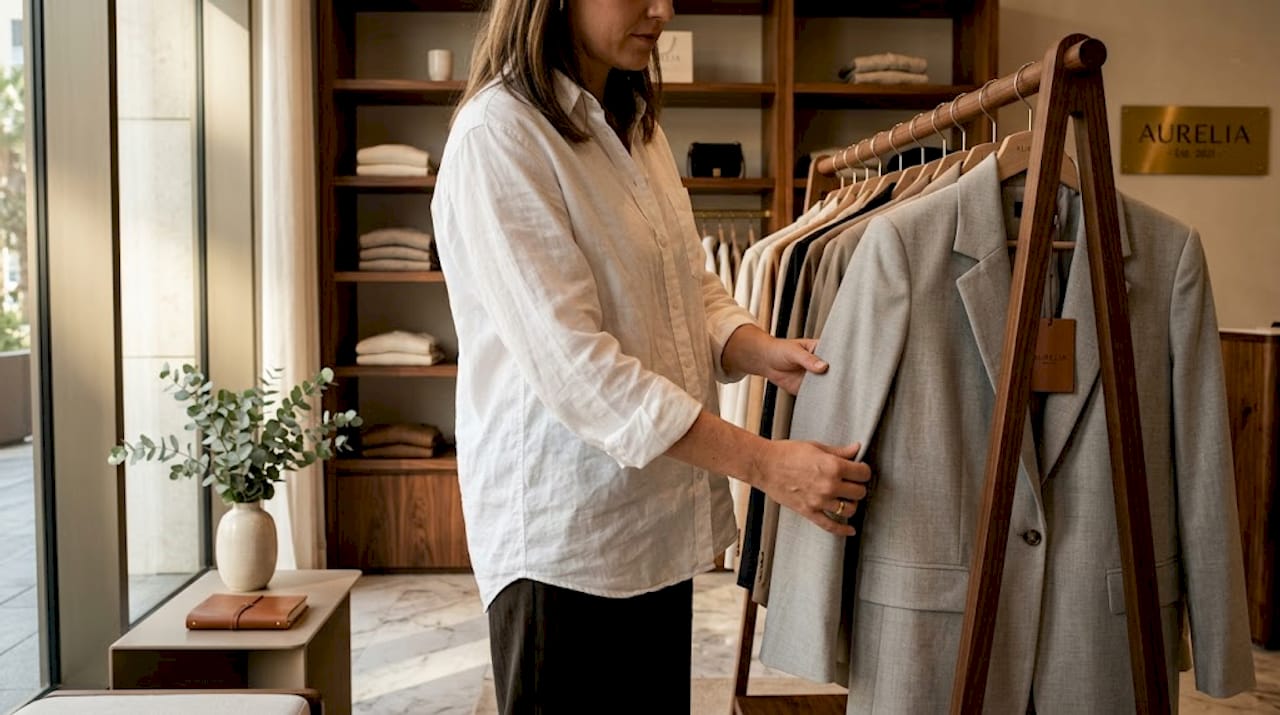
Minimalism without superior craftsmanship is perceived as cheapness, not restraint. A plain bag in mediocre leather reads as generic. That same silhouette in hand-stitched, vegetable-tanned leather from a heritage tannery reads as extraordinary. The difference is everything, and the modern minimalist luxury consumer can feel it the moment they touch the piece.
The most successful minimalist luxury houses invest deeply in:
Digital presence aligned with the aesthetic, meaning editorial photography that prioritizes mood, light, and texture over product quantity
Restrained copywriting that describes rather than sells, trusting the reader to understand the value
Consistency across seasons, so the brand code deepens and strengthens rather than chasing trend cycles
Thoughtful retail and unboxing experiences, where the simplicity of presentation amplifies the perceived value of what is inside
Luxury brands investing in experience over logo visibility are building the kind of emotional loyalty that no monogram can purchase. According to that same research, 28.6% of luxury executives now identify customer loyalty as their primary growth opportunity, which is a striking departure from the era of mass aspirational branding.
Pro Tip: The next time you encounter a brand presenting itself with extreme visual restraint, ask whether the restraint is earned. True minimalist luxury has a density of quality underneath its calm surface. If the quality is not there, the simplicity is merely empty.
4. Minimalist branding vs. explicit luxury branding: a head-to-head view
The impact of branding on luxury is nowhere more visible than in the direct contrast between these two philosophies. Each has genuine strengths, and understanding the differences helps you make more considered choices as a consumer.
Factor | Minimalist luxury branding | Explicit logo-driven branding |
Brand recognition | Slower, requires design literacy | Immediate, accessible to any observer |
Exclusivity perception | Highly exclusive, insider knowledge required | Broad recognition, reduced exclusivity over time |
Emotional connection | Deep, personal, relationship-driven | Status-driven, often transactional |
Consumer trust signals | Craftsmanship, material quality, restraint | Name authority, heritage, visible prestige |
Risk of misread | May appear generic without strong brand codes | May read as ostentatious or dated |
Longevity of appeal | Timeless, transcends trend cycles | Vulnerable to logo saturation and trend fatigue |
Loyalty depth | Strong long-term loyalty, community feel | High initial appeal, loyalty varies |
The 60 million consumer decline in the global luxury base from 2022 to 2025 pushed brands to prioritize depth of relationship over breadth of reach. That calculus naturally favors the minimalist philosophy, which rewards the most committed, most discerning segment of any brand’s audience.
The risk of going logo-free without the supporting architecture of strong brand codes is real, though. A house that simply removes its logo without investing in the visual and sensory language to replace it will find itself appearing anonymous rather than exclusive.
5. When minimalism shines and when explicit branding still earns its place
Not every context calls for restraint, and the most sophisticated approach to modern luxury consumer preferences acknowledges that nuance. The minimalist luxury lifestyle is an aspiration, but it is also a tool. And like any tool, its value depends on knowing when to use it.
Minimalism is at its most powerful in these situations:
Exclusive social settings where peers possess the design literacy to recognize brand codes without a logo
Investment dressing, when building a wardrobe of timeless pieces meant to outlast trends by decades
Professional environments where understated authority communicates more than conspicuous branding ever could
Personal collection building, particularly for the woman who sees her wardrobe as a curated archive of quality
Explicit branding still holds genuine value in specific contexts:
Gifting, where the recipient needs the immediate legibility of a recognizable name to understand the gesture
Cultural markets where visible brand prestige carries particular social weight and is the primary signal of value
Aspirational entry points, for consumers newer to luxury who derive genuine pleasure from the visible mark of a storied house
Some affluent consumers are embracing logo-heavy fashion again, signaling what analysts describe as a cultural counter-movement. This is not necessarily a retreat from good taste. It is a reminder that fashion is always a conversation, and conversations require contrasting voices.
Pro Tip: Rather than committing entirely to one philosophy, consider building a wardrobe architecture where minimalist pieces form the foundation and a few carefully chosen, explicitly branded accessories punctuate with intention. The contrast makes both more powerful.
6. What the research on transparency and trust reveals
One detail that rarely surfaces in mainstream fashion coverage is the relationship between minimalist branding strategy and consumer trust. 68% of Millennials and Gen Z trust brands with radical transparency and clarity, and minimalist brands with clean, purposeful visuals outperform industry engagement averages by approximately 25%.
The logic is worth sitting with for a moment. When a brand removes the noise of heavy branding and lets the product stand unadorned, it makes an implicit promise: the object is the argument. There is nowhere to hide behind a logo. The seam must be perfect. The leather must be extraordinary. The cut must be precise.
This transparency is not just aesthetic. It is ethical. Consumers who gravitate toward timeless luxury apparel are often the same consumers drawn to slow fashion values, to knowing the provenance of what they wear and trusting that the price reflects genuine artisanal investment rather than marketing spend.
Luxury executives in 2026 favoring selective logo use over aggressive branding are recognizing exactly this dynamic. The 66.9% expecting stable or growing revenues under value-driven strategies understand that the next generation of luxury spenders is not buying a logo. They are buying a relationship with a house that respects their intelligence.
7. The future of quiet luxury: sustainability, identity, and what comes next
The minimalist luxury movement does not exist in isolation. It runs parallel to broader shifts in how the most thoughtful consumers relate to their wardrobes altogether. The timeless fashion trends emerging in 2026 consistently return to one idea: longevity over novelty.
Quiet luxury and sustainability share a philosophical kinship. A piece purchased for its extraordinary craftsmanship, worn across decades, altered and cherished, is the antithesis of disposable fashion. The absence of a seasonal logo actually extends the life of the garment. It never becomes dated because it never loudly declared itself part of a particular moment.
The identity dimension is equally significant. A wardrobe built on strong silhouettes, exquisite materials, and restrained color tells the story of the woman wearing it rather than the brand she is wearing. This is perhaps the most profound reason why modern luxury consumer preferences are shifting. The most compelling fashion today is the kind that amplifies the wearer, not the house.
My perspective on this quiet revolution
I’ve watched this shift with genuine admiration and, I’ll admit, a certain relief. For years, I felt that the loudest version of luxury had crowded out something more interesting: the kind of dressing that asks something of you, that rewards you for paying attention.
What I’ve learned from observing the minimalist movement is that it is not simply a trend cycle. It is a recalibration of what luxury is actually for. The best pieces I’ve encountered recently communicate nothing on first glance and everything on closer inspection. That contrast is where the real pleasure lives.
My honest concern is that some brands will pursue minimalism as a marketing posture without making the underlying investment in quality that gives it meaning. That version is cynical, and discerning women will see through it quickly. The counter-movement toward conspicuous branding that some analysts are tracking is partly a reaction to exactly that kind of hollow restraint.
What I believe, after all of this, is that the most confident choice any of us can make is to dress in a way that we ourselves can fully justify, not to a room full of people, but to our own exacting standards. Minimalism, when it comes from genuine conviction and genuine quality, is the most powerful statement in the room.
— Vivien
Discover restrained elegance at Vivienlauren
The minimalist luxury philosophy that this article describes is not an abstraction at Vivienlauren. It is the organizing principle behind every piece in the collection.
At Vivienlauren, craftsmanship is the signature, not a logo. Each garment and accessory is chosen for the quality of its construction, the integrity of its materials, and the timelessness of its line. The occasion dresses in the collection speak through silhouette and fabric rather than surface decoration, and the handmade woven leather bucket bag carries the quiet authority of Italian artisanship passed down across generations. If you are building a wardrobe that speaks through quality rather than labels, this is where to begin.
FAQ
What is quiet luxury in fashion?
Quiet luxury refers to a high-end aesthetic that communicates exclusivity through craftsmanship, material quality, and subtle brand codes rather than visible logos or overt branding. It rewards design literacy and prioritizes personal refinement over status signaling.
Why are luxury consumers dropping explicit branding?
Affluent consumers are experiencing visual fatigue with overt branding and increasingly prefer pieces that signal taste through quality and subtlety rather than monograms or prominent logos.
Does minimalist branding always signal luxury?
Not automatically. Minimalism without strong craftsmanship can read as generic or cheap. True minimalist luxury requires exceptional quality and consistent brand codes to distinguish itself from basic or unbranded goods.
Is the quiet luxury trend declining?
Some analysts report a cultural counter-movement toward bolder branding among certain affluent segments. However, the core minimalist luxury consumer preference, rooted in craftsmanship and discretion, continues to grow among the most discerning buyers.
How do brands maintain recognition without logos?
They invest in distinct brand codes: signature colors, proprietary materials, iconic silhouettes, and a consistent sensory and editorial language across every touchpoint, from packaging to digital presence to the weight of a zipper pull.
Recommended
This fashion article has been written for you by Sammy Li. On behalf of Vivien Lauren. Vivien Lauren. Luxury. Craftsmanship. That's Proudly Italian. Vivien Lauren. Vivien Lauren. Luxury. Craftsmanship. That's Proudly Italian. Vivien Lauren. Proud To Style.
