
Fashion Design Sketching: Elevate Your Portfolio

Defining your personal style on paper can be just as challenging as choosing the perfect fabric for a bespoke evening gown. For fashion design students and emerging designers in the United Kingdom, mastering sketching techniques is the foundation for building an impressive portfolio in the competitive world of high-end womenswear. By focusing on figure proportions, textile representation, and expressive line work, you can transform initial ideas into striking visual narratives that truly showcase your creative vision.
Table of Contents
Key Takeaways
Point | Details |
Master Fashion Sketching Fundamentals | Gain proficiency in figure proportions, line quality, textile representation, and perspective to effectively communicate design ideas. |
Utilize Various Sketch Types | Incorporate rough concept sketches, technical flats, and detailed construction sketches to cater to different aspects of the design process. |
Enhance Portfolio with Diversity | Showcase a range of sketching techniques, demonstrating technical precision and creative expression to reflect individual design philosophies. |
Address Common Sketching Mistakes | Focus on practice to rectify proportional inaccuracies, inconsistent line quality, and limitations in spatial visualization to improve sketching skills. |
Defining Fashion Design Sketching Fundamentals
Fashion design sketching represents the foundational visual language through which designers communicate their creative vision. At its core, this skill transforms abstract concepts into tangible visual representations that capture the essence of clothing design. Foundational figure drawing techniques establish the critical framework for translating imaginative ideas onto paper.
The fundamental elements of fashion design sketching encompass several key components:
Figure Proportions: Creating accurate human body representations
Line Quality: Developing precise and expressive drawing techniques
Textile Representation: Depicting fabric textures and drape characteristics
Perspective and Movement: Capturing garment dynamics and silhouette
Successful fashion design sketches require mastering both technical skills and artistic interpretation. Professional illustrators understand that these sketches serve as more than mere drawings - they are communication tools that convey design intent, fabric behavior, and aesthetic vision. Fashion illustration techniques blend manual and digital approaches to create compelling visual narratives.
Understanding human anatomy remains crucial in fashion sketching. Designers must develop the ability to represent body forms accurately while maintaining artistic flexibility. This involves studying standard figure proportions, understanding body movement, and learning how clothing interacts with different body types.
Pro tip: Practice sketching the same design from multiple angles to develop comprehensive visualization skills and demonstrate technical proficiency in your portfolio.
Types of Fashion Sketches for Womenswear
Fashion design sketching for womenswear encompasses a diverse range of visual communication techniques, each serving a unique purpose in the design process. Fashion illustration approaches reveal the nuanced methods designers use to transform creative concepts into tangible representations.
The primary types of fashion sketches for womenswear include:
Rough Concept Sketches: Quick, gestural drawings capturing initial design ideas
Technical Flats: Precise, two-dimensional representations showing exact garment measurements
Fashion Illustrations: Expressive, artistic renderings that showcase design aesthetic
Detailed Construction Sketches: In-depth drawings highlighting intricate design elements
Accessory and Styling Sketches: Complementary drawings exploring complete look compositions
Comprehensive sketch documentation plays a critical role in translating design vision from imagination to reality. Technical flats, for instance, provide manufacturers with exact specifications, while fashion illustrations communicate the emotional and aesthetic qualities of a proposed design. Professional designers seamlessly move between these sketch types, using each to communicate different aspects of their creative vision.
Here’s a comparison of primary fashion sketch types and their best-use scenario:
Sketch Type | Primary Purpose | Ideal Use Case |
Rough Concept Sketch | Generate initial design ideas | Early stage brainstorming |
Technical Flat | Communicate construction details | Manufacturer instructions |
Fashion Illustration | Convey mood and style | Client presentation |
Detailed Construction Sketch | Show garment assembly and technique | Pattern making and sewing guidance |
Accessory/Styling Sketch | Complete the overall looks | Accessory coordination |
Mastering these sketch types requires understanding both artistic expression and technical precision. Designers must develop the ability to create sketches that are not just visually appealing, but also functionally communicative, bridging the gap between creative concept and practical implementation.
Pro tip: Develop a personal sketch portfolio that demonstrates proficiency across multiple sketch styles to showcase your versatility and technical skill.
Building Croquis and Proportional Figures
Croquis form the foundational blueprint for fashion illustration, representing the idealized human figure that designers use to showcase clothing designs. Figure drawing techniques provide critical insights into creating proportional and stylized representations that capture the essence of fashion design.
The key elements of developing accurate croquis include:
Height Proportions: Utilizing standard fashion figure measurements
Body Alignment: Creating balanced and dynamic pose structures
Stylization: Exaggerating proportions for visual impact
Anatomical Accuracy: Maintaining fundamental body mechanics
Flexibility: Adapting figures for different design contexts
Digital croquis creation has revolutionized the traditional sketching process. Designers now have multiple approaches to developing figures, ranging from hand-drawn techniques to sophisticated digital modeling. The standard 9-head tall figure remains the cornerstone of fashion illustration, representing an idealized human form that elongates and dramatizes the body’s natural lines.

Mastering croquis requires understanding both artistic expression and technical precision. Designers must develop the ability to create figures that are not just anatomically correct, but also capable of communicating the dynamic potential of a garment design. This involves studying human anatomy, movement, and the subtle nuances of body language that bring fashion illustrations to life.
Pro tip: Practice creating multiple croquis poses to develop versatility in representing different garment styles and silhouettes.
Rendering Fabrics, Textures, and Details
Rendering fabric details transforms a basic fashion sketch from a simple outline to a compelling visual narrative that communicates the intricate characteristics of a design. Fashion sketch rendering techniques bridge the gap between conceptual design and tangible visual representation, allowing designers to breathe life into their creative visions.
Key strategies for effective fabric and texture rendering include:
Line Weight Variation: Creating depth and texture through different pencil pressures
Texture Mapping: Simulating fabric characteristics like silk sheen or wool roughness
Shading Techniques: Depicting fabric drape and movement
Color Theory Application: Understanding how colors interact with different textile surfaces
Highlight and Shadow Placement: Communicating fabric volume and texture
Advanced textile visualization has evolved dramatically, with emerging technologies providing designers unprecedented tools for capturing fabric nuances. Digital and manual techniques now allow for incredibly detailed representations of textile characteristics, from the delicate translucency of chiffon to the structured rigidity of leather.
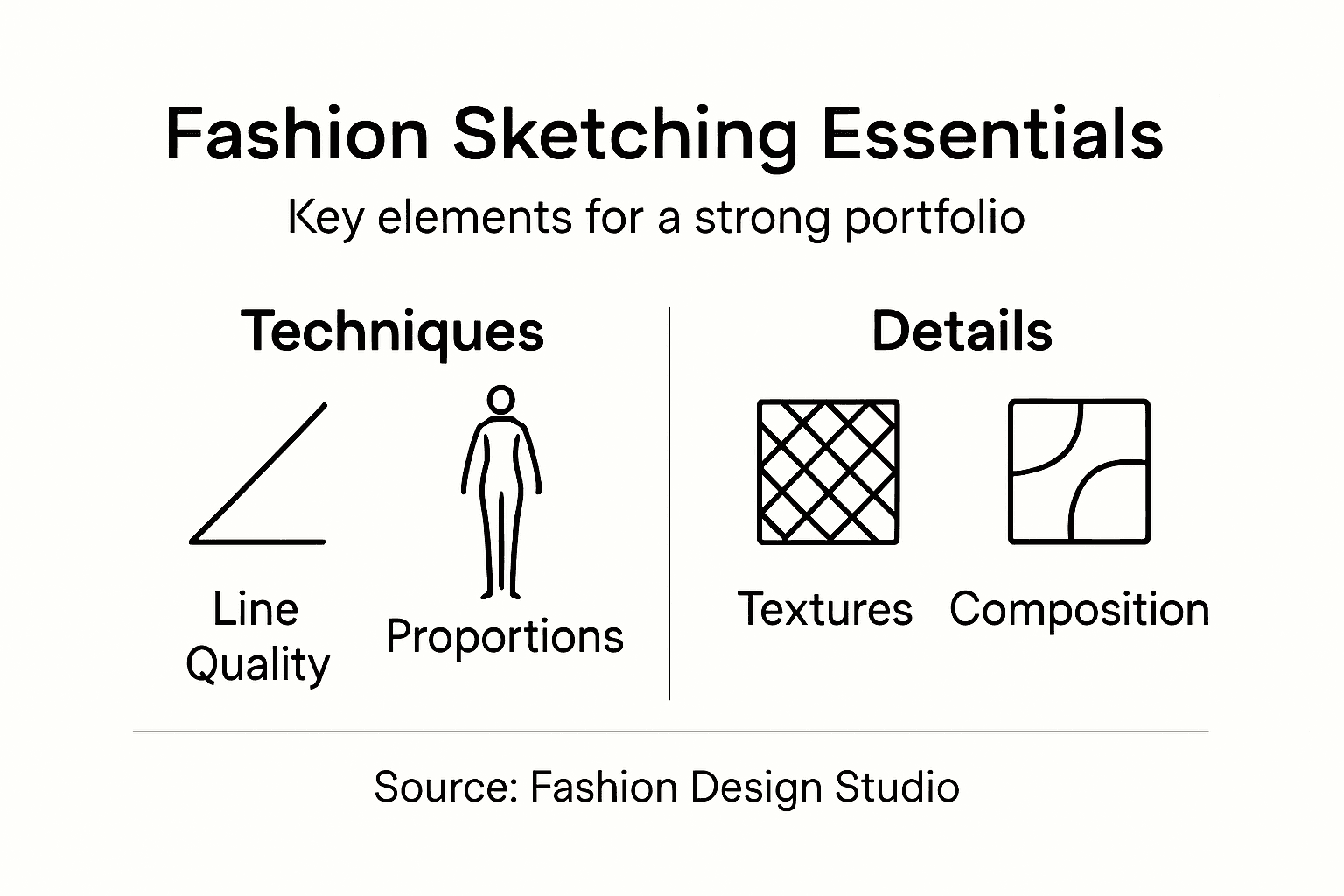
Mastering fabric rendering requires a deep understanding of material properties, light interaction, and visual communication. Designers must develop an acute sensitivity to how different fabrics behave, move, and reflect light, translating these complex visual phenomena into compelling two-dimensional representations that capture the essence of their design concepts.
Pro tip: Collect fabric swatches and practice rendering their unique textures to develop a more intuitive understanding of textile visualization.
Enhancing Portfolios With Sketching Techniques
A compelling fashion design portfolio transcends mere technical skill, representing a designer’s unique creative voice and professional potential. Sketching behavior research demonstrates that consistent, intentional sketching directly correlates with enhanced design capabilities and portfolio quality.
Key strategies for portfolio enhancement include:
Diversity of Techniques: Showcasing multiple sketching approaches
Technical Precision: Demonstrating exact rendering capabilities
Creative Expression: Highlighting individual artistic interpretation
Narrative Development: Creating visual stories through sequential sketches
Contextual Presentation: Displaying sketches in professional, cohesive layouts
Fashion illustration techniques emphasize the importance of composition, color application, and rendering details that transform basic sketches into professional portfolio pieces. Successful designers understand that portfolios are not just collections of drawings, but strategic visual narratives that communicate technical proficiency and creative potential.
Mastering portfolio development requires a holistic approach that balances technical skill with artistic innovation. Designers must curate their work thoughtfully, selecting pieces that demonstrate range, precision, and a distinctive design perspective. This involves continuous practice, critical self-evaluation, and an understanding of how visual communication translates design concepts into compelling visual stories.
Pro tip: Periodically review and refresh your portfolio, removing outdated work and adding pieces that reflect your most current skills and design philosophy.
Common Sketching Mistakes and Solutions
Fashion design sketching requires intentional practice and strategic skill development to overcome common technical and psychological barriers. Sketching practice challenges reveal that many emerging designers struggle with fundamental visualization techniques that can be systematically improved.
Common sketching mistakes and their targeted solutions include:
Proportional Inaccuracies: Practice consistent figure measurement techniques
Inconsistent Line Quality: Develop controlled drawing pressure and line confidence
Limited Spatial Visualization: Use grid techniques and perspective training
Overcomplicating Designs: Focus on clean, purposeful lines and minimal details
Fear of Imperfection: Embrace iterative sketching as a learning process
Sketching as a creative process transforms technical challenges into opportunities for creative exploration. Professional designers view mistakes not as failures, but as essential steps in developing a unique visual language and refining technical skills.
Below is a summary of common sketching errors and the design outcomes they impact:
Mistake | Impact on Design Outcome | Improvement Focus |
Proportional Inaccuracy | Distorted garment fit visualization | Practice standard measurements |
Inconsistent Line Quality | Unclear or confusing design intent | Develop steady hand control |
Limited Spatial Visualization | Flat or static garment appearance | Train perspective skills |
Overcomplication | Crowded sketches, loss of focus | Prioritize clarity |
Fear of Imperfection | Creative block, slow improvement | Promote iterative practice |
Mastering sketching requires moving beyond technical execution to understanding sketching as a dynamic thinking tool. Designers must cultivate a mindset of continuous improvement, viewing each sketch as an experiment in visual communication rather than a final product. This approach allows for greater creative freedom and reduces the paralysis often associated with perfectionism.
Pro tip: Dedicate 15 minutes daily to focused sketching practice, deliberately challenging yourself with new techniques and perspectives.
Elevate Your Fashion Sketching with Timeless Elegance
Mastering the art of fashion design sketching involves overcoming challenges like achieving precise figure proportions, rendering intricate fabric textures, and expressing your unique creative voice. These skills are critical for building a strong portfolio that speaks volumes about your vision and technique. At the same time, showcasing style and sophistication in your designs requires inspiration from real-world luxury fashion pieces that embody craftsmanship and exclusivity.

Discover how elevating your portfolio with refined sketching techniques can align perfectly with wearing elegant, quality pieces. Explore the curated collections at Vivien Lauren where each dress, bag, and accessory reflects the kind of timeless craftsmanship and modern sophistication that your sketches aspire to capture. Take your creative journey forward by surrounding yourself with inspiration found in high-end fashion and develop your personal style with pieces that complement your artistic growth. Start now by browsing the exclusive women’s apparel and accessories at Vivien Lauren collections and transform your portfolio and wardrobe simultaneously.
Frequently Asked Questions
What are the fundamental elements of fashion design sketching?
The fundamental elements include figure proportions, line quality, textile representation, and capturing perspective and movement in designs.
How can I improve my fashion sketching skills?
To improve your fashion sketching skills, practice consistently, study human anatomy, and experiment with various sketching techniques. Focus on mastering different styles to enhance your portfolio versatility.
What types of sketches are important for womenswear fashion design?
Key types of sketches for womenswear include rough concept sketches, technical flats, fashion illustrations, detailed construction sketches, and accessory and styling sketches.
How can I enhance my fashion design portfolio using sketching techniques?
Enhance your portfolio by showcasing a diversity of sketching techniques, demonstrating technical precision, and developing a narrative through your sketches to present a cohesive visual story.
Recommended
This fashion guide has been authored for you by Sammy Li. On behalf of Vivien Lauren. Vivien Lauren. Luxury. Craftsmanship that's Proudly Italian. Vivien Lauren. Proud To Style.


