
Georgette Material: Timeless Elegance in Fashion
Updated: Feb 28

Choosing the perfect fabric for a special event can feel like searching for the ideal balance between elegance and practicality. Fashion lovers worldwide continue to embrace the allure of lightweight, sheer crêpe fabric that offers both a graceful drape and surprising resilience. Named after French designer Georgette de la Plante, georgette’s evolution from exclusive silk to modern luxury marks a century of timeless style and high craftsmanship, making it a favorite for sophisticated wardrobes everywhere.
Table of Contents
Key Takeaways
Point | Details |
Georgette Fabric Definition | Georgette is a lightweight, sheer crêpe fabric known for its elegance and durability, ideal for various stylish garments. |
Historical Significance | Originating in the early 20th century, georgette transformed women’s fashion by offering a sophisticated alternative to heavy garments. |
Types and Uses | Georgette comes in several varieties including pure silk and synthetic options, each suited for specific occasions from casual wear to formal events. |
Care and Maintenance | Proper care is essential for preserving georgette; gentle washing methods and air drying help maintain its beauty and longevity. |
What Is Georgette Material and Its Origins
Georgette is a lightweight, sheer crêpe fabric that combines delicate elegance with surprising durability. Named after early 20th-century French dressmaker Georgette de la Plante, this material revolutionized women’s fashion by offering a fabric that moved beautifully while maintaining structure and sophistication.
The fabric’s distinctive character comes from alternating S- and Z-twist yarns), which create its signature slightly crinkled texture and springy feel. This twisted yarn construction gives georgette its unique ability to drape gracefully while resisting wrinkles—a quality that made it instantly popular among designers seeking elegance without constant maintenance.
Originally crafted from silk, georgette emerged during a transformative period in fashion history. Women were gaining freedom in their clothing choices, and this lightweight fabric perfectly suited the shift away from heavy, restrictive garments toward more fluid, comfortable silhouettes.
The Historical Journey
Georgette’s popularity grew rapidly throughout the 1920s and 1930s, becoming a staple for evening gowns, scarves, and sophisticated day wear. The fabric’s luminous, dull-finished surface created an understated luxury that appealed to women seeking refined elegance.
Key reasons for georgette’s enduring appeal include:
Luxurious drape that flatters the body
Lightweight comfort for all-day wear
Breathability ideal for layered styling
Versatility across multiple garment types
Sophisticated texture that catches light beautifully
During the mid-20th century, synthetic versions of georgette emerged, expanding accessibility and durability while maintaining the fabric’s flowing aesthetic. This innovation allowed more women worldwide to wear georgette without the delicate care requirements of pure silk.
Georgette transformed women’s fashion by proving that elegance and comfort are not mutually exclusive—a principle that remains central to timeless style today.
Today, georgette remains a cornerstone of luxury fashion. Designers continue selecting it for midi dresses, maxi gowns, and flowing blouses because it creates movement and femininity that heavier fabrics simply cannot achieve. The fabric works equally well for intimate gatherings and formal occasions.
Whether crafted from pure silk or high-quality synthetic fibers, georgette maintains its promise: a fabric that breathes, moves, and flatters while delivering undeniable sophistication. This is why it has remained relevant across more than a century of fashion evolution.
Pro tip: When investing in georgette pieces, prioritize natural silk versions for special occasions and high-quality synthetics for everyday wear—this approach gives you maximum elegance while protecting your investment.
Key Characteristics and Types of Georgette
Georgette’s magic lies in its construction. The fabric uses highly twisted yarns woven in alternating S and Z directions, creating that signature slightly crinkled texture and springy feel. This deliberate twist gives georgette its distinctive character—it’s neither too shiny nor completely matte, but something in between that catches light beautifully.

Unlike its delicate cousin chiffon, georgette offers more opacity and coverage while remaining wonderfully breathable. The fabric has a subtle roughness to the touch that prevents slipping, making it practical for structured pieces like blouses and dresses. This balance between elegance and wearability is why georgette has remained a designer favorite for over a century.
Understanding the Main Types
Georgette comes in several distinct varieties, each offering unique qualities for different occasions and styles:
Pure Silk Georgette: The luxurious original, prized for special occasions and formal wear with unmatched elegance
Synthetic Georgette: Made from rayon or polyester, offering affordability and easier care without sacrificing beauty
Jacquard Georgette: Features woven patterns creating texture and visual interest perfect for statement pieces
Crepe Georgette: Combines crêpe construction with georgette’s signature twist for enhanced texture
Embroidered Georgette: Pre-adorned with intricate embroidery for evening wear and bridal applications
Stretch Georgette: Blended with elastic fibers for comfortable, body-conscious silhouettes
Georgette’s true strength lies in its versatility—it transitions seamlessly from casual blouses to formal evening gowns while maintaining its signature elegance.
The weight and drape of georgette varies depending on fiber content. Pure silk georgette typically feels heavier and drapes with more intention, while synthetic versions tend to be lighter and flow more freely. Both have their place in a well-curated wardrobe.
This table summarizes the main types of georgette and their ideal uses:
Type of Georgette | Main Feature | Suggested Use |
Pure Silk Georgette | Highest elegance & drape | Formal wear, special events |
Synthetic Georgette | Easy care, affordable | Everyday blouses, travel wear |
Jacquard Georgette | Woven patterns | Statement dresses, overlays |
Stretch Georgette | Added flexibility | Fitted silhouettes, modern gowns |
When comparing georgette to other fabrics, crepe cloth offers similar sophistication but with different textural qualities. Georgette’s crinkled surface differs from crepe’s smoother finish, making each suitable for different design visions.
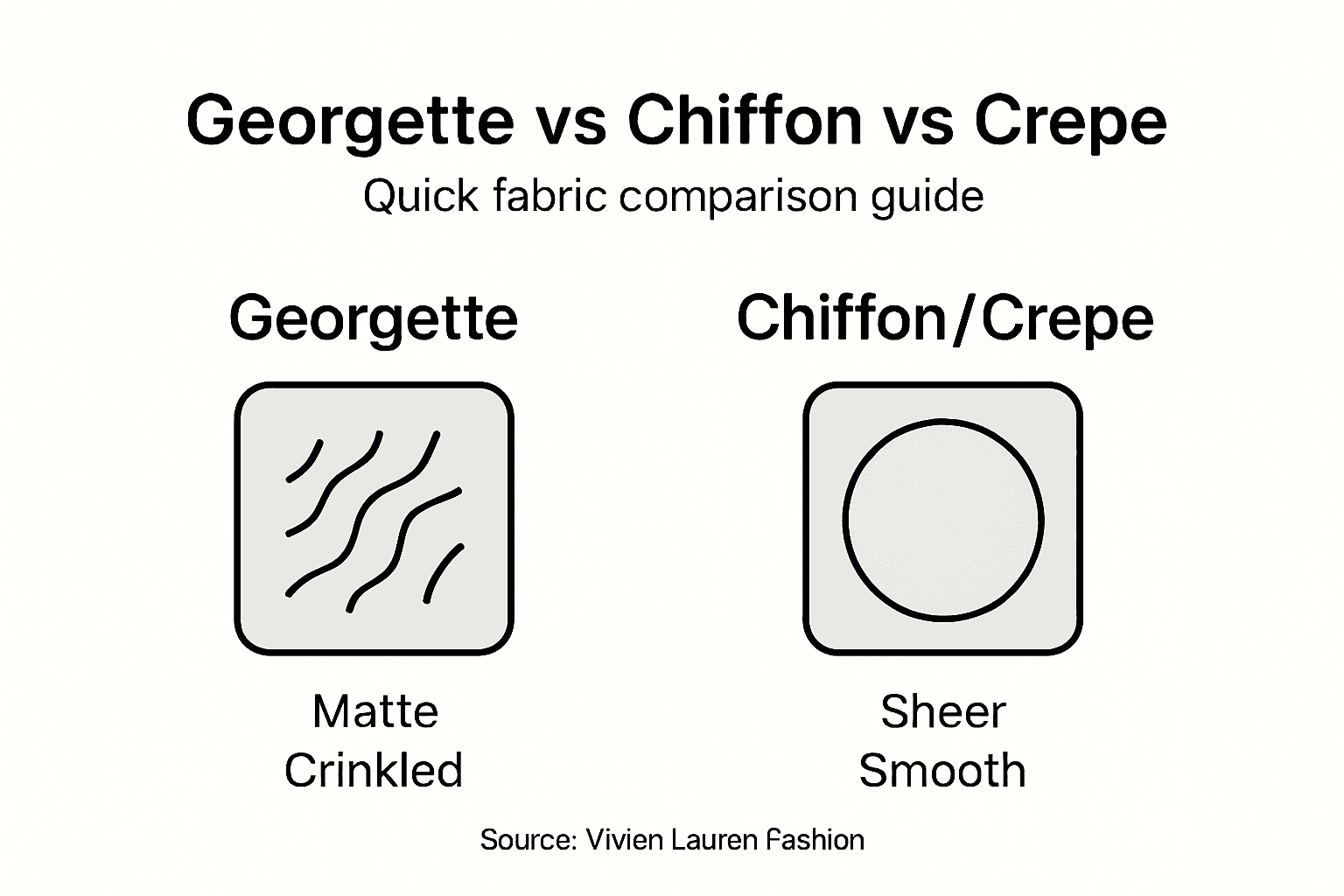
The matte finish of georgette is fundamental to its appeal. Unlike shiny fabrics that can appear costume-like, georgette’s subtle surface reflects light in an understated, refined way. This quality makes it appropriate for everything from midi dresses to flowing maxi gowns and elegant long-sleeved blouses.
Here’s a comparison of georgette with other popular lightweight fabrics:
Characteristic | Georgette | Chiffon | Crepe |
Texture | Crinkled, springy | Smooth, slippery | Smooth, pebbled |
Coverage | Moderately opaque | Very sheer | Moderate |
Best For | Layered dresses, blouses | Evening gowns, scarves | Elegant suits, dresses |
Shine Level | Subtle, matte | Slightly shiny | Matte to slightly lustrous |
Pro tip: When selecting georgette, run your fingers across the fabric to feel the texture—genuine georgette should have a slight grip and springy resistance, never slippery or overly smooth.
Advancements in Georgette Production Technology
Georgette production has evolved dramatically over the past century. What started as a hand-crafted luxury has transformed into a sophisticated manufacturing process that combines traditional artistry with cutting-edge technology. Modern producers now achieve consistency, durability, and quality that would have seemed impossible just decades ago.
The foundation of modern georgette lies in yarn innovation. Contemporary manufacturers utilize advanced synthetic fibers with high twist factors to create fabrics that are springier, softer, and more luminous than their predecessors. These engineered yarns dramatically improve the fabric’s functional properties while maintaining its signature elegance.
Key Technological Breakthroughs
Modern georgette production now incorporates several significant innovations:
Improved Dyeability: New synthetic fibers accept dyes more uniformly, creating richer, more consistent colors
Enhanced Resilience: Advanced yarn construction reduces wrinkles and extends the fabric’s lifespan
Consistent Texture: Precision looming techniques ensure every meter matches the intended crinkled surface
Increased Durability: Engineered fibers resist pilling and maintain their appearance through multiple wearings
Sustainable Options: New production methods reduce water consumption and chemical waste
The weaving process itself has been refined through technological precision. Computer-controlled looms now maintain exact tension and twist angles, eliminating the variations that plagued earlier production methods. This consistency means georgette garments perform predictably—they drape the same way, move the same way, and age the same way.
Understanding how fabrics are made reveals the complexity behind georgette’s seemingly effortless elegance. Modern facilities combine traditional weaving knowledge with digital monitoring systems that track fiber quality, tension, and output in real time.
Today’s georgette production represents a perfect marriage of heritage craftsmanship and technological precision, delivering luxury that’s both reliable and sustainable.
Quality control has transformed completely. Manufacturers now use spectroscopy and digital imaging to verify color accuracy, texture uniformity, and fiber integrity. This scientific approach ensures that every meter of georgette meets exacting standards before leaving the factory.
The shift toward sustainable production marks another crucial advancement. Modern facilities recycle water, minimize chemical runoff, and reduce energy consumption—proving that luxury and environmental responsibility can coexist beautifully.
Pro tip: When shopping for georgette pieces, look for consistent texture and vibrant colors—these indicators signal modern manufacturing excellence and suggest the garment will maintain its beauty for years.
Classic Fashion Designs Using Georgette
Georgette has dressed elegance across more than a century of fashion history. From the glamorous 1920s through mid-century sophistication to contemporary couture, this fabric has consistently been the designer’s choice for creating pieces that move, breathe, and captivate. Its versatility spans from understated daywear to showstopping formal occasions.
The magic of georgette in classic design lies in its ability to balance structure with fluidity. Georgette fabric has been favored for flowing dresses, blouses, saris, and evening gowns) since the early 20th century, proving its staying power across decades and cultures. What makes it truly timeless is how it adapts to any design vision while maintaining its signature elegance.
Iconic Georgette Silhouettes
Certain designs have become synonymous with georgette’s grace:
Long-Sleeved Blouses: Sophisticated and refined, perfect for layering or wearing alone with tailored trousers
Midi Dresses: Elegant knee-length or down to the calf length pieces that flow beautifully and suit various occasions
Maxi Gowns: Floor-length statement pieces for formal events and celebrations
Layered Skirts: Multiple-tier constructions that create movement and visual interest
Draped Evening Wear: Asymmetrical cuts that showcase georgette’s flowing properties
Embroidered Overlays: Georgette as a delicate canvas for intricate needlework
The 1920s aesthetic remains profoundly influenced by georgette. Designers during this era appreciated how the fabric’s weight and drape created that effortless, liberated silhouette women craved. Contemporary interpretations of vintage styles continue to lean on georgette for authenticity and refinement.
Modern georgette designs often incorporate embroidery and decorative techniques that enhance the fabric’s inherent beauty without overwhelming it. Delicate embroidery on georgette creates dimension while respecting the fabric’s translucent nature.
Georgette’s greatest strength in classic design is its ability to convey femininity and sophistication without ever appearing overdone or costume-like.
Traditional and contemporary designs coexist beautifully in georgette. Classic dresses in timeless silhouettes often feature georgette construction because the fabric inherently elevates even the simplest design. A basic georgette midi dress instantly reads as refined.
Georgette also serves as the foundation for cultural fashion traditions worldwide. Saris, traditional Indian garments, frequently showcase georgette for its drape and the way it moves during wear. This cross-cultural appreciation demonstrates georgette’s universal appeal.
When layered strategically, georgette creates sophisticated depth. A flowing georgette overlay over a fitted slip dress creates movement and visual interest. This technique has been used in high fashion for decades and remains current today.
Pro tip: Pair lightweight georgette pieces with structured undergarments or slips to maximize their elegance, ensuring the fabric drapes intentionally rather than clings unpredictably.
Care, Maintenance, and Common Mistakes
Georgette demands respect. This luxurious fabric rewards gentle handling with years of beauty, but careless treatment can damage it permanently. Understanding proper care transforms your georgette pieces into investment pieces that actually improve with age.
The foundation of georgette care is understanding what damages it. Heat, harsh chemicals, wringing, and rough handling distort the delicate fibers and destroy the fabric’s signature crinkle. Proper maintenance involves careful hand washing or gentle machine cycles with cold water and mild detergents specifically formulated for delicate fabrics.
Correct Washing Steps
Follow this straightforward process for clean, preserved georgette:
Fill a basin with cool water and add mild detergent designed for delicate fabrics
Submerge the garment and gently agitate for 3-5 minutes without scrubbing
Rinse thoroughly in cool water until all soap residue disappears
Gently press water out without wringing or twisting the fabric
Lay flat on a clean towel to air dry completely
Alternatively, use your washing machine’s gentle cycle with cold water and place the garment in a mesh laundry bag for extra protection.
Critical Mistakes to Avoid
These errors can permanently damage your georgette investment:
Hot Water: Causes fiber distortion and color fading instantly
Harsh Detergents: Strip the fabric’s natural softness and luster
Wringing and Twisting: Permanently crease and damage delicate yarns
Bleach: Destroys fibers and creates permanent discoloration
Machine Drying: Ruins the signature texture and causes shrinkage
Dry Cleaning Chemicals: Can cause yellowing over time if overused
Drying and Storage
Air drying is non-negotiable for georgette. Hang the garment on a padded hanger in a shaded, well-ventilated area, or lay it flat on a clean towel. Never expose georgette to direct sunlight, which fades colors and weakens fibers.
Georgette’s delicate nature is a feature, not a flaw—the proper care it requires ensures you’ll treasure these pieces for decades.
When ironing becomes necessary, use a low-heat setting with a protective cloth between the iron and fabric. Better yet, steam the garment gently from a distance to remove wrinkles while avoiding direct heat damage.
Storage matters as much as washing. Store georgette pieces in a cool, dry place away from moisture and direct light. Use acid-free tissue paper to help maintain shape, and avoid plastic bags that trap humidity and encourage mildew.
Pro tip: Spot-clean minor stains immediately with cold water and mild soap before they set, as fresh stains are infinitely easier to remove than aged ones.
Elevate Your Wardrobe with Timeless Georgette Elegance
Discover how the exquisite qualities of georgette fabric—its graceful drape, lightweight comfort, and subtle texture—can transform your style with pieces designed for both sophistication and everyday wear. If you have ever struggled with finding elegant apparel that blends comfort and luxury while maintaining durability and ease of care, this is your solution. Embrace fabrics crafted with mastery that honor tradition and modern innovation, just as the article describes.

Explore our curated collection at Vivien Lauren where each garment highlights the beauty of fine textiles like georgette, meticulously crafted in Italy by artisans preserving generations of skill. Experience the effortless femininity of flowing dresses, blouses, and evening wear that boast the signature elegance and practical luxury the article celebrates. Don’t wait to reinvent your style with pieces that truly respect your desire for timeless fashion and quality craftsmanship. Shop now and enjoy free UK shipping on orders over £80 to bring home your perfect georgette garment today.
Frequently Asked Questions
What is georgette material and what are its characteristics?
Georgette is a lightweight, sheer crêpe fabric known for its slightly crinkled texture and durability. It drapes beautifully, resists wrinkles, and is available in various types like pure silk, synthetic, and jacquard georgette.
How do I care for georgette clothing?
To care for georgette, hand wash or use a gentle machine cycle with cold water and a mild detergent designed for delicate fabrics. Avoid wringing, hot water, and harsh chemicals to preserve its texture and appearance.
What are the different types of georgette, and how do they differ?
Georgette comes in several varieties, including pure silk georgette, synthetic georgette, jacquard georgette, and stretch georgette. Each type has unique qualities, such as softness, durability, and design versatility, making them suitable for different occasions and styles.
How does georgette compare to chiffon and crepe fabrics?
Georgette has a crinkled texture and is moderately opaque, while chiffon is smooth and sheer, and crepe has a smooth finish with subtle pebbled texture. Georgette strikes a balance between elegance and wearability, making it versatile for various garment types.
Gallery with accessories by Vivien Lauren to complete look:
Georgette evening gown styled by Vivien Lauren 
Luxury Cute Mini Bag in Italian Leather & Bamboo - by Vivien Lauren
Recommended
This fashion & fabric piece has been written for you by Sammy Li. On behalf of Vivien Lauren. Vivien Lauren. Luxury. Craftsmanship that's Proudly Italian. Vivien Lauren. Proud To Style.


