
What Is Ethical Fashion? A Guide for Conscious Women
Ethical fashion is defined as the production and consumption of clothing with full accountability for environmental impact, fair labor, and animal welfare. It is not a trend. It is a philosophy that asks every garment to carry a clean conscience alongside its beauty. The definition of ethical fashion encompasses transparency across the entire supply chain, from the field where fibers are grown to the hands that stitch each seam. Vivienlauren was built on this very conviction: that truly exquisite fashion must honor the people who make it and the world it inhabits. Ethical clothes focus on renewable inputs and lower resource consumption, making each purchase a quiet act of care.
What is ethical fashion, and what are its core principles?
Ethical fashion rests on four interconnected pillars: fair labor, environmental stewardship, animal welfare, and radical transparency. Remove any one of them, and the structure collapses into marketing language rather than meaningful practice.
Fair labor is the most personal of these pillars. It demands living wages, safe working conditions, and freedom from coercion for every worker in the supply chain. The garment industry employs millions of people, many of them women in the Global South, and fair labor standards protect their dignity as much as their safety.
Environmental stewardship addresses the material cost of clothing. Textile dyeing and finishing cause about 20% of global clean water pollution. Plant-based dyes offer a safer alternative, and ethical brands are increasingly adopting them. Low-impact materials, reduced carbon footprints, and water conservation are not optional features in ethical fashion. They are the baseline.
Animal welfare means rejecting materials obtained through cruelty, including conventional leather, fur, and down, unless sourced through verified humane practices. Many ethical brands choose vegan alternatives or certified responsible wool and silk.
Transparency is what holds the other three together. A brand that publishes its factory names, audit results, and material sourcing is far harder to deceive than one hiding behind vague language. Third-party certifications like Fairtrade and the Global Organic Textile Standard (GOTS) provide trustworthy, independently verified evidence of ethical standards.
Fair wages and safe conditions for all garment workers
Low-impact, renewable, or certified organic materials
Cruelty-free or responsibly sourced animal products
Published supply chain information and third-party certification
Pro Tip: When evaluating a brand, search for its supplier list. Brands that publish factory names and audit scores are practicing genuine transparency, not just performing it.
How does ethical fashion differ from sustainable and regenerative fashion?
These three terms overlap, but they are not interchangeable. Understanding the distinctions helps you shop with greater clarity and hold brands to the right standard.
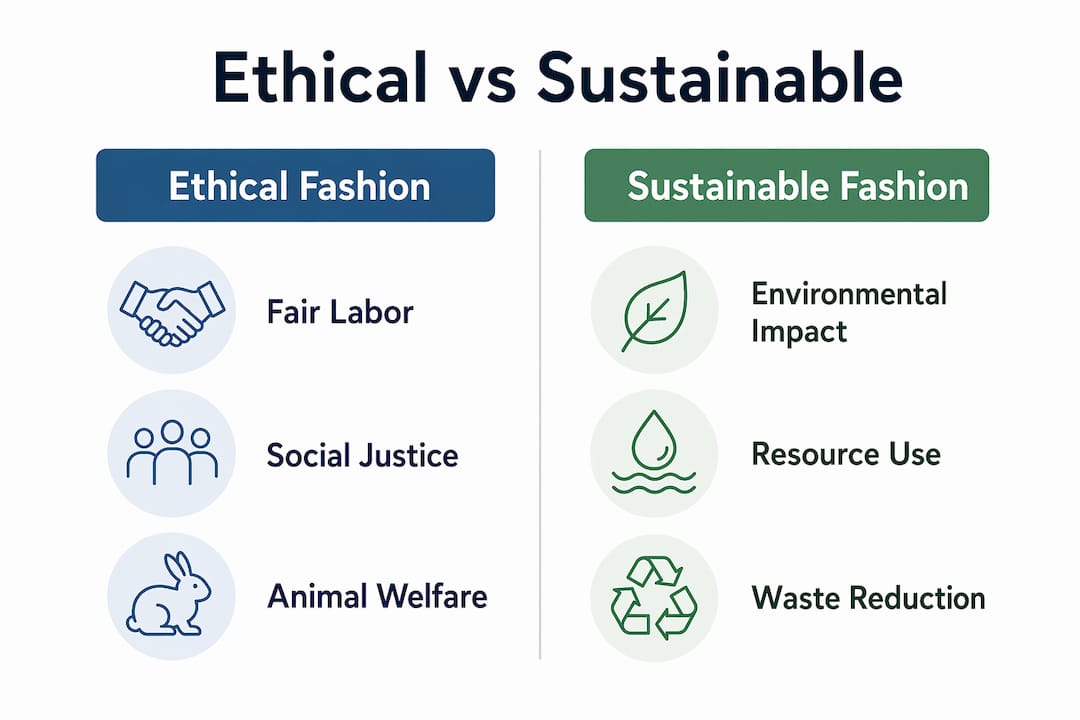
Sustainable fashion focuses primarily on reducing environmental harm. It asks: how do we produce clothing while consuming fewer resources and generating less waste? Sustainable fashion gave us organic cotton, recycled polyester, and water-saving dyeing techniques. Yet it remains, at its core, a harm-reduction model. It aims to slow damage rather than reverse it.
Ethical fashion is broader. It adds the social dimension, asking not only “what does this garment cost the planet?” but also “what does it cost the people who made it?” A garment can be made from certified organic cotton and still be sewn in a factory where workers earn poverty wages. Ethical fashion refuses that trade-off.
Regenerative fashion is the most ambitious of the three. The fashion industry is shifting from sustainability to regeneration, aiming to actively improve ecosystems and communities rather than merely preserving them. Regenerative practices include soil restoration through biodynamic farming, community wealth-building programs, and circular design that eliminates waste entirely.
Approach | Primary Focus | Core Goal |
Sustainable fashion | Environmental impact | Reduce harm |
Ethical fashion | Social and environmental | Accountability across the supply chain |
Regenerative fashion | Whole-system restoration | Actively improve ecosystems and communities |
The slow fashion model sits closest to ethical fashion in practice, prioritizing craftsmanship, longevity, and intentional production over volume and speed.
Why is ethical fashion important for the environment and society?
The scale of fashion’s environmental damage is genuinely staggering, and the numbers demand attention rather than abstraction.
“If current apparel consumption rates persist, the fashion industry is projected to utilize over 25% of the world’s total carbon budget by 2050. That is not a distant warning. It is a trajectory already in motion.”
Annual textile production consumes enough water to fill at least 37 million Olympic-size swimming pools. That figure represents water drawn from communities and ecosystems that cannot afford to lose it.
The social cost is equally grave. Fast fashion’s business model depends on compressing production costs, and labor is the most compressible line item. Workers, predominantly women, absorb that pressure through suppressed wages, excessive hours, and unsafe conditions. Ethical fashion directly counters this by treating fair compensation as non-negotiable rather than aspirational.
Consumers carry real power in this system. Purchase decisions in ethical fashion are influenced more by price and fashion trends than by sustainability perceptions alone. That gap between values and behavior is where awareness and education do their most important work. When you choose a garment made with care, you send a signal through the supply chain that care has market value.
How to identify and support ethical fashion brands and practices
Recognizing a genuinely ethical brand requires more than reading its website copy. The following steps give you a practical framework for making informed choices.
Look for third-party certifications. Labels like “natural” and “eco-friendly” are often unregulated. Certifications like Fairtrade and GOTS are more reliable indicators because they require independent auditing. Look for these marks on product pages and packaging.
Examine the materials. Organic cotton, linen, Tencel, and responsibly sourced wool are strong starting points. Be cautious with recycled synthetics: recycled polyester carries risks including microplastic pollution during washing, which poses ongoing environmental harm even when the fiber itself is reclaimed. A deeper look at post-consumer recycled fabric reveals both the promise and the limitations of this material category.
Scrutinize brand transparency. Does the brand name its factories? Does it publish wage data or environmental audits? Silence on these questions is itself an answer.
Recognize greenwashing. Vague language like “conscious collection” or “eco-line” without supporting evidence is a red flag. Greenwashing exploits the goodwill of ethical shoppers without delivering the substance.
Buy less, buy better. The most impactful ethical fashion practice is reducing consumption and extending garment life through careful use and repair. A single well-made dress worn for a decade outperforms ten disposable alternatives in every environmental metric.
Pro Tip: Before purchasing, ask yourself: “Would I still want this in five years?” If the answer is yes, it is likely worth the investment. If not, it may be a fast-fashion impulse dressed in ethical language.
The sustainable fashion shopping workflow offers a practical, step-by-step approach to applying these principles every time you shop.
What are the emerging trends shaping ethical fashion’s future?
Ethical fashion is not static. The field is evolving rapidly, and the most significant shift is the move from harm reduction toward active restoration.
Regenerative fashion broadens ethical fashion’s scope to whole-system restoration, expanding beyond traditional sustainability models. Brands are beginning to partner with biodynamic farms, invest in community land programs, and design garments intended for disassembly and reuse. This is not philanthropy. It is a structural reimagining of what fashion’s relationship with the natural world could look like.
Technology is accelerating this shift. Waterless dyeing processes, bio-fabricated materials grown from mycelium or algae, and digital design tools that reduce sampling waste are all moving from experimental to commercial. Longevity-focused design, where garments are built to be repaired, altered, and passed on, is gaining ground as a genuine market differentiator rather than a niche preference.
Consumer psychology is also changing, though unevenly. Organic cotton is perceived as significantly more sustainable than polyester, yet low price often drives purchase over sustainability. Closing that gap requires not just awareness campaigns but pricing structures that make ethical choices accessible. Regulatory pressure is building in the European Union and United Kingdom, where extended producer responsibility laws and mandatory supply chain disclosure are moving from proposal to policy.
The benefits of ethical fashion extend well beyond environmental metrics. They include the psychological satisfaction of wearing something made with integrity, the aesthetic pleasure of superior craftsmanship, and the social statement of refusing to participate in exploitation.
Key Takeaways
Ethical fashion is the most complete framework for responsible consumption because it addresses environmental impact, labor rights, and transparency simultaneously rather than in isolation.
Point | Details |
Core definition | Ethical fashion requires fair labor, environmental stewardship, animal welfare, and supply chain transparency. |
Certifications matter | Fairtrade and GOTS provide independently verified proof of ethical standards; unregulated labels do not. |
Regeneration goes further | Regenerative fashion actively restores ecosystems and communities, moving beyond harm reduction. |
Longevity is the highest impact action | Buying less and extending garment life reduces environmental damage more than switching materials alone. |
Consumer power is real | Purchasing decisions shape supply chain behavior; choosing quality over volume sends a measurable market signal. |
Why I believe ethical fashion is the only luxury worth pursuing
Working closely with Vivienlauren has reinforced something I have come to hold as a near-absolute conviction: true luxury and ethical production are not in tension. They are the same thing, expressed differently.
The garments I admire most are the ones I can trace. I want to know the hands that cut the fabric, the atelier where the seams were pressed, the Italian tradition of craftsmanship that shaped every detail. That knowledge does not diminish the beauty of a piece. It deepens it. A dress made with care is more beautiful than one made with indifference, even if they look identical on a hanger.
What troubles me about much of the ethical fashion conversation is its tendency toward austerity. The implicit message is often: consume less, choose plainer things, sacrifice style for conscience. I reject that framing entirely. The goal is not to wear less beautiful clothing. The goal is to wear clothing whose beauty is honest, whose elegance carries no hidden cost to a worker or a watershed.
Vivienlauren’s collections, handcrafted in Italy with techniques passed down through generations, embody this without apology. Slow fashion is not a compromise. It is the highest expression of what fashion can be.
— Vivien
Vivienlauren’s collections: where elegance meets ethical craft
Vivienlauren brings the principles of ethical fashion to life through collections that are handcrafted in Italy, built on generational artisanship, and designed to be worn for decades rather than seasons.

Every piece in the Vivienlauren range reflects a commitment to quality materials, transparent sourcing, and the kind of slow, considered production that ethical fashion demands. The women’s dress collection showcases occasion wear made with the same care and intention that defines the ethical fashion philosophy. For those who want to complete a look with the same integrity, the luxury accessories and handcrafted footwear collections offer pieces built to last. Explore the full world of Vivienlauren and find fashion that honors both your values and your sense of style.
FAQ
What is the simplest definition of ethical fashion?
Ethical fashion is clothing produced with full accountability for environmental impact, fair labor conditions, and animal welfare across the entire supply chain.
How does ethical fashion differ from sustainable fashion?
Sustainable fashion focuses on reducing environmental harm, while ethical fashion also includes social justice, fair wages, and worker rights as non-negotiable standards.
Which certifications confirm a brand is truly ethical?
Fairtrade and GOTS (Global Organic Textile Standard) are the most reliable third-party certifications because they require independent auditing rather than self-reporting.
Is recycled polyester an ethical material?
Recycled polyester reduces landfill waste but carries risks including microplastic shedding during washing, which means it requires careful evaluation rather than automatic approval as an ethical choice.
What is the single most impactful thing a consumer can do?
Reducing consumption and extending the life of garments through careful use and repair has a greater positive environmental impact than any single material switch.
Recommended
This fashion piece has been authored for you by Sammy Li, on behalf of Vivien Lauren. Vivien Lauren. Luxury. Craftsmanship. That's Proudly Italian. Vivien Lauren. Proud To Style.
