
What Made Black the Classic Color in Fashion History
Updated: Aug 19

Black Elegance. Simply Classic. Vivien Lauren.

Black has long evolved from a symbol of mourning and authority to a timeless emblem of elegance and versatility in fashion. Its cultural significance, shaped by centuries of social customs and designer reinterpretation, grants it an elastic symbolic range that endures across eras. This deep historical resonance and adaptability make black an essential, perpetual cornerstone in luxury wardrobes worldwide.
Black is defined as fashion’s most enduring classic because it carries centuries of social, cultural, and symbolic weight that no other color can replicate. From the grief-laden drawing rooms of Victorian England to the ateliers of Coco Chanel’s Paris, black accumulated meaning with every generation that wore it. The history of black as a color in fashion is not simply a story of aesthetics. It is a story of mourning, authority, rebellion, and ultimately, liberation. Understanding what made black the classic color reveals how deeply a single shade can shape an entire civilization’s relationship with dress.
What made black the classic color in fashion?
Black became the classic color through a convergence of mourning customs, power symbolism, and deliberate designer reinterpretation that no other color has experienced in quite the same way. Its significance of black color lies not in one defining moment but in centuries of accumulated cultural meaning, each layer reinforcing the last. By the time Coco Chanel presented her 1926 Little Black Dress, black had already spent hundreds of years earning its authority in wardrobes across Europe. Chanel did not invent black’s prestige. She redirected it.
The cultural meanings of black span contradictions that most colors cannot hold. Black signals mourning and glamour, austerity and luxury, severity and sensuality, all simultaneously. This symbolic elasticity is precisely what makes black timeless. A color that can mean everything to everyone across every era does not go out of style. It simply changes its story.
How mourning customs shaped black’s place in fashion
The most underappreciated chapter in the history of black as a color is the Victorian mourning tradition, which effectively trained an entire society to associate black with sustained dignity and public decorum. 19th century mourning etiquette required women to wear black for extended periods after bereavement, with widows observing up to two and a half years of all-black dress and mothers mourning a child for approximately one year. This was not private grief. It was a visible social role, performed daily in public spaces, reinforcing black as the color of seriousness and respect.
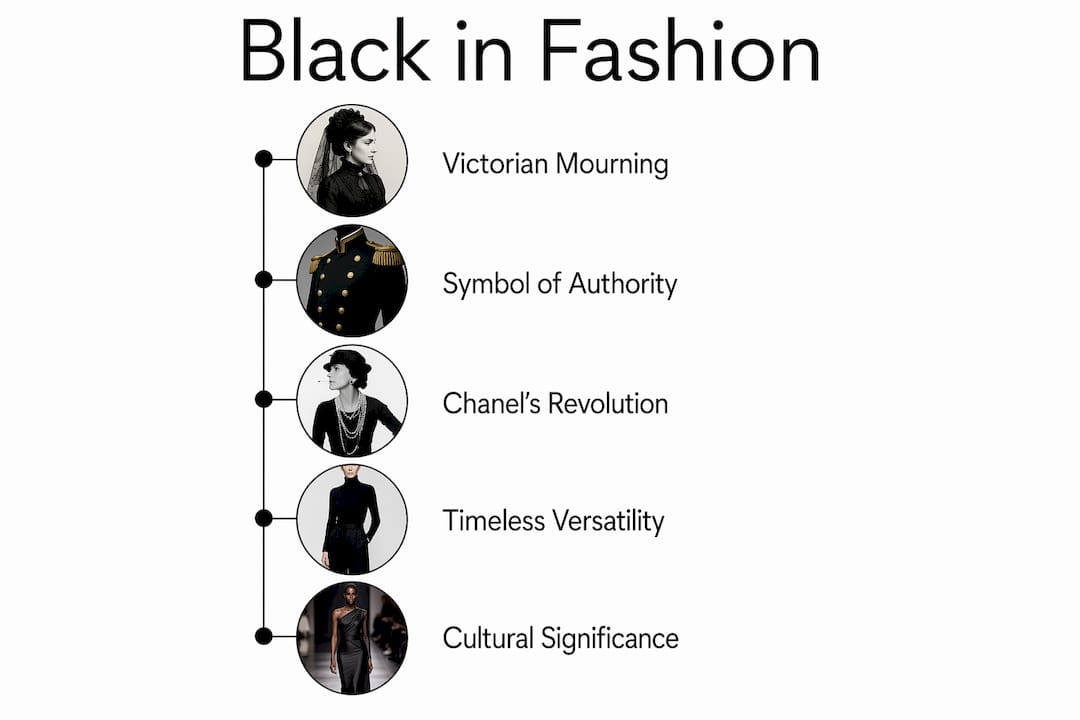
What this prolonged exposure accomplished was remarkable. Generations of women wore black not as a fashion choice but as a social obligation, and in doing so, they normalized the color’s presence in everyday life. Mourning dress infrastructure supported entire textile industries, making black garments widely accessible and culturally ingrained long before any designer declared it chic.
The transition out of deep mourning introduced its own sophistication. After the strictest mourning period, women were permitted to introduce white or lilac accents into their black ensembles, and this gradual easing allowed black to evolve from a rigid color code into something more flexible. Mourning jewelry crafted from expensive natural materials such as ebony and jet elevated black’s prestige far beyond grief symbolism, associating it with luxury and refinement. The color had earned its gravitas through social practice before fashion ever claimed it.
Consider the following dimensions of mourning’s influence on black’s fashion legacy:
Social visibility: Wearing black publicly for years made it the most recognized and respected color in a woman’s wardrobe.
Textile accessibility: The demand for mourning attire built supply chains and dyeing expertise that made quality black fabric widely available.
Material prestige: Jet and ebony jewelry, worn during partial mourning, linked black to expensive craftsmanship and exclusivity.
Psychological normalization: Prolonged daily wear conditioned society to find black natural, appropriate, and even beautiful in contexts beyond grief.
Pro Tip: When building a luxury wardrobe, consider that the depth of black’s cultural resonance means a well-chosen black piece carries more authority than almost any other color. Invest in quality fabric and precise tailoring, because black reveals construction with unforgiving clarity.
Why black became the color of authority and power

Black’s authority in fashion did not begin with mourning. Black has been a color of solemnity and authority since the Middle Ages, worn by judges and magistrates in contexts where gravity and impartiality were required. The color communicated power without ostentation, severity without cruelty. It was the visual language of institutions that wished to project permanence.
In the 15th and 16th centuries, black fabric was historically expensive and technically difficult to produce with consistency, making it a luxury reserved for royalty and aristocrats. Spanish royal courts adopted black as their signature palette, using it to signal authority and restraint simultaneously. The color communicated that its wearer needed no embellishment to command a room. This association between black and restrained power proved extraordinarily durable.
What makes black’s symbolic history so fascinating is the breadth of contradictory meanings it has held without losing coherence:
Death and glamour: Black appears at funerals and on red carpets with equal conviction.
Austerity and creativity: Religious orders and avant-garde artists both claim black as their own.
Severity and sensuality: A black judicial robe and a black evening gown occupy opposite ends of desire, yet both derive authority from the same color.
Tradition and rebellion: Black is the color of institutions and of those who reject them.
“Black’s cultural durability stems from its symbolic elasticity: the same color means death, glamour, austerity, creativity, and more simultaneously.” — The Story of Black, Reaktion Books
This capacity to hold opposing meanings without contradiction is the foundation of black’s longevity. A color that belongs to judges and jazz musicians, to mourners and movie stars, cannot be reduced to a single era or a single mood. It belongs to all of them at once, which is why the black color symbolism in fashion never exhausts itself.
How Coco Chanel and Paris designers transformed black into modern elegance

The transformation of black from a color of obligation into a color of desire is one of fashion history’s most consequential stories, and it unfolded in the years following World War I. Postwar social changes and the Jazz Era’s demands made black both practical and symbolic of women’s growing independence. Women entering the workforce, moving through cities, and claiming new social freedoms needed clothing that was versatile, dignified, and free from the elaborate ornamentation of the previous century. Black answered every requirement.
Coco Chanel understood this shift with extraordinary precision. Her 1926 Little Black Dress democratized black as accessible elegance, stripping away the mourning associations and presenting the color as the ultimate expression of modern femininity. Vogue compared the dress to the Ford Model T, recognizing it as simple, revolutionary, and destined to become universal. The little black dress became not just a garment but a philosophy: that true sophistication requires no excess.
The steps by which Parisian designers cemented black’s modern status followed a clear progression:
Stripping mourning associations: Designers presented black in contexts of joy, movement, and social celebration, severing its exclusive link to grief.
Embracing simplicity: Streamlined silhouettes in black emphasized the body and the quality of the fabric rather than decorative complexity.
Dressing the modern woman: The shopgirl in a black dress became a modern icon, reflecting new urban social dynamics and the visibility of working women.
Establishing versatility: A single black dress could move from day to evening with minimal adjustment, making it the most practical luxury a woman could own.
Aligning black with youth: Paris designers used black for youthful, streamlined designs that rejected the heavy formality of Victorian and Edwardian dress.
Pro Tip: The principle Chanel established still holds. A black dress of exceptional cut and fabric quality will serve you across more occasions than almost any other single garment in your wardrobe. Choose construction over trend when selecting yours.

Why black remains timeless across every era of style
The question of what makes black timeless is ultimately a question about symbolic adaptability. Black’s survival in fashion is helped by its ability to hold different, even contradictory meanings without changing its visual identity. Design houses can present the same black garment across decades while the cultural narrative surrounding it shifts entirely. This is a quality no other color possesses to the same degree.
The table below illustrates how black’s meaning has shifted across contexts while its visual authority has remained constant:
Context | Black’s meaning | Visual effect |
Victorian mourning | Grief, social duty, respect | Uniform, somber, dignified |
1920s Paris fashion | Modernity, independence, elegance | Streamlined, youthful, chic |
1950s–60s artistic circles | Rebellion, intellectualism, creativity | Austere, expressive, deliberate |
Contemporary luxury fashion | Sophistication, versatility, timelessness | Refined, authoritative, adaptable |
Digital and minimalist culture | Clarity, restraint, visual precision | Clean, modern, uncluttered |
Black’s role as a neutral base for formal, casual, rebellious, and artistic styles means it never belongs exclusively to one aesthetic movement. When minimalism rises, black leads it. When maximalism returns, black anchors it. The color’s visual neutrality, combined with its deep symbolic complexity, creates a foundation that every generation of designers can build upon without exhausting. This is why classic fashion endures and why black remains at its center.
Key takeaways
Black is the classic color in fashion because centuries of mourning customs, power symbolism, and deliberate designer reinterpretation created a color whose symbolic elasticity makes it perpetually relevant across every cultural era.
Point | Details |
Mourning customs built the foundation | Victorian etiquette normalized black through years of obligatory daily wear, creating deep cultural familiarity. |
Authority and luxury reinforced prestige | From medieval judges to Spanish royal courts, black signaled power and restraint across centuries. |
Chanel redirected black’s meaning | The 1926 Little Black Dress transformed black from mourning obligation into modern elegance and independence. |
Symbolic elasticity ensures longevity | Black holds contradictory meanings simultaneously, allowing each era to claim it without depleting its authority. |
Versatility sustains relevance | Black functions equally in formal, casual, rebellious, and minimalist contexts, making it irreplaceable in any wardrobe. |
Black as a cornerstone: my perspective on wearing it with intention
I have spent years studying the relationship between color and confidence in women’s fashion, and I return to the same conclusion every time. Black is not the easy choice. It is the considered one. There is a persistent misconception that choosing black is somehow a retreat from personal expression, a safe default for the uninspired. The history tells a completely different story.
Every woman who wore black through two years of Victorian mourning was making a statement of profound social commitment. Every Parisian designer who stripped away ornamentation and presented a clean black silhouette was making an argument about what modern femininity could look like. Black has never been passive. It has always been a declaration.
What I find most instructive about black’s history is that its power was built through repetition and cultural enforcement before it was ever claimed by fashion. The mourning traditions, the judicial robes, the royal courts: all of these created a reservoir of meaning that designers like Chanel could draw from and redirect. That reservoir has never emptied. It simply keeps refilling with new cultural associations.
My practical advice is this: wear black with the awareness of what it carries. A black dress chosen for its cut, its fabric, and its fit is not a neutral choice. It is a choice that connects you to centuries of women who understood that restraint and sophistication are not opposites of expression. They are its most refined form. Pair your black pieces with ankle strap heels in jet black for a complete study in tonal elegance, or introduce a single accent of color through a handcrafted accessory to let the black do what it does best: make everything else more vivid by contrast.


— Vivien Lauren.
Discover timeless black pieces at Vivien Lauren
The history of black in fashion is, at its heart, a history of women choosing garments that carry meaning beyond the moment. At Vivien Lauren, every piece in our collection is designed with that same understanding, crafted in Italy using techniques passed down through generations of artisans who know that true elegance is built into the construction, not applied as decoration.

Whether you are drawn to the architectural simplicity of a black dress or the quiet authority of a black accessory, our curated women’s fashion collection offers pieces that honor black’s extraordinary legacy. Each garment is made to be worn across seasons and occasions, embodying the very versatility that made black the enduring cornerstone of the luxury wardrobe. Explore the collection and find the black piece that speaks to your own sense of timeless style.
FAQ
Why is black considered a classic color in fashion?
Black is classic because it carries centuries of accumulated cultural meaning, from Victorian mourning customs to Coco Chanel’s 1926 Little Black Dress, giving it a symbolic authority no other color has built over the same period. Its ability to hold contradictory meanings simultaneously makes it perpetually relevant.
What is the history of black as a fashion color?
Black’s fashion history begins with medieval authority symbolism and 19th century mourning etiquette, which normalized it through obligatory daily wear, before Parisian designers like Chanel reframed it as modern elegance in the 1920s.
What does black symbolize in fashion and culture?
Black symbolizes mourning, authority, glamour, rebellion, austerity, and creativity simultaneously. This symbolic elasticity, the capacity to hold opposing meanings without contradiction, is the core reason black color symbolism remains so powerful across eras.
How did Coco Chanel change the meaning of black?
Chanel’s 1926 Little Black Dress severed black’s exclusive association with mourning and presented it as accessible, modern elegance. Vogue compared it to the Ford Model T, recognizing it as a simple, universal, and revolutionary garment.
What makes black so versatile in a luxury wardrobe?
Black functions as a visual neutral while carrying deep symbolic weight, allowing it to anchor formal, casual, and artistic looks with equal authority. Its visual consistency means the same garment can hold entirely different cultural meanings across decades without losing relevance.
Recommended
This fashion article has been written for you by Shona White. On behalf of Vivien Lauren. Vivien Lauren. Luxury. Craftsmanship. That's Proudly Italian. Vivien Lauren. Proud To Style.


