
Definition of fashion exclusivity: How Luxury Brands Create Value
Updated: May 8

Discover what is true Luxury for fashion. Vivien Lauren: for those seeking both Luxury and Exclusivity.
True fashion exclusivity includes heritage, craftsmanship, and a sense of belonging, not just scarcity.
Italian artisanal fashion emphasizes non-replicable skills and small-batch production, fostering deep exclusivity.
Modern luxury focuses on community and earned loyalty, shifting away from simple product scarcity.
Exclusivity in fashion is one of those ideas that nearly everyone believes they understand, and yet almost everyone defines too narrowly. Ask most people what makes a luxury piece exclusive, and they will point to limited quantities, a daunting price tag, or a waitlist that stretches months into the future. But that reading, however intuitive, misses the deeper and far more fascinating truth. True fashion exclusivity is a layered concept, one woven from heritage, handcraft, cultural knowledge, and a sense of intimate belonging that no volume strategy can manufacture. In the pages that follow, we will clarify what exclusivity really means, trace how its models are shifting, and show why Italian artisanal fashion remains its most eloquent expression.
Table of Contents
Key Takeaways - definition of fashion exclusivity
Point | Details |
Exclusivity redefined | Modern fashion exclusivity blends rare craftsmanship, heritage, and community. |
Italian craftsmanship’s value | Non-replicable Italian artisan skills are a top standard for true exclusivity. |
Relationship-driven brands | Luxury brands increasingly cultivate loyalty through experiences and belonging. |
Scarcity versus belonging | The shift from ownership alone to the value of access and earned community is key. |
What is fashion exclusivity?
Now that we have introduced why exclusivity is so compelling in the world of luxury fashion, let us consider what makes up its essence. At its most surface level, exclusivity suggests that not everyone can have something. But stop there and you have described scarcity, not exclusivity. True exclusivity is something richer: it is the convergence of uniqueness, cultural heritage, and a feeling of belonging to a world that rewards discernment.
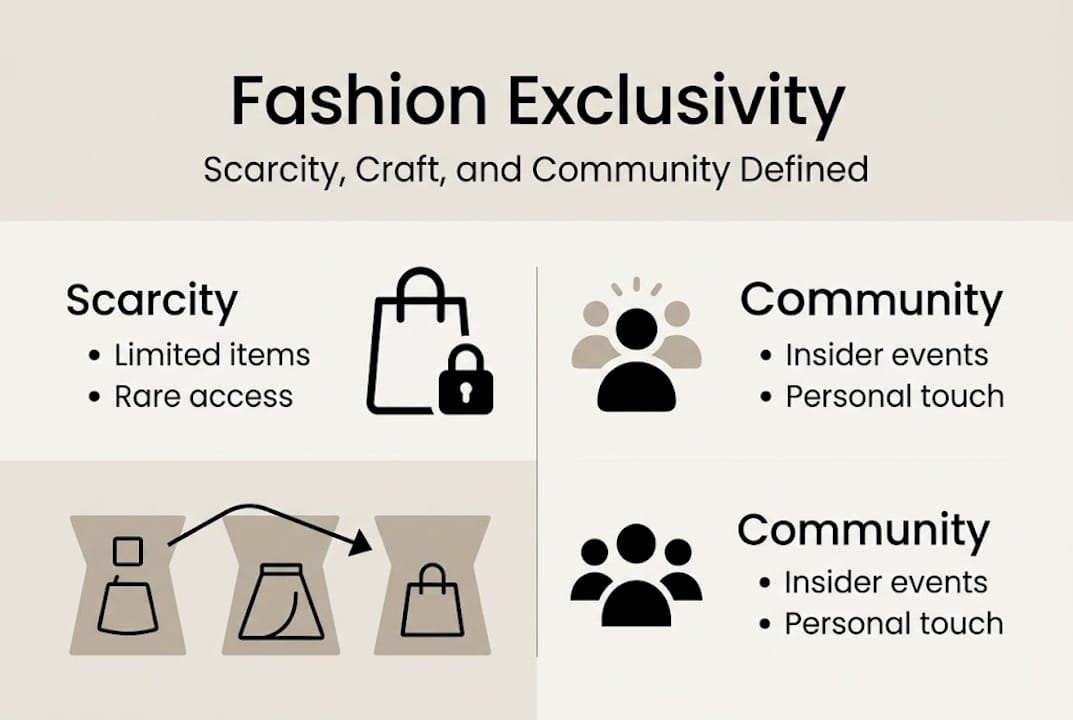
Think of it the way you might think of describing a genuinely great painting to someone who has never seen it. Words like “rare” or “expensive” barely scratch the surface. What you are really trying to convey is the atmosphere of the piece, the stories embedded in every brushstroke, the lineage of the artist who created it. Fashion exclusivity operates in exactly the same register.
There are, broadly speaking, two forms of exclusivity that coexist in the luxury market today:
Perceived scarcity exclusivity: This is the classic model. Limited production runs, waitlists, restricted retail points of sale. The item is exclusive because relatively few people can physically obtain it.
Experiential and cultural exclusivity: This is the evolving standard. A garment is exclusive because it carries irreplicable knowledge, a heritage story, or access to an intimate community that cannot be bought on a whim.
For brands rooted in Italian artisanal tradition, the second form has always been the more meaningful one, even if the market has taken decades to fully recognize it. As exclusivity has evolved from product scarcity to experiences and cultural knowledge, the tension between a brand’s desire to grow and its need to preserve mystery has never been more acute.
“Exclusivity is not merely a quantity. It is a quality of encounter, a sense that what you hold was made specifically for those who know how to see it.”
For the woman who appreciates timeless luxury apparel, this distinction is everything. She is not purchasing an item because of its price point alone. She is entering a world, a lineage, a conversation between maker and wearer that spans generations. That is the foundation upon which genuine fashion exclusivity is built, and it is the lens through which every subsequent idea in this piece should be read.
An important nuance: exclusivity is also increasingly about fostering insider communities. Brands that cultivate small, knowledgeable circles of devoted clients understand that belonging itself is a luxury good. When you feel genuinely seen and known by a brand, that sensation is non-replicable, and it is worth far more than any certificate of limited edition production.

Scarcity versus belonging: Shifting models of exclusivity
With an understanding of the elements of exclusivity, it is important to see how the models of exclusivity have shifted in recent years. For most of the twentieth century, luxury brands relied almost entirely on physical scarcity to signal value. Waitlists, controlled distribution, and numbered editions were the primary vocabulary of exclusivity. That model still exists, and in certain rarefied contexts it still works beautifully. But it is no longer sufficient on its own.
The new paradigm centers on what we might call earned intimacy: the idea that a client’s status within a brand’s world is conferred not simply by purchasing power but by demonstrated knowledge, loyalty, and shared values. Consider two of the world’s most storied houses:
Hermès has long practiced a form of gatekeeping that goes far beyond price. Access to certain bags is not simply a matter of budget; it is a reward for an established relationship with the house, for demonstrated appreciation of its craft, and for a history of engagement with the brand’s broader universe of leather goods, silks, and equestrian heritage.
Chanel operates through recognition, where loyal clients are welcomed into intimate preview events, offered early access to ateliers, and invited into a cultural conversation that makes ownership feel like membership rather than mere transaction.
The contrast between these two approaches and a purely volume-driven strategy is stark. Consider the following comparison:
Model | Primary driver | Risks | Long-term appeal |
Physical scarcity | Limited supply | Counterfeiting, frustration | Moderate |
Earned intimacy | Relationship depth | Slower growth | Very high |
Over-distribution | Wide accessibility | Brand dilution | Low |
This table reveals something important. As aspirational mid-tier brands suffer from over-distribution, ultra-luxury houses thrive precisely because they resist the volume temptation. The fashion heritage of a brand, when treated as a living, breathing asset rather than a marketing footnote, becomes the engine of earned intimacy.
Relationship-driven value is increasingly vital. Clients who feel they belong to a brand’s inner circle become its most passionate advocates, its most enduring customers, and, crucially, the custodians of its reputation. That is a dynamic that no social media campaign can replicate and no markdown sale can manufacture.
Pro Tip: When evaluating a luxury purchase, ask yourself not just “how many of these exist?” but “does this brand know who I am and what I value?” The answer reveals whether you are engaging with real exclusivity or simply scarcity theater.
How Italian craftsmanship defines exclusivity
Let us focus on how Italian fashion in particular has set an enduring standard. Italy’s role in global luxury is not an accident of geography. It is the result of centuries of accumulated mastery, passed from maestro to apprentice in workshops scattered across Florence, Milan, Naples, and the smaller ateliers of regions whose names are synonymous with a specific craft. The leather of Tuscany. The silk of Como. The tailoring traditions of Neapolitan sartorie. These are not marketing stories. They are living inheritances.
What makes Italian artisanal fashion genuinely exclusive is precisely its non-replicability. A machine can produce a garment at speed. It cannot replicate the judgment of a craftsperson who has spent thirty years learning to read the grain of leather, to feel when a seam is perfectly tensioned, or to recognize the precise moment a fabric reaches its ideal drape. That knowledge, embodied and intuitive, is the irreducible core of Italian exclusivity.
View the table below for further definition of fashion exclusivity
Attribute | Mass-market fashion | Italian artisanal fashion |
Production method | Automated, high volume | Handcrafted, small batch |
Skill inheritance | Standardized training | Generational transmission |
Personalization | Minimal | Integral to the process |
Longevity | Seasonal | Decades |
As Italian artisanal exclusivity emphasizes artisanal heritage and non-replicable craftsmanship, the discerning shopper recognizes that what she is acquiring is not simply a beautiful object. She is acquiring proof of a living tradition. Handcrafted leather’s elegance, for example, is not a stylistic choice alone. It is a declaration of values: patience over speed, depth over volume, permanence over trend.
Beyond the garment itself, Italian artisanal brands elevate exclusivity through personalization and VIP experience. Limited runs and VIP experiences are now recognized as key pillars of luxury brand management, and Italy’s finest ateliers have practiced this instinctively for generations, long before business schools codified it. A client who visits a Florentine leather workshop and watches her bag take form in real time is not simply shopping. She is participating in a rite, and that participation confers a form of belonging that a department store transaction simply cannot offer.
Authentic craftsmanship, in this light, transcends logos and trends entirely. The woman who understands artisan Italian luxury knows that the most exquisite pieces rarely shout their origins. They whisper them, through the softness of the leather, the precision of the stitching, the way a silhouette moves. And for those with the eye to see it, that whisper is far more compelling than any embossed monogram. This is what couture craftsmanship has always understood at its finest: that excellence announces itself through presence, not noise.
Pro Tip: When considering an Italian artisanal piece, look beyond the label and examine the construction. Hand-stitched seams, natural dye variations, and slight asymmetries are not flaws. They are the signature of a human hand, and they are precisely what makes the piece irreplaceable.
Exclusivity’s role in luxury value and pricing
To connect the art of exclusivity with its real-world impact, let us see how it influences the value and pricing of luxury fashion today. Exclusivity is not merely an aesthetic virtue. It is an economic engine. When a brand successfully cultivates genuine exclusivity, it earns the right to price at a premium that the market will not only accept but actively celebrate.
The mechanics are worth understanding. When supply is constrained and desirability is high, basic economics would predict higher prices. But luxury exclusivity goes further than supply and demand alone. It creates what economists sometimes call perceived value, which is the sense that an item is worth far more than the sum of its material components because of what it represents, who made it, and what it says about its owner.
Relationship-based loyalty is now a primary driver for premium brands. Clients who feel a genuine bond with a house will pay prices that purely rational analysis might not justify, because the emotional and social value they receive is real and significant.
A shrinking but more affluent consumer base is reshaping market strategies across the luxury sector. Rather than chasing volume, the most sophisticated brands are deliberately concentrating on fewer, deeper relationships with clients of greater purchasing power and longer lifetime value.
Resistance to discounting is itself a signal of exclusivity. Brands that refuse to participate in seasonal sale cycles preserve their cachet in a way that price-reactive brands cannot.
The 2026 luxury market data confirms that exclusivity drives premium pricing even as the consumer base contracts, with leading houses prioritizing relationship-based value over volume strategies. This is a decisive shift. The luxury brands that will endure are not those that cast the widest net but those that build the deepest connections.
For the discerning shopper, understanding this dynamic is genuinely empowering. Recognizing the luxury fashion hallmarks that justify a premium means you are never simply paying for a name. You are investing in a piece whose value is underwritten by craft, heritage, and the deliberate restraint of a brand that knows exactly what it is and refuses to be anything less.
The pieces that hold their value, and their beauty, across decades are invariably those created within a culture of intentional exclusivity, where every decision from material sourcing to production volume is made with the long view in mind.
Why modern fashion exclusivity is about community, not just scarcity
After considering the mechanics of exclusivity in depth, here is a candid perspective from inside the world of modern fashion. The mainstream conversation about luxury still fixates on scarcity as the primary currency of desirability. Limited editions trend on social media. Waitlist announcements generate breathless coverage. And yet the women who inhabit the real inner world of high fashion, those who have collected for decades and built wardrobes that are genuinely personal and coherent, rarely speak about scarcity at all.
What they speak about is belonging. They describe the feeling of being known by a brand, of receiving a piece that seems made with their particular sensibility in mind, of participating in a lineage of taste that connects them to something larger than a single purchase. Handcrafted Italian brands cultivate this intimacy naturally, through small communities, deep storytelling, and the irreducible honesty of visible craftsmanship. When a piece is genuinely made by hand, in small numbers, by people who have devoted their lives to a specific skill, the resulting object carries a human warmth that no algorithm can fabricate.
Our sincere belief, informed by years of immersion in this world, is that the most rewarding approach to luxury fashion in 2026 is to seek brands that invite you into a legacy rather than simply sell you a rare item. Timeless luxury is not found in the most limited edition or the highest price point. It is found in the deepest story, the most honest craft, and the most genuine sense of community around a shared set of values.
Experience true Italian exclusivity with Vivien Lauren
If you are seeking true Italian exclusivity for your wardrobe, Vivien Lauren offers pieces that epitomize everything discussed above.

At Vivien Lauren, every piece in the collection is curated with the most exquisite standards of Italian artisanal craft, from exclusive Italian Leather & Textile Shoes that carry the confidence of heritage to handcrafted leather bags that carry the detail of craftsmanship and improve with age and wear. Each garment and accessory is produced in limited runs, embodying the non-replicable craftsmanship and timeless elegance that define genuine exclusivity. More than a retailer, Vivien Lauren is an invitation into a world where slow fashion, feminine grace, and generational skill converge. Discover the collection and step into a community that celebrates fashion as it was always meant to be experienced, with depth, intentionality, and singular beauty.
Frequently asked questions
What does fashion exclusivity really mean?
Fashion exclusivity is the combination of scarcity, unique craftsmanship, cultural heritage, and the feeling of belonging to a select, discerning community. It has evolved beyond product scarcity to encompass experiences and cultural knowledge that cannot be replicated.
How does Italian craftsmanship influence fashion exclusivity?
Italian craftsmanship creates exclusivity through non-replicable generational skills, heritage techniques, and small-batch production methods that prioritize depth and longevity over volume. The non-replicable craftsmanship embedded in each piece is what elevates it beyond the reach of mass production.
Why do luxury brands avoid over-distribution?
Over-distribution dilutes brand value and erodes the sense of exclusivity that justifies premium pricing and sustains long-term desirability. Aspirational mid-tier brands that expand too aggressively consistently find that their perceived cachet diminishes alongside their selectivity.
Is exclusivity still about owning rare items in 2026?
Exclusivity now centers on unique experiences, deep personal connections, and access to a brand’s cultural world, not simply on product scarcity. The most meaningful luxury relationships in 2026 are built on earned intimacy and belonging rather than restricted inventory alone.
Recommended
This fashion piece has been written and brought to you by Chloe. For Vivien Lauren. Vivien Lauren. Luxury. Craftsmanship That's Proudly Italian. Vivien Lauren. Proud To Style.


