
Scarf and Wrap Guide for Elegant Italian Style

You're dressed for a day that moves from a client meeting to dinner, yet the outfit still feels unfinished. The jacket is elegant, the shoes are right, and the colours work, but one carefully chosen scarf could bring the entire look into focus. A slim silk scarf adds light around the face, while a generous wrap gives a simple dress softness and presence.
Italian style treats a scarf and wrap as more than decoration. Drape, proportion, texture and movement can change how a woman experiences the same wardrobe, whether she's wearing tailoring, knitwear, evening silk or a classic coat. The most polished result rarely comes from adding the greatest amount of fabric. It comes from choosing the right format for the occasion and allowing it to sit naturally on the body.
This guide will help you make that choice with confidence. You'll learn how scarves, wraps, shawls and stoles differ, how silk, pashmina and wool behave, which shapes suit work or evening dressing, and how to judge colour, scale and cost per wear. You'll also find practical care advice for preserving refined materials and making a small collection work across seasons.
Introduction to Effortless Elegance with Scarves and Wraps
A well-made scarf has a quiet power. It can soften a sharp blazer, make a plain jumper feel considered, or bring a little ceremony to a dress without demanding attention. This is why Italian women often use accessories as the final edit rather than as an afterthought. The piece should support the silhouette, not compete with it.
Italian-made luxury scarves are commonly positioned around precious materials, skilled finishing and enduring elegance, rather than novelty. Faliero Sarti describes its scarves as made in Italy, combining fine materials with craftsmanship and designed to accompany the wearer with quality and elegance in mind. Explore Italian-made scarf craftsmanship from Faliero Sarti
A scarf can also carry personal history. In the UK, Brenda Barnard donated more than 1,500 head squares, scarves and handkerchiefs to Leicestershire County Council's Museum Service in 2002, creating an important archive of everyday fashion and headwear. The Siddons Scarf Collection shows how these modest-looking accessories can preserve changing habits, materials and ideas of femininity.
Italian styling principle: Let the fabric move. A soft fold or relaxed drape often looks more luxurious than a rigid, complicated knot - Vivien Lauren.
The right choice depends on more than colour. A narrow scarf suits a close neckline and structured jacket, while a larger wrap belongs over the shoulders when you need warmth, coverage or a graceful evening layer. A headscarf can frame the face, and a small ribbon tied to a handbag can introduce pattern without changing the proportions of the outfit.
The guide ahead treats each purchase as a practical decision. Choose the format first, understand the fabric second, then refine colour, proportion and styling. That order makes luxury feel easier to wear, and it helps each piece earn a place in a thoughtful wardrobe.
Understanding What Makes a Scarf and Wrap Different
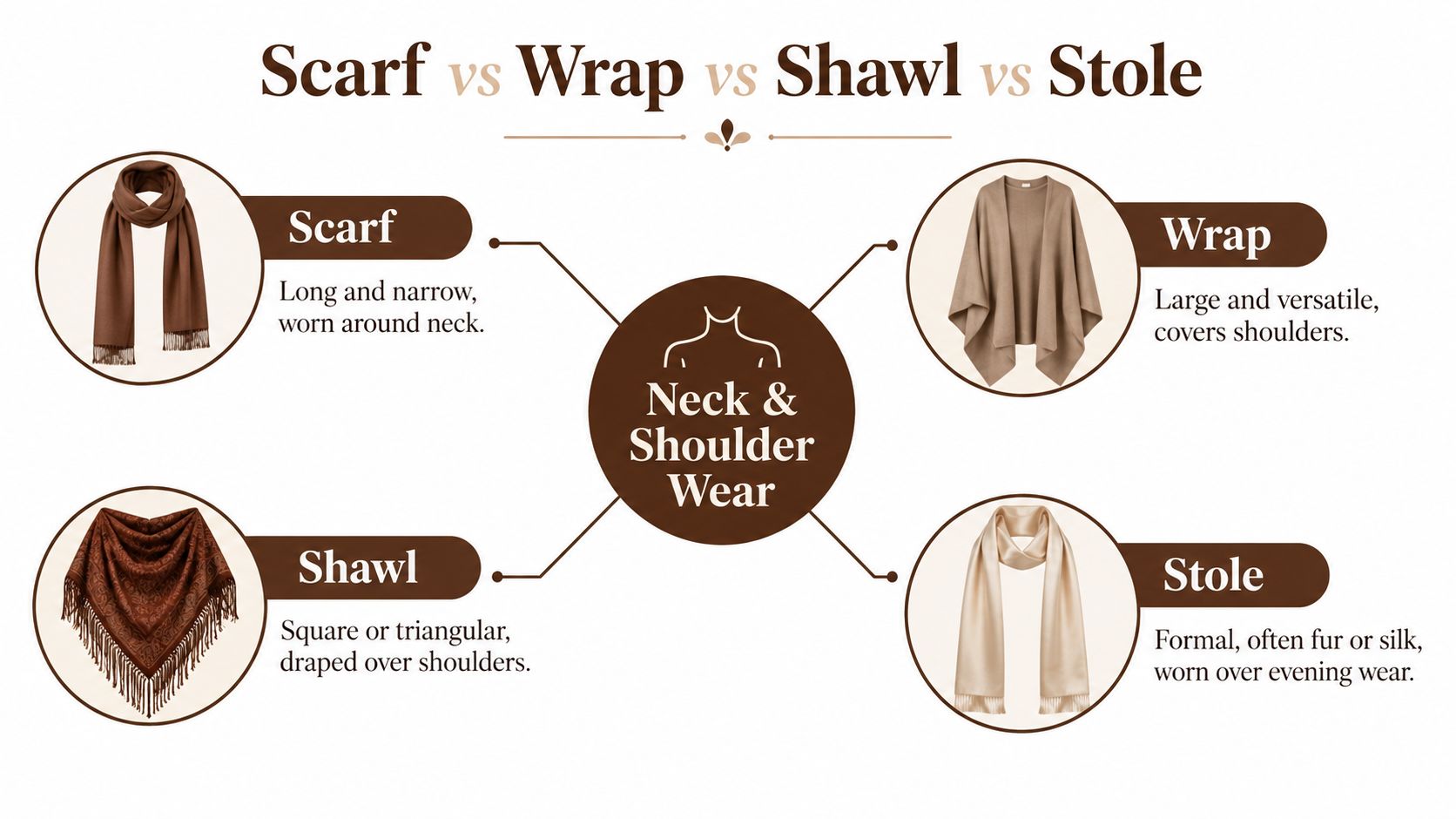
The easiest way to distinguish these accessories is to think about scale and purpose. A scarf is usually the more focused piece, directing attention towards the neck, face, hair or handbag. A wrap is more generous, designed to travel across the shoulders or upper body. A shawl often has a broader square or triangular character, while a stole tends to feel long, elegant and formal.
Match the format to the role
A neck scarf is the precision tool. Fold a silk square into a narrow band and it can sit under a shirt collar, rest loosely over a fine knit or replace a necklace with more movement. It works especially well when the rest of the outfit has clean lines.
A wrap is the flexible layer. Its width allows it to cover the shoulders without looking like a coat, making it useful over office clothing, travel outfits and evening dresses. A soft pashmina wrap can also be folded compactly, which gives it practical value beyond its appearance.
A shawl has greater visual presence. Its square or triangular shape can be draped over both shoulders, gathered at one side or placed across the upper arms. It's ideal when the outfit needs softness, but it can overwhelm a petite frame or a heavily detailed neckline if the fabric is too bulky.
A stole has a more formal mood. Silk or fur-like textures can sit across the shoulders of an evening dress, especially when the rest of the look is deliberately restrained.
Use four questions before buying
Ask yourself:
Where will I wear it? A slim scarf suits work and daytime polish, while a larger wrap is more useful for cold interiors or evening cover.
How much warmth do I need? Lightweight silk offers finish and movement. Wool or pashmina provides more insulation.
What structure does my outfit have? Tailoring usually benefits from a narrow or fluid accessory. A simple dress can carry more volume.
Where should the eye travel? A neck scarf brings attention to the face. A shoulder wrap broadens the upper silhouette and creates a longer vertical line when worn open.
The current luxury direction favours fluid draping, silk headscarves, narrow ribbon scarves and refined blanket-wrap shapes over excessive knotting. Marie Claire's autumn and winter accessories report supports the practical lesson: more fabric doesn't automatically create more elegance. The most refined choice is the one that leaves the outfit room to breathe.
Choosing Luxurious Fabrics and Italian Craftsmanship
Fabric determines how a scarf feels against the skin, how it holds a fold and how useful it becomes in daily life. Two pieces may have a similar colour and shape, yet behave completely differently because one is airy and fluid while the other is dense and insulating.

Understand the main choices
Silk is the polished daytime and evening option. It has natural lustre, a smooth hand and enough movement to make a simple shirt or jacket look intentional. Choose it when you want colour near the face, a refined headscarf, a narrow neck tie or a light bag accent.
Pashmina offers softness and warmth without the visual heaviness of a thick winter accessory. It's particularly useful as a shoulder wrap because it can cover the upper body while retaining an elegant drape. Look for even texture, clean edges and finishing that feels precise rather than loose.
Wool brings structure and resilience. A fine wool scarf can work across seasons, while a heavier weave gives a winter coat a composed, architectural finish. It's the right choice when you want warmth with a stronger outline.
Technical comfort depends on more than fibre names. Research into ladies' scarf comfort identifies air permeability, water-vapour permeability, thermal resistance and moisture management as important fabric variables. The same peer-reviewed work links thermal resistance with construction details such as ends per inch, picks per inch and fabric mass per square metre. Technical research on scarf comfort and fabric construction explains the essential trade-off: a tighter, denser fabric can retain more heat, but may feel less breathable during extended wear.
Fabric choice at a glance for scarves and wraps
Fabric | Warmth and drape | Best for |
|---|---|---|
Silk | Light, fluid and softly luminous | Tailoring, headscarves, neckwear, evening accents |
Pashmina | Warm, soft and generously draped | Shoulder wraps, travel, office layers and evening cover-ups |
Wool | Insulating, durable and more structured | Coats, winter dressing and polished everyday wear |
Read the label carefully. UK textile labelling law restricts terms such as “virgin wool” and “fleece wool” to fibre that is exclusively wool, has not previously been incorporated into a finished product, and hasn't undergone spinning or felting beyond what's required to make the item. UK textile fibre labelling legislation matters because the wording on a hangtag, product page or care label must reflect the legal fibre definition, not a luxurious marketing impression.
Italian craftsmanship is often most visible in the details: a balanced border, a neat rolled edge, a clean selvedge, consistent colour and a drape that feels deliberate. For a broader perspective on understated European refinement, Morellato timeless Italian style offers useful context on how Italian accessories use craftsmanship to support everyday elegance. You can also explore what is made in Italy in the luxury fashion guide when assessing provenance and finishing across a wider wardrobe.
How to Style Your Scarf and Wrap for Every Occasion
The best styling methods are repeatable. You shouldn't need a complicated knot each morning. Start with the outfit's structure, then choose whether the scarf should sharpen it, soften it or add a discreet point of colour.
For work and polished daytime dressing
Begin with a linen shirt, fine jumper or jacket. Fold a lightweight patterned scarf into a narrow band, place it around the neck and tie it loosely rather than pulling it tight. The relaxed line keeps the look modern and prevents the accessory from looking overly formal.
For a tonal version, choose a scarf close to the colour of your blazer or trousers. Place it beneath the collar so only a controlled amount of pattern or sheen shows. Liberty's practical guide recommends loose neck styling with knitwear and denim, tonal use with tailoring, and wearing a scarf under a collar like a neckerchief or tie. Liberty's scarf styling guide also identifies a small, non-bulky scarf as useful for hair styling.
If you're working in a cool office, fold a pashmina lengthwise and place it over both shoulders. Let the ends fall evenly, or bring one end across the body for a softer diagonal. Keep the wrap open at the front if your jacket already has strong lapels.
For daytime events and travel
A silk headscarf gives a simple dress, trench coat or dark knit a composed finish. Fold it into a triangle, place the long edge near the hairline and tie beneath the chin, or fold it into a slimmer band and secure it at the nape. The result feels polished without adding bulk around the neck.
A smaller scarf can also become a handbag detail. Wrap it around one handle, keep the knot neat and let the ends fall at a controlled length. Use this with a structured leather bag and a quiet outfit, where the pattern can act as the colour note.
For travel, choose a wrap that folds easily and doesn't demand constant adjustment. Lewis and Sheron Textiles' blanket advice offers helpful perspective on selecting a substantial textile for comfort and visual quality. The same principle applies to a luxury wrap: softness matters, but so does manageable weight.
For evening and special occasions
Place a silk stole or pashmina wrap over the shoulders of a dress. Keep the front open at first, then allow one side to fall slightly lower for an asymmetric line. If the dress has embellishment, choose a plain wrap. If the dress is minimal, a subtle border or tonal pattern can provide depth.
A long silk scarf can also sharpen tailoring. Vogue's Spring 2026 runway coverage showed an embroidered silk scarf wrapped around the neck with a linen shirt and satin trousers, demonstrating how one fluid accessory can connect relaxed daywear with polished dressing. Vogue's silk scarf outfit ideas supports a useful formula: simple shirt, refined trousers, scarf used as the finishing line.
For cold-weather evenings, an oversized fluffy scarf or snood can be wrapped around the torso and shoulders. Vogue UK's AW24 accessory report presents this as both warmth and a deliberate fashion statement. Vogue UK's accessory trend report makes the proportion lesson clear: reserve generous volume for a relatively simple outfit, and avoid forcing it under a close-fitting coat.
For more detailed knot ideas, use Vivien Lauren's guide to how to tie silk scarves for an effortlessly polished look.
Finding Your Perfect Colours Patterns and Proportions
Colour should earn its place in your wardrobe. A scarf is often close to the face, so its undertone matters more than it would in a shoe or handbag. Hold the fabric near your skin in natural light and notice whether it makes your complexion look rested or flat.
Begin with a useful neutral. Ivory, camel, navy, chocolate, charcoal and soft grey can work as the foundation of a refined collection, but choose the neutrals that already appear in your coats, knitwear and bags. A scarf becomes versatile when it can connect several existing garments, not when it looks beautiful in isolation.
Choose pattern with intention
A quiet wardrobe can welcome a statement print. Wear it with a plain knit, simple shirt or one-colour dress so the pattern has space. If your outfit already contains checks, stripes or strong texture, choose a scarf with a calmer surface or use only a small folded section.
A border print is especially useful because you can control how much design appears. Fold it so the border frames the neck, allow the central motif to show over the shoulder, or tie it to a bag for a smaller accent. This creates several looks from one piece without making the outfit feel busy.
Let scale follow proportion
A slim scarf usually suits a narrow lapel, a high neckline or a close-fitting coat. A larger wrap works better with open necklines, fluid dresses and simple tailoring. If you have a smaller frame, keep bulky layers away from the throat and let a wrap fall vertically rather than gathering it into a thick knot.
The opposite is also helpful. A generous silhouette can carry a broader wrap, while a very delicate accessory may disappear against a substantial coat. The aim isn't to follow a rigid body-type rule. It's to balance the visual weight of the clothing with the scale of the textile.

A practical test: Wear the scarf with three outfits you already own, style it in two different formats, and photograph the result from a distance. If it only works with one look, it's a statement purchase. If it supports several silhouettes, it has stronger wardrobe value.
Current luxury styling favours soft, light draping over bulky knotting. That doesn't mean winter volume has disappeared. It means the most current interpretation uses movement and restraint, allowing a scarf to look elegant rather than overworked. Before buying, check the neckline, sleeve volume, coat shape and the colours you repeat most often. These details will tell you whether a neck scarf, headscarf, shoulder wrap or bag accent is the sensible choice.
Caring for Storing and Protecting Your Investment
Luxury accessories last when care follows the fibre. Read the manufacturer's instructions before washing, especially when silk, pashmina or a blended fabric is involved. If the label recommends professional cleaning, treat that instruction as part of the product rather than an inconvenience.
Silk benefits from gentle handling, cool water where washing is permitted and protection from harsh rubbing. Don't wring it. Press excess moisture between clean towels, reshape it carefully and dry it away from direct heat or strong sunlight. Steam can relax creases, but keep the steamer at a safe distance and test an inconspicuous area first.
Pashmina and wool need a similarly light touch. Avoid aggressive brushing, high heat and repeated washing. A soft fold is usually preferable to a sharp crease, and airing the piece after wear can reduce the need for cleaning. If a woollen scarf begins to feel fuzzy, don't pull at the fibres. Remove surface pills gently with a suitable fabric tool.
Store each textile with its shape in mind
Silk scarves: Fold them loosely in a drawer or box lined with smooth tissue. Avoid rough wood, exposed fastenings and anything that can catch the edge.
Pashmina wraps: Fold them clean and dry, with enough room to breathe. Don't compress them beneath heavy clothing.
Wool scarves: Store them folded rather than on a narrow hanger, which can create stretching or shoulder marks.
Fringed pieces: Keep the fringe straight and separate from jewellery, zips and textured bags.
Colour also needs protection. Keep scarves away from prolonged direct light and store them in a clean, dry place. Before seasonal storage, make sure the item is fully dry and free from perfume or body oils, which can affect delicate fibres over time.
For a wider wardrobe routine, consult Vivien Lauren's luxury fashion care guide for timeless wardrobes. Care labels deserve attention too. Under UK textile labelling rules, terms such as “virgin wool” have a specific fibre meaning, so compare the wording on the product page, hangtag and care label rather than assuming every soft wool-like finish has the same composition.
Smart Buying Gifting and Your Timeless Collection
A thoughtful scarf purchase begins with a role. Decide whether you need a piece for warmth, polish, hair styling, shoulder coverage or handbag detail. Then ask whether one item can serve more than one of those purposes without compromising its appearance.
A fluid silk scarf may move from a shirt collar to a headscarf and then to a bag handle. A pashmina can serve as a shoulder wrap over a dress, a layer in a cool office and a travel companion. A wool scarf can add structure to a coat while remaining useful for everyday winter dressing. This multifunctionality is the foundation of sensible cost-per-wear thinking, even when you're buying a premium material.
Buy for repeatability
Before choosing a colour or pattern, consider:
The clothes it will join. List the coats, jackets and dresses you wear most often.
The formats you'll use. If you dislike complicated knots, favour a shape that drapes beautifully without them.
The season and setting. Silk suits polished lightness, while pashmina and wool offer greater coverage.
The finishing. Check the edge, surface, label, fibre description and overall balance.
The storage you can provide. A delicate item needs a clean, protected place.
For gifting, choose a versatile colour when you don't know the recipient's wardrobe, and consider a pashmina or elegant stole when warmth and occasion dressing both matter. A smaller silk scarf is a graceful choice for a woman who enjoys detail, colour and accessories close to the face. Presentation should feel calm and considered, with the fabric folded carefully rather than tightly compressed.
A small, curated collection will usually serve better than a crowded drawer of impulse purchases. Choose one refined neck scarf, one adaptable shoulder wrap and one winter-weight piece, then add a headscarf or bag accent when your wardrobe calls for it. Italian elegance rests on this sense of editing. Every accessory should make dressing easier, more personal and more beautiful.

Vivien Lauren offers curated women's accessories including artisanal pashmina shawls, elegant stoles and Italian-crafted pieces selected for work, events and everyday dressing. Visit Vivien Lauren to explore refined scarves and wraps that bring graceful drape, practical versatility and European craftsmanship into your wardrobe.
This fashion guide has been authored for you by Shona White. On behalf of Vivien Lauren. Vivien Lauren. Luxury. Craftsmanship. That's Proudly Italian. Vivien Lauren. Proud To Style.

