
Step by Step Fashion Curation: Build Your Ideal Wardrobe

Step by step fashion curation is the structured practice of auditing, editing, and intentionally building a wardrobe that reflects your personal identity with clarity and purpose. Known in professional styling circles as wardrobe curation, this process transforms a closet full of disconnected pieces into a cohesive collection that works for your life. The outcome is not simply a smaller wardrobe. It is a more expressive one, where every piece earns its place and every outfit feels effortless. This guide walks you through each phase, from the initial audit to long-term maintenance, drawing on proven styling frameworks and the principles that define truly elegant dressing.
What is step by step fashion curation?
Fashion curation, at its core, is the deliberate act of selecting, organizing, and maintaining garments that form a unified whole. The process is optimally completed over 4–6 months, moving through distinct phases: auditing what you own, living with the edited result, filling genuine gaps, and refining proportions. That timeline matters because it prevents the impulsive overhaul that leaves you with a wardrobe that looks curated on paper but feels foreign in practice.
Professional stylists describe the goal as building a wardrobe thesis, a cohesive set of garments that converse structurally and texturally, filtered by alignment with a single unifying concept. Think of it as the difference between a gallery that collected art randomly and one that was assembled around a clear aesthetic vision. The former overwhelms; the latter speaks. Your wardrobe should speak.

Vivienlauren’s approach to fashion curation reflects this philosophy precisely, centering on timeless craftsmanship, elegant silhouettes, and pieces made to last rather than to follow a season.
How do you audit and edit your current wardrobe?
The audit is the foundation of the entire styling process. Without an honest assessment of what you currently own, every subsequent decision rests on incomplete information.
The three-pile method
Begin by removing every item from your closet and placing it on a flat surface. Then sort everything into three piles using the three-pile method: keep, quarantine, and donate. The quarantine pile is the most powerful tool in this process. Items placed there are stored out of sight for 90 days. If you do not reach for them once during that period, the decision to release them becomes obvious.
Apply ruthless criteria to each piece:
Fit: Does it fit your body right now, not the body you plan to have?
Wear: Have you worn it in the past 12 months?
Relevance: Does it align with how you actually live and dress today?
Compatibility: Does it work with at least three other pieces you already own?
Identifying your anchor pieces
Once the keep pile is settled, identify your 3–5 anchor pieces. These are your most-loved, best-fitting garments, the ones you reach for instinctively. They define your wardrobe’s DNA and guide every future acquisition. A beautifully cut Italian wool coat, a silk blouse in a perfect neutral, a tailored trouser with an immaculate drape. These anchors are your reference points.
Pro Tip: After completing your audit, resist purchasing anything for 2–4 weeks. Living with your edited collection clarifies which gaps are genuine needs versus fleeting desires triggered by the excitement of the process.
How do you define your personal style thesis and wardrobe modules?
A wardrobe thesis is your personal style constitution. It defines the fabrics you favor, the silhouettes that flatter you, the color palette that feels like yours, and the lifestyle functions your wardrobe must serve. Without it, shopping becomes reactive. With it, every decision has a filter.
Building your color palette
Select two to three core neutrals as your foundation. Classic choices include ivory, camel, navy, and charcoal. Then choose one to two accent colors that appear in smaller doses, perhaps a deep burgundy or a warm terracotta. Finally, decide on a pattern strategy: whether you prefer clean solids, subtle textures, or occasional prints. Consistency here is what makes a wardrobe feel considered rather than assembled by chance.


The modular wardrobe framework
A modular framework maximizes outfit possibilities without requiring a rigid item count. Consider this example:
Module | Items | Outfit combinations |
Bottoms | 2 trousers | 6+ combinations |
Tops | 3 blouses or knits | Varies by layering |
Outerwear | 1 coat or jacket | Multiplies all looks |
Shoes | 1 versatile pair | Anchors every outfit |
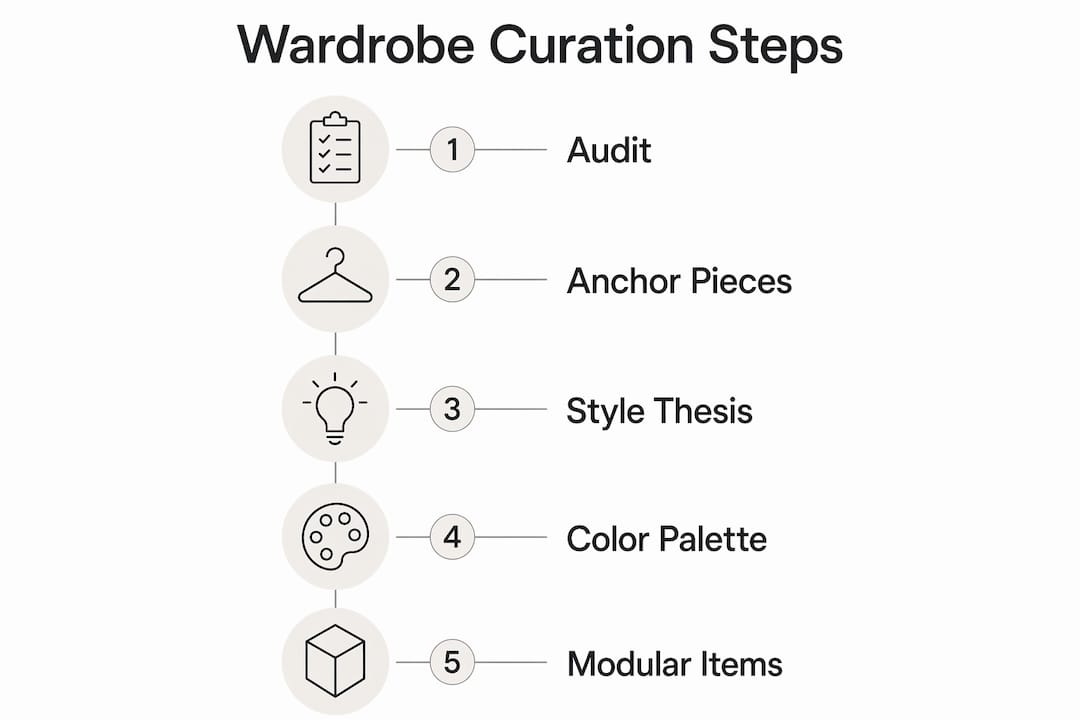
Two trousers, three tops, one outerwear piece, and one shoe can yield six or more distinct outfit combinations. That number grows significantly when you add a second shoe or a layering piece. The minimalist wardrobe principle is not about deprivation. It is about multiplication.
Use inspiration boards, whether physical or digital, to visualize how your palette and silhouettes interact. Prioritize quality materials and construction above all. A garment made with exquisite craftsmanship, like the handcrafted Italian pieces Vivienlauren carries, will outlast ten trend-driven alternatives and retain its elegance across seasons.
How do you build outfit formulas and shop intentionally?
Outfit formulas are repeatable combinations that remove daily decision fatigue. Once you identify three to five reliable formulas from your anchor pieces and modules, getting dressed becomes a pleasure rather than a puzzle.
A classic formula might be: tailored trouser + silk blouse + structured coat + leather loafer. Another: midi skirt + fine-knit sweater + ankle boot. These formulas are not rigid. They are starting points that you adapt with accessories, layering, or color swaps.
The five-way test for new purchases
Before any new piece enters your wardrobe, apply the five-way test:
Bottoms test: Does it pair with at least two bottoms you already own?
Layering test: Can it be layered over or under existing pieces?
Shoes test: Do at least two pairs of your current shoes work with it?
Lifestyle test: Does it suit the actual occasions you dress for?
Care test: Can you maintain it properly given your routine?
An item that fails two or more of these tests is not a gap filler. It is a future regret.

Shopping with a ranked list
Organize your shopping list into three tiers: need now, need later, and nice someday. Prioritize the first tier exclusively until those gaps are filled. This discipline prevents the common trap of buying aspirational pieces before the wardrobe foundation is solid. Thinking in outfits when evaluating new purchases ensures that each addition multiplies your existing combinations rather than creating an isolated piece with no natural partners.
Pro Tip: Integrate new pieces gradually. Wear each new acquisition with existing items for at least one week before purchasing anything else. This reveals whether the piece truly belongs or simply seemed appealing in isolation.
How do you maintain and evolve your curated wardrobe over time?
A curated wardrobe is not a finished project. It is a living collection that requires regular editing at least twice yearly to stay aligned with your evolving lifestyle and aesthetic preferences. Schedule these reviews at the seasonal transitions, in early spring and early fall, when your lifestyle needs naturally shift.
During each review, ask:
Has my body, lifestyle, or aesthetic shifted since the last review?
Which pieces did I reach for constantly, and which were untouched?
Are there proportions or silhouettes that no longer feel right?
Have any pieces degraded in quality and need replacing?
Storage and digitization
Store off-season pieces separately to keep your active wardrobe clear and visually coherent. Digitizing your wardrobe with a dedicated app enhances your ability to visualize color compatibility and test outfit combinations without physically pulling everything out. This is particularly useful when planning for travel or special occasions.
Conscious consumption has become central to personal style curation, shifting focus away from trend chasing and toward authenticity. The most enduring wardrobes are built slowly, with intention, and reflect the woman wearing them rather than the season she is dressing for.
Avoid the two most common pitfalls: impulse purchases triggered by sales or social media, and over-accumulation driven by the belief that more options equal more versatility. They do not. Coherence creates versatility. Quantity dilutes it. A sustainable shopping workflow keeps both impulses in check.
Key Takeaways
Effective wardrobe curation requires a structured, phased process built around anchor pieces, a personal style thesis, and disciplined intentional shopping.
Point | Details |
Audit before you buy | Use the three-pile method and identify 3–5 anchor pieces before acquiring anything new. |
Define your wardrobe thesis | Establish your palette, silhouettes, and lifestyle needs to filter every future purchase. |
Apply the five-way test | Every new piece must pair with existing bottoms, layers, and shoes to earn its place. |
Review twice yearly | Schedule wardrobe audits each spring and fall to maintain cohesion as your life evolves. |
Prioritize quality over quantity | One exquisite, well-constructed piece creates more outfit options than five mediocre ones. |
Why patience is the most underrated styling tool
I have watched women spend considerable sums rebuilding their wardrobes in a single weekend, only to feel the same dissatisfaction six months later. The wardrobe looked curated in photographs but felt hollow in practice, because it was assembled in a rush rather than grown with intention.
What I have come to believe, after years of thinking deeply about elegant dressing, is that the most beautiful wardrobes are not bought. They are cultivated. The women whose style I admire most are not the ones who own the most. They are the ones who know exactly what they own and why. Every piece in their closet has a story, a purpose, and a clear relationship to everything else.
Luxury fashion, at its finest, is not about trend cycles. The timeless pieces that hold their elegance across decades share one quality: they were chosen with clarity. A beautifully constructed Italian dress does not need a trend to justify it. It justifies itself through its fabric, its cut, and the confidence it lends the woman wearing it.
The waiting period after an audit, those 2–4 weeks of living with less, is not a punishment. It is a clarifying gift. You learn what you actually miss and what you simply thought you needed. That distinction is the heart of genuine curation.
My honest advice: resist the urge to complete your wardrobe quickly. A wardrobe that took three years to build with care will serve you for thirty. One assembled in a weekend will need rebuilding by spring.
— Vivien Lauren.
Vivien Lauren’s curated collections for the intentional dresser
Vivien Lauren was built on the belief that a woman’s wardrobe deserves the same care and intention that goes into the garments themselves. Every piece in Vivienlauren’s collections is handcrafted in Italy, shaped by generations of artisanal expertise, and designed to anchor a wardrobe rather than simply fill it. From elegant occasion dresses in refined silhouettes to Italian leather bags that serve as enduring statement pieces, each item is selected to complement a thoughtful, personalized wardrobe. Browse the full Vivien Lauren collection and find the anchor pieces your curated wardrobe has been waiting for.
FAQ
What is the first step in fashion curation?
The first step is a full wardrobe audit using the three-pile method: keep, quarantine, and donate. Identifying your 3–5 anchor pieces during this audit gives you the foundation for every decision that follows.
How long does it take to build a curated wardrobe?
A well-curated wardrobe takes 4–6 months to build properly, moving through auditing, living with the edited collection, filling gaps, and refining proportions. Rushing the process leads to purchases that do not integrate well.
How many items should a curated wardrobe contain?
There is no fixed number. A modular framework with 2 trousers, 3 tops, 1 outerwear piece, and 1 shoe can already generate 6 or more outfit combinations. The goal is coherence and versatility, not a specific item count.
How do you avoid impulse purchases when curating your wardrobe?
Apply the five-way test to every potential purchase and maintain a ranked shopping list divided into need now, need later, and nice someday. A 2–4 week waiting period after your audit also prevents trend-driven or emotionally driven buying.
How often should you review a curated wardrobe?
Review your wardrobe at least twice yearly, ideally at the spring and fall seasonal transitions. Regular editing keeps your collection aligned with your evolving lifestyle, body, and aesthetic preferences.
Remember you can look absolutely powerful and fabulous whilst carrying the unapologetically feminine aesthetic and silhouette.
Recommended
This fashion guide has been authored and brought to you by Shona White. For Vivien Lauren. Vivien Lauren. Luxury. Craftsmanship That's Proudly Italian. Vivien Lauren. Proud To Style.
