
Convert UK to EU Shoe Sizes: Add 33, Then Measure in cm

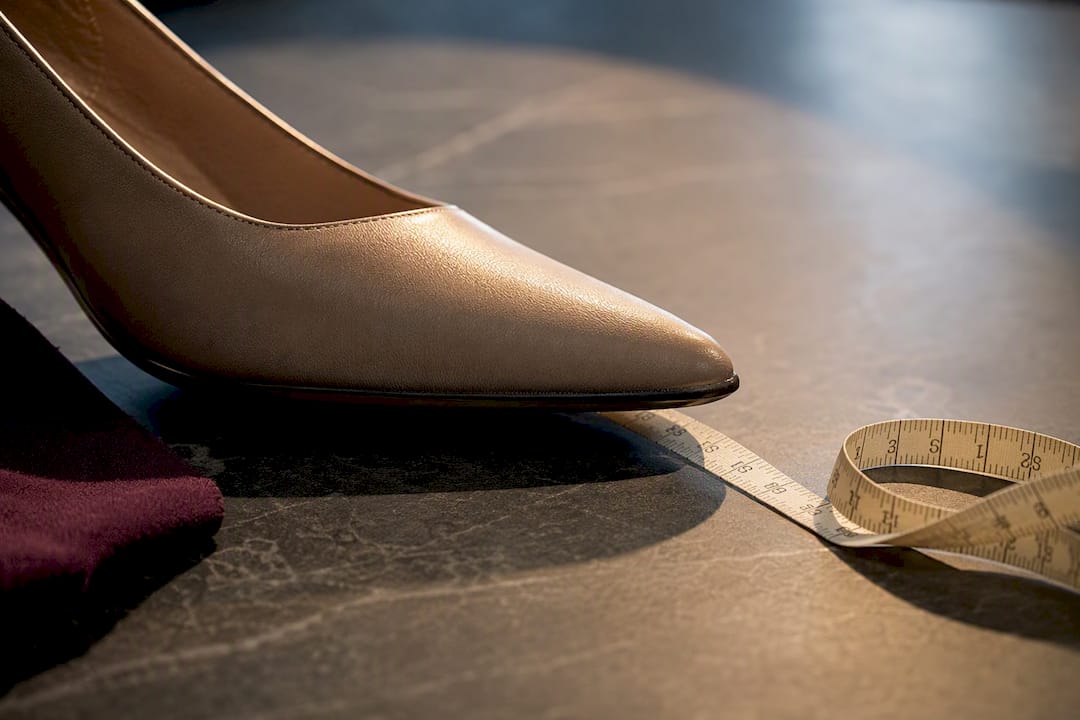
The shorthand that works most of the time: EU = UK + 33, so a UK 6 becomes an EU 39. Treat that as your starting point, not your final answer, because it’s an approximation that brands stretch and shrink to their own liking. The one figure that never lies is your foot length in centimeters, measured heel to toe. Charts and a proper measuring routine follow below.
I don't how these researched methods work, because I fit in UK5, but tend to take EU 39. But this all depends on the particular cut. Different designers tend to have different fit on shoes, some are cut small. You would require a size larger for good fit, some are cut wider and larger, you would fit just right. At Vivien Lauren. Our stylists tend to try on each shoe and then add a recommendation for each shoe on how you should choose sizes. So always be on the look out for recommendations on whether the shoe fits just right, or it's a small cut, buy one size larger, an so on. You will find this info on the informative details of the shoe usually appearing on the pull down descrptive menus on right side of the product page. Always measure your foot, then follow the recommendations. When I buy online, I tend to buy two sizes at times if I am not certain as usually, then return one. The trick is to never walk on hard floors with the new shoes you are trying on. Walk on a floor rug or carpet, this way you do not damage the sole, leaving the shoe in perfect condition should you choose to return it.
Researched perspectives on conversion. This is what exists in open literature.
Shoe sizes vary by brand, and conversions based on UK + 33 for EU are approximate; always measure your foot in centimeters for accuracy.
Measuring heel to toe in centimeters and matching that to size charts ensures a better fit than relying solely on numbered conversions.
Different shoe styles and lasts, especially in handcrafted Italian footwear, can cause size discrepancies even within the same EU or UK size.
For optimal comfort, consider the shoe’s width, style-specific fit notes, and whether to size up or down based on the fit description.
Always verify product measurements and fit notes before purchasing, and use the brand’s internal length measurements rather than general conversion formulas.
Table of Contents
What Is the UK to EU Shoe Size Conversion?
The formula every conversion chart leans on is simple: add 33 to your UK size to land on the equivalent EU size. For example, a UK 5 generally corresponds to an EU size around 38, and a UK 7 roughly to an EU size near 40. This shorthand, widely cited as the standard conversion approach, gets you close enough for casual browsing, but “close enough” isn’t the standard we hold ourselves to when you’re choosing a pair of handcrafted Italian heels you can’t try on before they arrive.
Here are the numbers that matter, laid out for women, men, and children, with the heel-to-toe centimeter measurement alongside each size, because that centimeter figure is the one number a proprietary last can’t argue with.
Women’s UK to EU shoe size chart
Men’s UK to EU shoe size chart
Children’s UK to EU shoe size chart
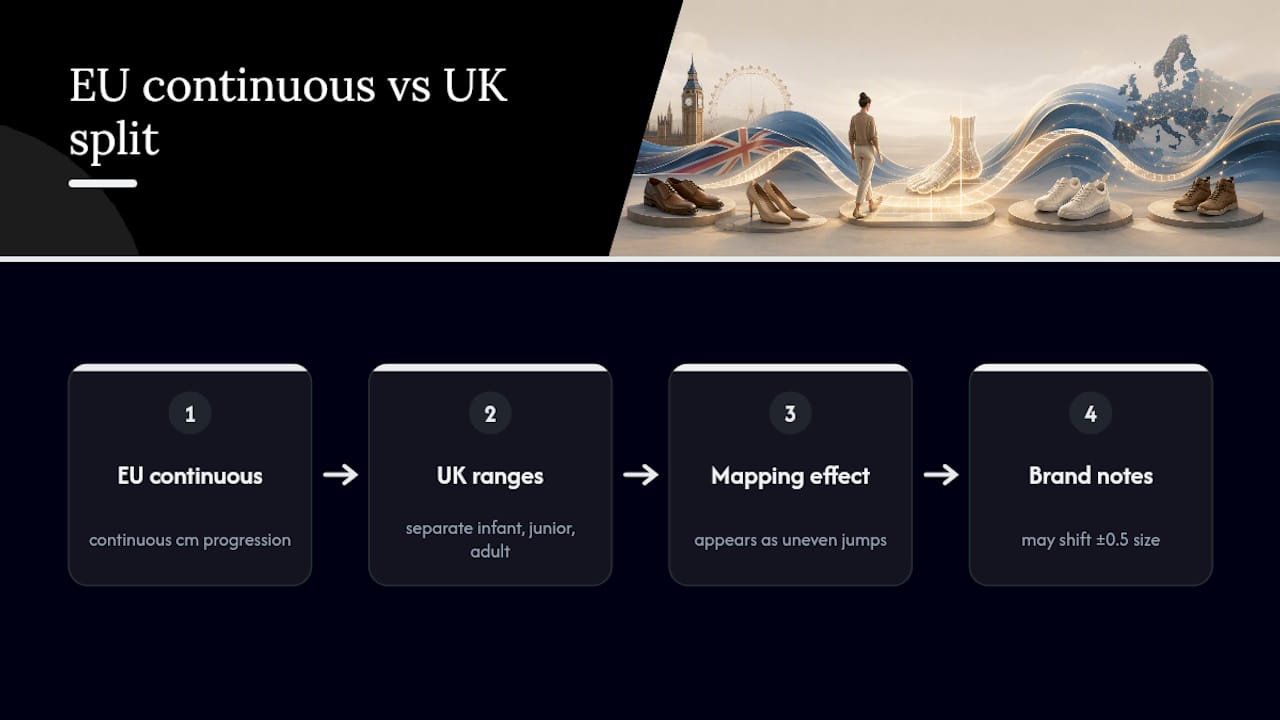
Children’s sizing runs on a genuinely continuous EU scale from infant through adult, while the UK splits it into separate infant, junior, and adult ranges. That’s why a child’s size jump can look uneven on paper even though the actual growth in foot length is perfectly steady, a quirk conversion chart specialists flag often. Treat every one of these numbers as a starting point. Brand-specific charts, especially for boots, pointed courts, or anything with a narrow vamp, can shift the equivalent EU size by half a size in either direction.
How Do I Measure My Foot for the Right EU Size?
Skip the guesswork and measure properly, it takes two minutes and saves you a return shipment.
Stand on a sheet of paper, barefoot, with your full weight on your foot, the way you’d stand in a shoe rather than perched on tiptoe.
Trace the outline of your foot with a pencil held straight up and down, not at an angle.
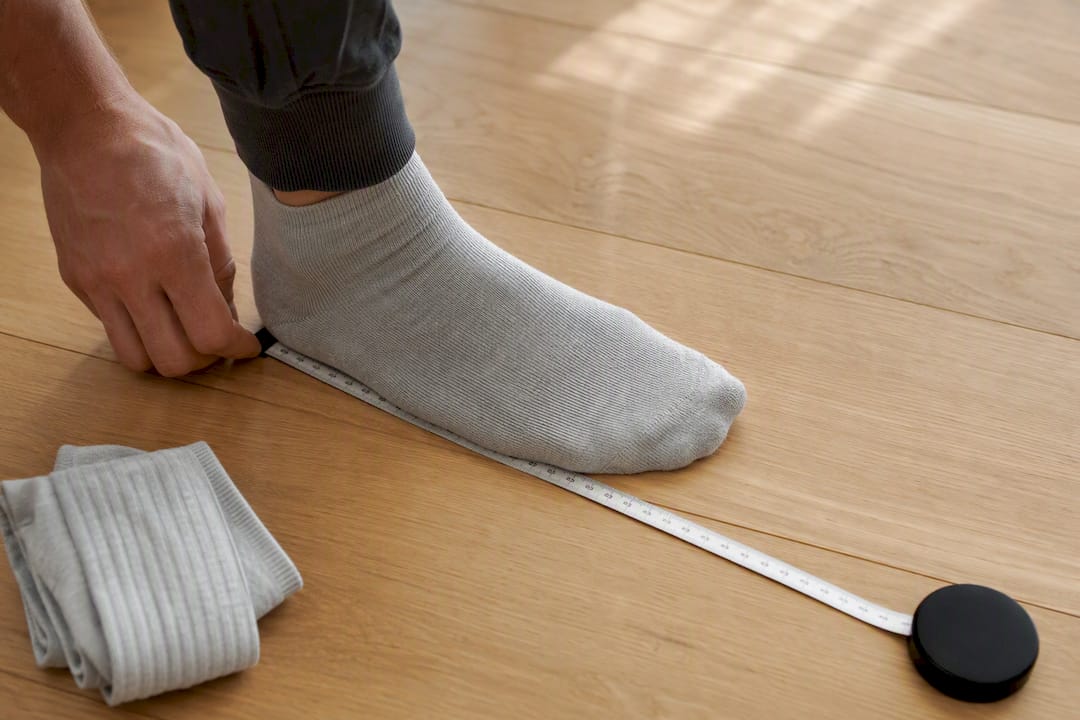
Measure the longest distance from your heel to the tip of your longest toe, in centimeters.
Repeat for both feet, most people have a slight difference, and always size to the larger measurement.
Match that centimeter figure to the chart above rather than to your usual UK number.
If your measurement lands between two sizes, round up. A snug shoe with no give will hurt within an hour; a slightly loose one is fixable with an insole. Before you check out, look for three things on the product page: the internal length in centimeters, any “true to size” or “runs narrow” note from the brand, and the UK returns window, so you know exactly how long you have to send it back if the fit is off.
Pro Tip: Measure your feet again if it’s been over a year since you last checked. Feet lengthen gradually with age, and a size that fit perfectly two years ago may now leave you half a size short.
Why Don’t UK and EU Sizes Line Up Exactly?
The mismatch isn’t sloppiness, it’s arithmetic. The UK system is built on the barleycorn, an old English unit equal to a third of an inch, while the EU’s Paris point measures two-thirds of a centimeter. Neither increment divides evenly into the other, which means any UK-to-EU formula is rounding by design, not by accident.
The Paris point and the barleycorn were never meant to translate cleanly into one another. One is rooted in imperial fractions of an inch, the other in metric fractions of a centimeter, and that structural mismatch is baked into every conversion chart you’ll ever see.
That’s the technical explanation behind how shoe sizing systems actually work, and it’s worth sitting with for a moment, because it explains something shoppers often blame on inconsistent brands when it’s really just inconsistent math. Layer manufacturer lasts on top of that, the actual three-dimensional mold a shoe is built around, and you get further drift. A pointed-toe last and a rounded almond-toe last can both claim to be “EU 39” and fit two entirely different feet. Handcrafted Italian shoemaking, where lasts are often proprietary and passed down through generations of the same workshop, makes this variability more pronounced, not less. Experts consistently advise measuring in centimeters over trusting a formula, because the centimeter figure maps directly to the internal last length, while a size number is only ever a label.
Fit Tips for Buying Premium Shoes Online
A pointed-toe court shoe fits differently than a loafer, and a loafer fits differently than a boot with a structured shaft. Pointed styles need a touch of room at the toe box even when the length is technically correct, because the narrowing shape compresses your foot forward. Boots and closed pumps, by contrast, often benefit from sizing true or even slightly snug, since leather relaxes and molds with wear.
A few things worth building into your shopping habit:
Check whether the listing mentions width, not just length; a narrow last on a wide foot is the most common cause of a bad fit.
Keep a thin leather insole on hand if a beautifully made pair runs a touch generous rather than sizing down and losing the intended silhouette.
Read the product description for phrasing like “true to size,” “narrow fit,” or “roomy vamp,” these are the manufacturer’s own hints about how the last behaves.
When two sizes seem plausible, reach out to customer service before you order rather than after you’ve already opened the box.
Pro Tip: For handcrafted styles with a fitted vamp, size up if you’re between measurements. A slightly roomy toe box is a quick insole fix; a tight one is not.
Finding Your Fit With Vivien Lauren
Getting the fit right on a handcrafted pair matters more to me than almost anything else in this business, because an exquisite shoe that pinches is a wasted piece of craftsmanship. Our Luxury Shoe Fit Guide walks you through exactly how our Italian lasts run, since handmade lasts can shift half a size from the generic charts above. Every product page carries its own fit notes for precisely that reason.
— Vivien Lauren.
Shop With Confidence: Vivien Lauren’s Fit-First Approach
Vivien Lauren is the alternative to guessing your way through an unfamiliar EU size chart: every pair in our shoe collection carries its own measurements and fit notes drawn from the actual Italian last it’s built on, not a generic conversion formula.

Our craftsmen have refined these over generations, and that heritage shows in details a mass-market chart could never capture, the curve of a mule, the give of a soft leather flat like our leather mule shoes. Every product page states the internal length in centimeters, alongside notes on whether that particular style runs true, narrow, or roomy. And if the fit still isn’t right once the box arrives, our UK returns and exchange policy gives you room to send it back without a fight. Browse the current collection and check the measurements listed on any pair that catches your eye before you check out.

Sources
FAQ
Is a UK 6 a 39 or 40 in EU sizing?
A UK 6 most commonly converts to an EU size near 39 using the standard EU = UK + 33 formula, though some brands list it slightly differently or round it to adjacent sizes. Check the chart above and measure in centimeters if you’re between sizes.
Is a UK 9 a 43 or 44?
For men’s sizing, UK 9 typically converts to EU size around 43. Some European brands list nearby sizes, so a heel-to-toe measurement close to 27 cm is your most reliable check.
Is a UK 10 a 44 or a 45?
UK 10 generally lines up with EU size near 44, corresponding roughly to a 28 cm heel-to-toe length. Some brands may size it slightly larger, especially for wider or sportier shoes.
What is EU 38 in UK sizing?
EU size around 38 corresponds roughly to a UK 5 for women, matching a foot length near 23 cm. If your measurement is just above that, consider sizing up rather than squeezing into a snug fit.
Recommended
This piece on shoe size fit and guide has been researched and authored for you by Nancy. On behalf of Vivien Lauren. Vivien Lauren. Luxury. Craftsmanship. That's Proudly Italian. Vivien Lauren. Proud To Style.

