
Tradition's Role in Modern Fashion: Heritage Meets Style

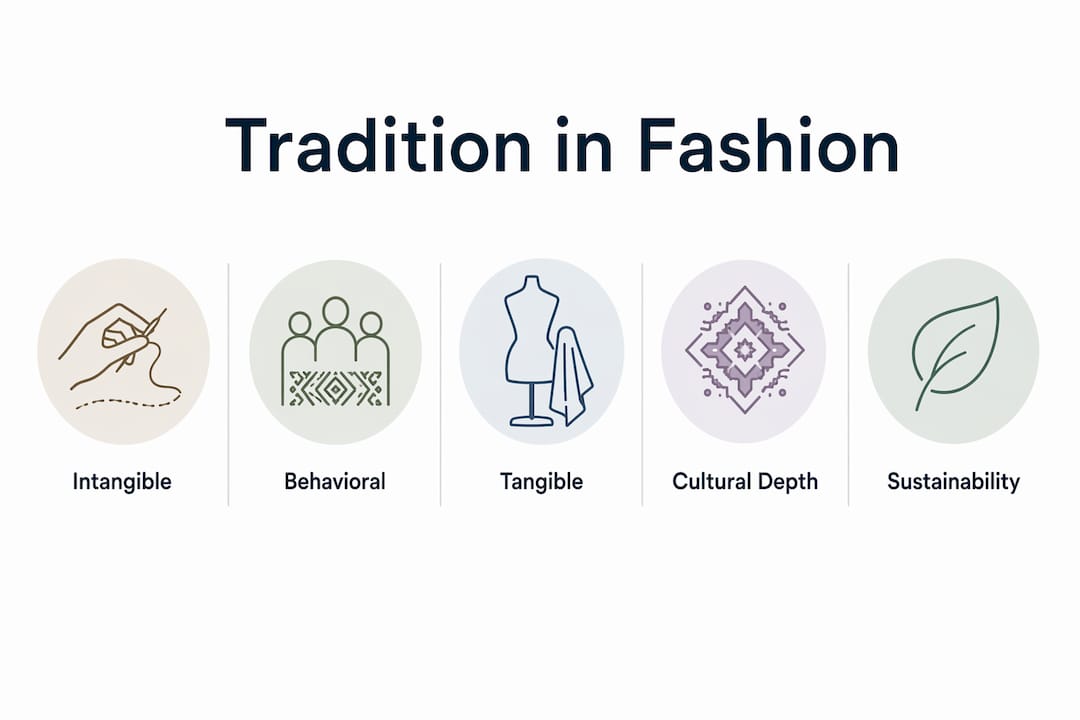
Tradition in modern fashion is not a relic preserved behind glass. It is a living force, woven into the silhouettes, textiles, and symbolic languages of the most celebrated collections in the world today. At its most elemental, tradition functions across three interconnected levels: the intangible, encompassing cultural symbols, heritage narratives, and emotional memory; the behavioral, expressed through craftsmanship, artisanal technique, and the rituals of making; and the tangible, manifest in textiles, color, silhouette, and decorative motifs. Together, these dimensions give modern fashion its depth, its soul, and, increasingly, its sustainability credentials.

For the woman who dresses with intention, tradition is not nostalgia. It is a source of meaning, a design philosophy, and a quiet declaration of identity. Consider what tradition offers contemporary fashion:
Cultural grounding: Heritage motifs and textiles carry stories that transcend seasonal trends.
Sustainability: Traditional craftsmanship techniques often require fewer materials and enable more efficient, multifunctional production.
Identity expression: Wearing tradition signals belonging, continuity, and personal values.
Design inspiration: Centuries of accumulated aesthetic wisdom give designers a vocabulary no trend cycle can replicate.
Emotional resonance: Garments rooted in heritage carry an intimacy and weight that purely commercial fashion rarely achieves.
This is the foundation from which all the richness below unfolds.
Table of Contents
How tradition shapes modern attire through cultural significance
Traditional fashion is never merely decorative. Every embroidered border, every hand-woven textile, every silhouette drawn from a specific cultural moment carries a narrative identity, reflecting the origins, values, and social structures of the community that created it. When a contemporary designer reaches into that archive, they are not simply borrowing an aesthetic. They are engaging with a living cultural system.
The cultural resilience of traditional attire within modern fashion has been documented across multiple cultures and markets. Designers from Lagos to Milan have demonstrated that heritage motifs, when treated with genuine understanding, do not dilute a collection’s modernity. They deepen it. West African kente cloth appearing in luxury ready-to-wear, Japanese shibori dyeing techniques applied to contemporary silk blouses, or the geometric embroideries of Central Asian textiles reinterpreted in structured evening wear, all of these speak to fashion’s capacity to carry cultural meaning forward without freezing it in time.
The cultural functions that traditional fashion serves within contemporary contexts include:
Fostering belonging: Garments that reference shared heritage create an immediate sense of community among wearers.
Maintaining continuity: Fashion becomes a thread connecting generations, allowing younger consumers to inhabit their cultural inheritance in a modern register.
Communicating values: Handcrafted textiles signal a commitment to quality, patience, and respect for the maker’s skill.
Challenging homogenization: In a global market that can flatten difference, tradition asserts the irreducible particularity of place and people.
This is precisely why fashion heritage matters for women who seek more than a passing trend. A garment that carries cultural meaning ages beautifully, because its value was never purely seasonal.
How modern fashion incorporates traditional elements practically
The integration of tradition into contemporary design is rarely accidental. It follows deliberate strategies, each operating at a different level of the creative process.
At the behavioral level, craftsmanship is the primary vehicle. Techniques passed down across generations, including hand-weaving, intricate embroidery, lacework, and natural dyeing, translate traditional cultural languages into modern communicative forms. A hand-embroidered bodice on a contemporary dress is not simply ornamental. It is a record of skill, time, and cultural knowledge made wearable.

At the intangible level, designers work with symbols and narratives. A collection might draw on the mythology of a specific region, the color symbolism of a ceremonial textile tradition, or the geometric grammar of an ancient craft. Simone Rocha’s AW23 collection offers a compelling illustration: her use of raffia weaving and seasonal rituals connected the collection to folkloric tradition while remaining unmistakably contemporary in silhouette and styling.
At the tangible level, the practical incorporation of tradition appears in:
Silhouettes drawn from historical dress forms, recut in modern proportions.
Traditional textiles, such as brocade, jacquard, or hand-dyed silk, used as the primary fabric in otherwise minimal designs.
Decorative motifs, embroidery, beading, or appliqué, applied to modern garments as focal points rather than all-over pattern.
Color palettes derived from regional dyeing traditions, giving a collection a cultural specificity that synthetic color stories cannot replicate.
The numbered steps through which designers typically move when incorporating tradition are:
Research the source culture with genuine depth, consulting artisans, historians, and community representatives.
Identify the element’s function within its original context, whether ceremonial, everyday, or symbolic.
Translate, not transplant: adapt the element to a modern silhouette or construction method rather than reproducing it wholesale.
Collaborate with artisans from the source tradition wherever possible, ensuring that the craft knowledge and economic benefit remain connected to its origin.
Contextualize the collection through storytelling, so that the cultural reference is legible and respected rather than decorative noise.
This process is what separates genuine cultural engagement from superficial borrowing, and it is the standard that the most admired houses in luxury fashion hold themselves to.
How to mix traditional fashion elements with modern trends in your own wardrobe
Blending heritage and contemporary style in personal dress is one of the most rewarding forms of self-expression available to a fashion-conscious woman. The key is proportion and intentionality.
Lead with one traditional element per look. A hand-embroidered blouse paired with tailored modern trousers allows the heritage piece to speak without competing with itself.
Use traditional textiles as the anchor. A brocade skirt, a hand-woven scarf, or a silk piece in a regional print grounds an otherwise contemporary outfit in something richer and more particular.
Balance heritage motifs with clean modern silhouettes. Intricate pattern or decoration reads most powerfully against simplicity. A heavily embroidered jacket over a minimal dress is a study in elegant contrast.
Invest in traditional accessories. A handcrafted leather bag, a silk scarf with a regional motif, or artisan jewelry can introduce cultural heritage into any look without requiring a complete wardrobe overhaul.
Research before you wear. Younger urban consumers who blend local cultural symbols with global fashion trends do so most successfully when they understand the meaning behind what they are wearing.
The question of cultural appropriation deserves honest attention here. The distinction between appreciation and appropriation turns on depth of engagement, attribution, and economic relationship. Wearing a garment that references another culture’s tradition becomes problematic when it reduces a living heritage to costume, when it profits from a community’s creative labor without acknowledgment, or when it is worn in a context that trivializes its original significance. The solution is not avoidance but genuine curiosity: learn the story, credit the source, and where possible, purchase directly from artisans within that tradition.
Pro Tip: When shopping for heritage-inspired pieces, look for brands that name their artisan partners and describe the specific craft tradition they are drawing from. That transparency is the clearest signal of genuine engagement rather than surface-level aesthetic borrowing.
What research and expert perspectives reveal about tradition in fashion
The three-level analytical model of tradition in fashion design, spanning intangible, behavioral, and tangible dimensions, is among the most rigorous frameworks scholars have developed for understanding how cultural heritage operates within contemporary collections. Its central finding is that fashion functions as a living cultural system, one in which tradition is dynamically reinterpreted in relation to contemporary values, social behaviors, and environmental challenges rather than simply preserved or discarded.
Heritage’s role in luxury fashion has been studied with particular attention to French fashion houses, where archives and founding values serve as both creative fuel and competitive differentiation. As one analysis of the heritage-creativity interplay in these houses demonstrates, heritage is not a static relic but a dynamic resource, one that enables brands to build identity and reinvent tradition with the technical mastery of the present moment.
The recent folkloric turn in contemporary fashion, exemplified by designers who draw on seasonal rituals, regional craft techniques, and community-based making practices, reflects a broader cultural shift. Consumers, particularly those who invest in luxury and slow fashion, are increasingly drawn to garments that carry a legible story. The slow fashion movement and traditional craftsmanship are natural allies: both resist disposability, both honor the time and skill embedded in a finished piece, and both offer an alternative to the accelerated churn of trend-driven production.
At Vivienlauren, this philosophy is not theoretical. The collections draw on Italian craftsmanship passed down across generations, where the behavioral and tangible levels of tradition converge in every hand-finished seam and every textile chosen for its quality and longevity rather than its novelty.
Why preserving cultural heritage through fashion matters
Fashion’s capacity to preserve cultural heritage is more democratic than it might first appear. Unlike museum conservation or academic documentation, fashion allows living communities to inhabit and adapt their traditions in real time, wearing them into new social contexts rather than sealing them away.
The case of Gaucho traditionalist culture in southern Brazil illustrates this with particular clarity. Research into that community found that contemporary fashion producers and consumers embraced modern gaucho clothing as a mechanism for tradition preservation, one that allowed heritage to adjust to changing social roles, including evolving gender patterns, without losing its bond with local identity. The finding challenges any rigid conception of tradition as fixed or fragile. Tradition, in this reading, is resilient precisely because it can be worn differently by each generation.
Successful traditional-modern fashion collaborations tend to share several characteristics:
Artisan partnership: The collaboration involves makers from within the source tradition, not merely designers inspired by it from the outside.
Narrative transparency: The collection’s cultural references are named and explained, giving consumers the context to appreciate what they are wearing.
Adaptive design: Traditional elements are reinterpreted for contemporary silhouettes and social occasions, making heritage wearable rather than ceremonial.
Community benefit: Economic value flows back to the artisan community, sustaining the craft tradition that made the collaboration possible.
The history of luxury fashion is, in many ways, a history of exactly this kind of adaptive preservation. The houses that have endured across centuries are those that understood tradition not as a constraint but as a creative inheritance, one to be honored, questioned, and renewed.
How globalization has reshaped traditional fashion
Globalization has done two contradictory things to traditional fashion simultaneously. It has accelerated the spread of heritage aesthetics across international markets, making once-local craft traditions visible and desirable to consumers worldwide. And it has created the conditions under which those same traditions can be flattened, decontextualized, or absorbed into a homogenized global aesthetic that strips them of their original meaning.

The cross-cultural exchange that globalization enables has produced genuinely hybrid styles, collections that blend elements from multiple traditions in ways that reflect the actual complexity of contemporary identity. Social media has accelerated this process dramatically, making regional craft traditions visible to international audiences almost instantly and creating new markets for artisan-made goods that might otherwise have remained purely local.
Yet the comparative study of Western and Eastern fashion trends reveals a persistent tension. Western fashion tends toward individualism and trend-driven cycles, while Eastern fashion traditions tend to emphasize handcrafted heritage and collective cultural identity. Neither orientation is superior, but understanding the distinction matters enormously for brands seeking to resonate across both markets. The influence of culture on fashion at a global level requires brands to hold both registers simultaneously: the universal appeal of quality and beauty, and the particular resonance of cultural specificity.
What globalization has also done, perhaps most valuably, is surface the hybrid origins of traditional designs themselves. Authentic traditional styles are rarely the product of a single, fixed cultural moment. They reflect centuries of exchange, migration, trade, and creative borrowing. Acknowledging this complexity does not diminish tradition. It makes the conversation about cultural heritage in design more honest, and ultimately more productive.
The role of traditional craftsmanship in fashion remains one of the most compelling responses to globalization’s homogenizing pressures. When a garment is made by hand, using techniques specific to a place and a lineage of makers, it carries a particularity that no algorithm can replicate and no fast-fashion supply chain can reproduce at scale.
Vivien Lauren’s curated collections embody exactly this conviction. Each piece in the women’s apparel collection draws on Italian artisanal heritage, where craftsmanship is not a marketing claim but a generational practice. From the handcrafted leather accessories to the elegantly constructed dresses, every item reflects the belief that the most beautiful things a woman can wear are those made with time, skill, and cultural intention.

Key Takeaways
Tradition enriches modern fashion by providing cultural depth, sustainability principles, and aesthetic foundations that no trend cycle can replicate or replace.
Point | Details |
Three levels of tradition | Heritage operates at intangible, behavioral, and tangible levels, each shaping contemporary design differently. |
Craftsmanship and sustainability | Traditional techniques often require fewer textile variants, supporting more efficient and sustainable production. |
Cultural identity in dress | Wearing heritage-rooted garments expresses belonging, continuity, and personal values beyond seasonal aesthetics. |
Globalization’s dual effect | Cross-cultural exchange spreads heritage aesthetics globally while also risking the decontextualization of their meaning. |
Artisan collaboration | The most successful traditional-modern fusions involve makers from within the source tradition and transparent storytelling. |
FAQ
What is the role of tradition in modern fashion?
Tradition provides modern fashion with cultural meaning, design vocabulary, and sustainability principles by operating across intangible symbols, behavioral craftsmanship, and tangible textiles. It gives contemporary garments depth and identity that purely trend-driven design cannot achieve.
Why does traditional fashion matter in contemporary culture?
Traditional fashion preserves cultural identity and community belonging while adapting to changing social roles, making heritage accessible and wearable across generations rather than confining it to museums or ceremonial contexts.
How do traditional values shape what people wear today?
Traditional values, including respect for craftsmanship, material quality, and cultural continuity, influence consumers who seek garments with legible stories and lasting relevance rather than disposable seasonal novelty.
How does globalization affect traditional fashion?
Globalization simultaneously spreads heritage aesthetics to international audiences and risks flattening their cultural specificity. The most thoughtful designers and brands navigate this by collaborating with artisans from within source traditions and contextualizing their cultural references transparently.
What is the difference between cultural appreciation and appropriation in fashion?
Cultural appreciation involves genuine research, artisan collaboration, attribution, and economic benefit flowing back to the source community. Appropriation reduces a living heritage to surface decoration without acknowledgment, context, or reciprocity.
Recommended
This fashion piece has been researched and put together for you by Chloe. On behalf of Vivien Lauren. Vivien Lauren. Luxury. Craftsmanship. That's Proudly Italian. Vivien Lauren. Proud To Style.

