
Shoe Lasts: Why Your Size Varies and How to Shop Luxury Women's Shoes
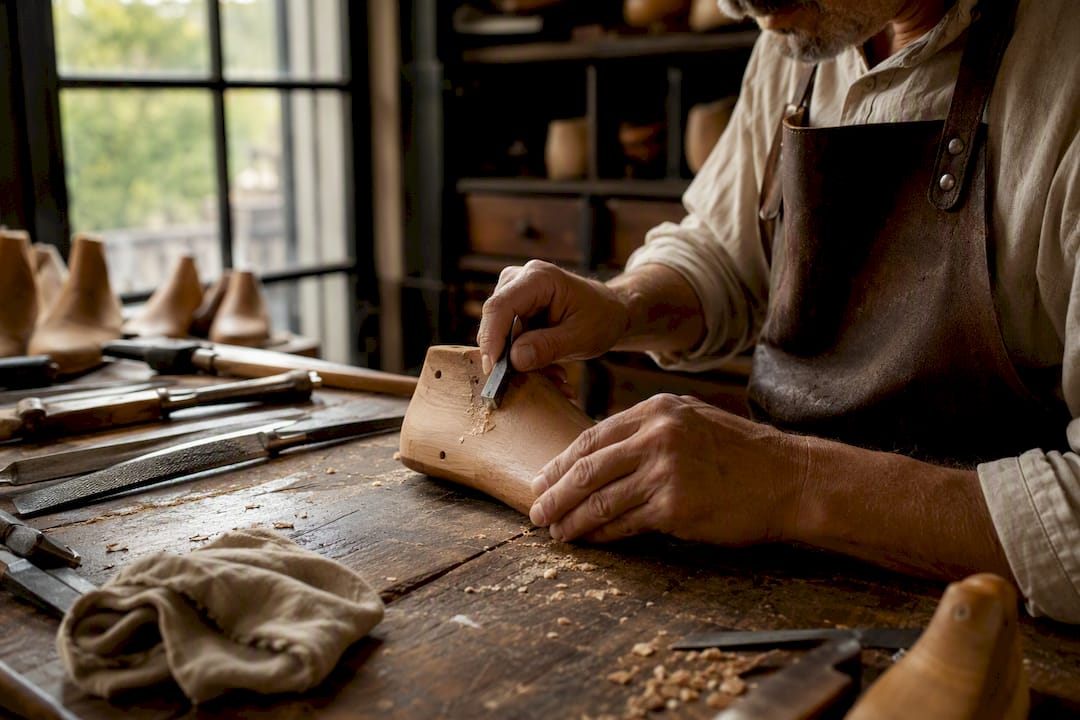
A shoe last is a solid, foot-shaped form used as the foundational mold in shoemaking, and it determines nearly everything about how a shoe fits and looks. Every measurement that matters, toe shape, heel pitch, ball girth, instep height, and overall silhouette, traces back to this single wooden or plastic form. Understanding the last is the surest way to understand why one size feels entirely different from brand to brand, and why the finest women’s shoes feel like an extension of the foot rather than a container for it.
The making of Shoes:

The fit of a shoe depends heavily on the last’s specific measurements, such as ball girth, instep height, and toe shape, rather than the size label alone.
Mass-produced lasts are mainly made from high-density plastics for durability and efficiency, while bespoke lasts are carved from hardwoods to allow hand adjustments.
Different brands may use multiple lasts for the same size, meaning shoe sizes cannot be universally transferred between brands or styles.
Modern technology like CAD and 3D scanning now complement traditional craftsmanship, speeding up production while maintaining the last’s ergonomic and aesthetic qualities.
Carefully choosing styles with different toe shapes from the same brand can help identify how their lasts influence fit, especially if sizes fit differently across styles.
Table of Contents
What a Shoe Last Actually Does in Design and Manufacturing
Shoemakers often call the last the heart of the shoe, and it earns that title. During what the trade calls “lasting,” the leather upper is stretched and tacked over the last, the insole is fixed to its base, and the sole is attached beneath. Every subsequent step, from stitching to finishing, happens around this form. Remove the last afterward, and the shoe holds its shape because the leather has been trained, quite literally, to remember it.
The shoe last comes first in the design process, before a single pattern is cut or a hide is chosen, because it is the mechanical, foot-shaped form that defines internal volume, toe shape, arch support, and heel pitch before anything else is decided.
Several defining traits of a finished shoe originate entirely from the last:
The pointed, round, or square shape of the toe box
How wide or narrow the shoe sits across the ball of the foot
The angle at which the heel meets the ground, known as heel pitch
The overall stance and posture the shoe gives the wearer
The word itself has surprisingly old roots. It descends from an Old English term for “footprint” or “track,” and historical evidence points to lasts being used in early shoemaking across ancient civilizations, long before the word “shoe” carried its modern meaning. The tool predates the industry’s vocabulary for it.
Key Parts and Measurements of a Last
Once you know what to look for, a last reads almost like a technical drawing of a shoe’s future fit. A handful of measurements govern how a finished pair will feel on your foot, and none of them are visible once the shoe is complete.
Ball girth, the circumference around the widest part of the foot, controls how snug the shoe feels across the forefoot.
Toe spring, the slight upward curve at the tip, affects how naturally the shoe rolls with each step.
Instep height determines how much room exists over the top of the foot, which is why some shoes feel tight even when the length is correct.
Heel pitch sets the angle of the heel seat, shaping posture and stability.
Waist refers to the narrower midsection of the last, beneath the arch, which influences how closely the shoe hugs that part of the foot.
Here is the detail most shoppers never learn: two shoes marked the same size can fit completely differently, because sizing is applied to a last’s specific length and girth points rather than any single universal standard. A size 38 built on a narrow Italian last and a size 38 built on a fuller last from another maker are, functionally, two different shapes wearing the same label. That is why a reliable shoe fit guide matters more than the number on the box.
Materials and How Lasts Get Made at Scale
Material choice separates the bespoke world from mass manufacturing, and the difference isn’t cosmetic—bulk used shoes suppliers often influence material sourcing in large-scale production. It’s structural.
Bespoke and artisanal lasts are typically carved from hardwoods, hornbeam being a favorite among European makers, because wood absorbs moisture from the leather during lasting, holds a carved shape with precision, and can be sanded and adjusted by hand as a fit is refined. Mass production, by contrast, runs almost entirely on high-density plastics, which resist warping, withstand repeated use in automated lasting machines, and hold dimensional accuracy across thousands of cycles.
The scale involved is easy to underestimate:
Some large European last factories produce a very high volume of plastic last pairs daily.
Specialist manufacturers maintain extensive archives covering a vast number of last models over many years.
Plastic lasts are engineered with hinges and wedge systems so machines can insert and extract them quickly during high-volume runs. This production approach documented by specialist manufacturers who build entire lines around block molding and finishing.
Wood remains preferred wherever hand adjustment matters more than throughput, which is precisely why fine leather craftsmanship, the kind found in handcrafted leather goods, still leans on carved forms rather than molded ones.
Types and Shapes of Lasts: Stock, Bespoke, and Style Families
Not every last serves the same purpose, and the distinction between stock and bespoke shapes explains most of the fit variation you’ll notice across brands.
Stock lasts are pre-made, standardized forms that brands use across an entire size range. They’re organized into families with small, incremental changes in length, ball girth, and instep, which lets a brand grade sizes up and down while keeping the same silhouette intact.
Bespoke lasts are carved for one individual’s foot, often after careful measurement or a plaster cast, and exist solely to serve that one customer. They represent the opposite end of the spectrum from a factory archive of millions.
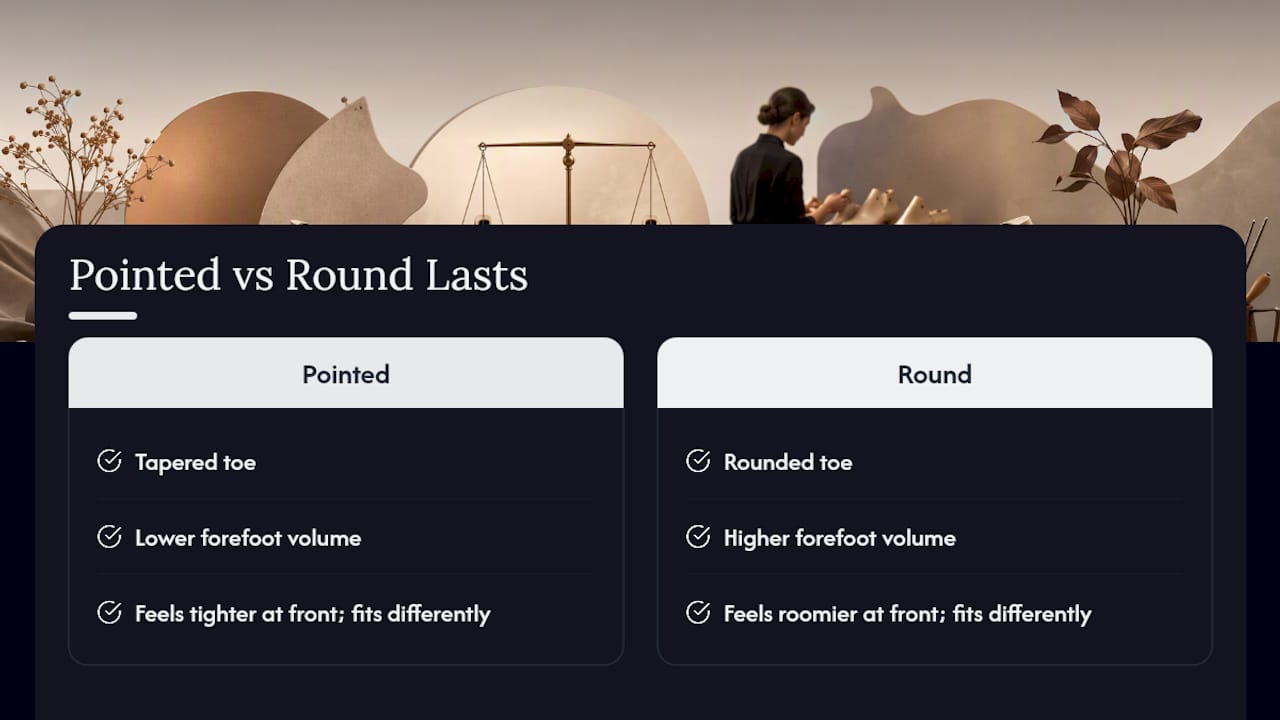
Pointed and narrow lasts create the elongated, elegant toe line associated with formal and evening wear, favoring silhouette over roominess.
Round and full lasts prioritize comfort and everyday we arability, giving the toes more lateral space.
Square lasts sit between the two, offering a modern, structured line that has become popular in contemporary flats and loafers.
Whichever family a maker chooses, that decision drives the entire upper pattern. Designers cut leather to match the last’s curves, not the other way around, which means the last is really the origin point of the design, not a manufacturing afterthought.
Why Lasts Matter for Fit, Sizing, and Quality Control
Here’s the practical truth every shoe shopper should internalize: the last is the real source of fit, and the size label is secondary. Two pairs from the same brand, built on different lasts for different style lines, can fit noticeably differently even when both say “size 39.” A pointed pump last and a round flat last from the same label rarely share the same internal volume.

Brands rely on lasts for repeatability precisely because they need every pair in a production run to match the sample that was approved. Last choice affects far more than comfort. It shapes tooling design, how much leather a pattern consumes, and how consistently quality control can catch defects, since last selection carries real business consequences well beyond the wearer’s experience.
For shoppers, a few habits make a real difference:
Pay attention to how a brand’s narrow-toe styles fit you versus their round-toe styles. They are likely built on entirely different lasts.
Don’t assume your size from one brand transfers cleanly to another, even within the same category, like office-appropriate leather shoes.
If a shoe fits well through the ball but feels tight at the instep, the issue is usually the last’s instep height, not your foot.
How Lasts Are Made Today: Craft Meets CAD
The romantic image of a last carved entirely by hand still exists, but it now shares the workshop with digital tools. Master model makers remain essential in luxury footwear because they translate an aesthetic vision, the specific curve of a toe, the precise lift of a heel, into a technical form that machines alone cannot originate. Craftsmanship and modern technology now work in tandem, with skilled modelers still setting the final artistic and ergonomic decisions even inside highly automated factories.
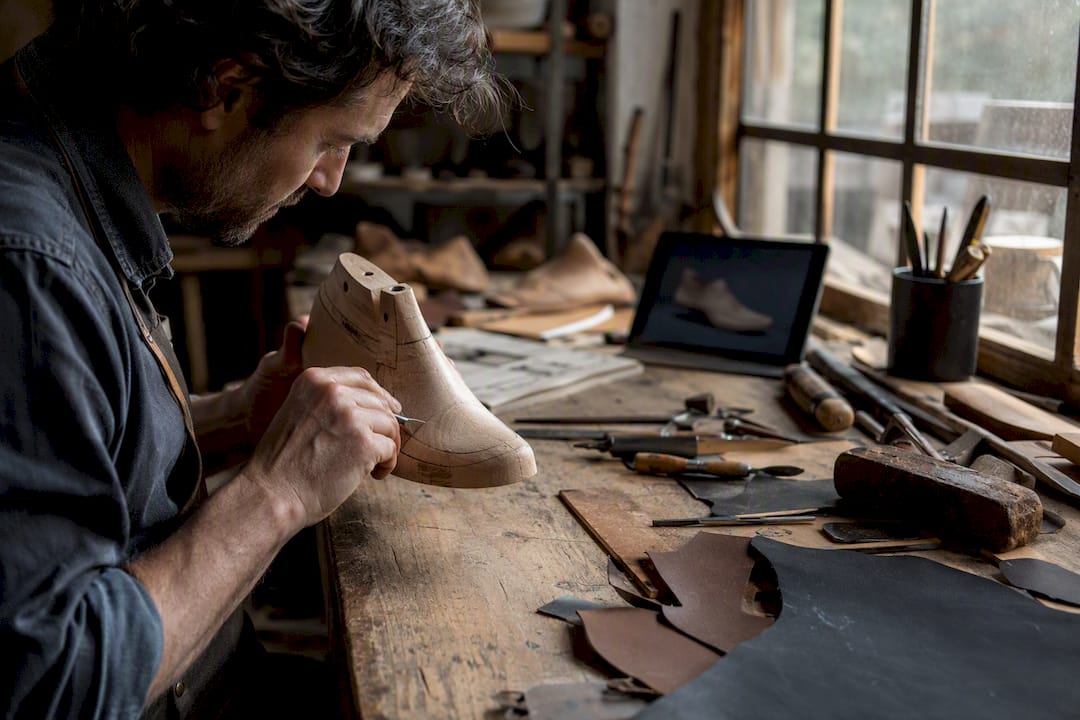
CAD software and 3D scanning have transformed how quickly that vision becomes production ready. A last is never a literal cast of a human foot; it’s an idealized form that compensates for how leather stretches and how weight shifts during walking. Modern workflows combine model making with CAD and 3D measurement to translate those anatomical judgments into files that can be milled, adjusted, and archived digitally, dramatically speeding up sampling while preserving a brand’s signature silhouette across seasons.
The contrast at the two ends of the industry is stark. A bespoke last might take a skilled carver days of shaping and hand sanding to finish. A plastic last destined for a mass run gets milled to CAD specifications and molded for durability across thousands of production cycles.
Pro Tip: When trying on a new shoe brand for the first time, test both a pointed style and a round-toe style before deciding your size. If they fit differently, you’ve just discovered the brand uses more than one last family, and your “true size” may not be a single number at all.
Why Last Craftsmanship Shapes Every Vivien Lauren Shoe Choice
When we at Vivien Lauren evaluate footwear for our collections, we start where the shoemakers do: with the last. A silhouette can be beautiful on a sketch and still disappoint on the foot if the underlying form wasn’t shaped with genuine care. We look for evidence of thoughtful lasting, balanced heel pitch, generous but elegant toe volume, and construction that respects how leather behaves over time. Our golden heel shoes reflect exactly this philosophy: a silhouette engineered for both drama and comfort, never one sacrificed for the other.
— Vivien Lauren.
Explore our full shoe collection to see how thoughtful lasting translates into elegant, wearable design, or browse Vivien Lauren for the complete range, including shoes handcrafted from Luxury Italian Leather, Luxury handbags, and timeless accessories that share this same commitment to considered form.
Sources
FAQ
Why Is It Called a Shoe Last?
The word comes from an Old English term related to “footprint” or “track,” reflecting its original purpose as a foot-shaped tracing tool used by early shoemakers long before modern shoemaking vocabulary existed.
Why Is a Cobbler’s Last Called a Last?
Cobblers adopted the term because the wooden form represented the “track” or shape their work followed, a naming convention that stuck through centuries of hand shoemaking and carried into today’s factories.
What Does “Last” Mean in Shoemaking Slang?
In shoemaking, “last” simply refers to the solid foot-shaped mold used to build a shoe. It has no connection to the everyday meaning of “final” or “previous.”
How Do I Choose the Right Shoe Last for Fitting?
Focus on ball girth, instep height, and toe shape rather than the size label alone, since sizing applies to a last’s specific measurements rather than a universal scale across brands.
Are Italian Shoe Lasts Different From Other Countries?
Italian lasts are known for narrower waists and more elongated toe shapes, a style choice tied to a long tradition of hand-carved model making rather than a strict manufacturing standard.

Recommended
This fashion piece on how shoes are made, has been written for you by Sammy Li. On behalf of Vivien Lauren. Vivien Lauren. Luxury. Craftsmanship. That's Proudly Italian. Vivien Lauren. Proud To Style.

