
How French Fashion Shaped Global Style Through the Ages

French fashion has been the primary architect of several enduring global style norms, operating through three interlocking forces: institutionalized haute couture, exportable aesthetics codified by legendary maisons, and persistent diffusion networks spanning press, trade, and digital media.
The mechanisms that carried Parisian taste across borders were never accidental:
Institutional infrastructure: The Chambre Syndicale de la Haute Couture, Paris Fashion Week, and legal protections for couture design created a regulated, prestigious system that other cities could admire but not easily replicate.
Press and celebrity amplification: French Vogue (founded 1920), international fashion photography, and film transformed runway silhouettes into aspirational images consumed worldwide.
Trade, licensing, and export networks: Licensing agreements allowed maisons like Christian Dior and Yves Saint Laurent to seed their aesthetics into mass-market ready-to-wear across Europe, the Americas, and Asia.
Digital and social media: Instagram, TikTok, and influencer culture now accelerate what fashion seasons once did slowly, yet Paris Fashion Week retains its position as the calendar’s most-watched event.
Today, that influence persists through luxury conglomerates LVMH and Kering, whose combined portfolios encompass dozens of French and international maisons, and through the crossover of couture sensibility into streetwear and prêt-à-porter collections that reach every price point on the planet.
Key Takeaways
French fashion’s global authority was built not on creative genius alone but on a durable combination of institutional infrastructure, deliberate cultural branding, and exportable aesthetic principles that translated across markets and centuries.
Point | Details |
Couture’s institutional foundation | The Chambre Syndicale (founded 1868) and Paris Fashion Week created a regulated prestige system no other city has replicated. |
Cosmopolitan origins | Key innovators like Worth (English) and Balenciaga (Spanish) show that “French fashion” was always an international creative project centered on Paris. |
Measurable diffusion | GeoStyle’s analysis of 7.7 million images confirms Paris as a central node in global visual style networks. |
Art-commerce negotiation | The shift from couture to prêt-à-porter was a strategic adaptation, not a retreat, allowing maisons to scale revenue while protecting prestige. |
Craft as enduring principle | Fit, proportion, and investment in quality remain the practical legacy of French fashion for any wardrobe, at any price point. |
Table of Contents
What institutions gave Paris its lasting structural advantage?
How did French style actually travel from Paris to the world?
How does Paris compare to London, Milan, New York, and Tokyo?
How can you apply French fashion principles to your own wardrobe?
Why French fashion’s legacy matters more than you might think
What does ‘French fashion’ actually mean?
The phrase covers three distinct but overlapping modes of production, each with its own aesthetic logic and commercial structure.
Haute couture is the most legally precise category. In France, the term is protected by the Chambre Syndicale: a house must employ a minimum number of full-time atelier workers, produce a set number of original looks per season, and present them to the press in Paris. The result is clothing made almost entirely by hand, fitted to an individual client, and priced accordingly. You can explore the technical depth of this practice in Vivienlauren’s guide to couture craftsmanship, which traces how atelier techniques translate into wearable luxury.
Maison traditions sit slightly broader. A maison is a fashion house with a named founder, a recognizable aesthetic signature, and a heritage that outlives its originator. Chanel, Dior, Balenciaga, and Givenchy are all maisons; their identity is as much about accumulated cultural meaning as about any single garment.
Prêt-à-porter (ready-to-wear) democratized the maison aesthetic from the 1960s onward, offering seasonal collections at accessible price points without the bespoke fitting of couture. This is the mode through which most people actually encounter French fashion influence.
The core aesthetic principles that unite all three modes are worth naming precisely:
Proportion and cut over surface decoration: French tailoring prizes how a garment moves with the body, not how much embellishment it carries.
La Parisienne ideal: an archetype of studied nonchalance, where effort is invisible and elegance appears effortless.
Craft and atelier values: even in ready-to-wear, the best French-influenced pieces carry evidence of skilled construction, from French seams to hand-finished buttonholes.
Restraint as sophistication: understatement is not absence of thought; it is the highest form of considered dressing.
Pro Tip: To translate French fashion principles into your own wardrobe, start with fit. A single well-cut dress or jacket in a neutral tone will carry more authority than a rack of trend-driven pieces. Invest in one exquisite garment per season rather than several mediocre ones.

How did French fashion build its global authority?
The story begins well before the first runway show. Louis XIV and his finance minister Jean-Baptiste Colbert deliberately positioned French luxury goods, including textiles and dress, as instruments of economic and diplomatic power in the 17th century. Colbert’s protectionist policies nurtured the silk weavers of Lyon and the lacemakers of Alençon, creating a supply chain of extraordinary craft that would underpin couture for the next three centuries. Museum scholarship and FIT exhibition materials confirm that Versailles-era patronage was among the earliest engines of fashion’s economic and cultural value in France.
The milestones that followed built on that foundation with remarkable consistency:
1858: Charles Frederick Worth opens his house on the Rue de la Paix, becoming the first designer to show seasonal collections to buyers and to sew his own name label into garments. Modern haute couture traces to the 1860s, and Worth’s atelier is the origin point.
1868: The Chambre Syndicale de la Haute Couture is founded, formalizing the rules of couture and giving Paris a trade body that would regulate and protect its prestige for over 150 years.
1910s–1920s: Gabrielle “Coco” Chanel dismantles the corset silhouette, introduces jersey fabric to womenswear, and redefines femininity as active and unencumbered.
1920: French Vogue launches, giving Paris a dedicated press organ that codifies seasonal trends and distributes them to an international readership.
1947: Christian Dior’s “New Look” collection reintroduces nipped waists and full skirts after wartime austerity, triggering a global conversation about femininity and luxury that reaches every fashion capital within months.
1960s: Yves Saint Laurent introduces Le Smoking (the women’s tuxedo suit) and launches Rive Gauche, his prêt-à-porter line, signaling that couture values could travel into ready-to-wear without losing their authority.
1973: The “Battle of Versailles” fashion show pits five French houses against five American designers, a cultural moment that crystallizes the Paris–New York dynamic and introduces American sportswear to a European audience.
1980s–1990s: Paris Fashion Week becomes the global calendar’s most prestigious event; Japanese designers Yohji Yamamoto and Rei Kawakubo show in Paris, confirming the city’s cosmopolitan character.
1987: LVMH is formed, beginning the consolidation of French maisons under corporate ownership and creating the financial architecture that sustains couture in the 21st century.
2000s–present: Digital media and social platforms extend Paris’s seasonal influence into a year-round global conversation, while sustainability pressures reshape production models across all French houses.
Era | Milestone | Significance |
1660s | Colbert’s luxury trade policies | State-backed supply chain for textiles and craft |
1858 | Worth opens on Rue de la Paix | First couture house; seasonal collections formalized |
1868 | Chambre Syndicale founded | Regulatory body protecting couture’s legal status |
1920 | French Vogue launches | Press organ codifying and exporting Parisian taste |
1947 | Dior’s New Look | Postwar silhouette reset; global media coverage |
1966 | YSL’s Rive Gauche opens | Couture values enter ready-to-wear at scale |
1973 | Battle of Versailles | Paris–New York dynamic crystallized on one stage |
1987 | LVMH formation | Corporate consolidation sustains maison heritage |
Which designers set the templates the world still follows?
The maisons that shaped global style did so not by accident but through specific, exportable innovations. What made each contribution travel was its capacity to solve a universal problem of dress, whether that was comfort, modernity, femininity, or power.
Charles Frederick Worth (1825–1895) was English by birth, a fact that the H-France Salon scholarship uses to argue that “French fashion” was always a cosmopolitan, hybrid construct rather than a purely national one. Worth invented the seasonal collection, the fashion show as a commercial event, and the designer label. Every system that followed, from prêt-à-porter to fast fashion, descends from his model.
Gabrielle “Coco” Chanel (1883–1971) is perhaps the single most consequential figure in 20th-century womenswear. The Chanel suit, the little black dress, the quilted 2.55 bag, and the use of jersey in tailored garments each addressed a real need: women wanted to move, work, and live without architectural undergarments. Her aesthetic traveled because it was functional as much as beautiful. Licensing agreements carried the Chanel name into perfume (No. 5, launched 1921) and accessories long before the house became the global luxury brand it is today.
Christian Dior (1905–1957) understood that fashion could be an act of cultural restoration. His 1947 New Look arrived when Europe was exhausted and fabric-rationed; the full skirt and cinched waist were a deliberate statement of abundance and femininity. The collection generated immediate controversy in the UK and US, where women’s groups protested the return of restrictive silhouettes, yet department stores from London to Buenos Aires placed orders within the season. Vivienlauren’s dedicated piece on Dior’s influence on modern refinement traces how that single collection reshaped postwar fashion’s vocabulary.
Yves Saint Laurent (1936–2008) democratized couture’s authority. Le Smoking (1966) gave women a garment previously reserved for men and made it more powerful, not less feminine. His Mondrian dress (1965) proved that fine art and fashion could share a visual language. The Rive Gauche ready-to-wear line, launched the same year, was the first deliberate move by a couture house to reach a broader audience without diluting its prestige.
Hubert de Givenchy (1927–2018) built his reputation on a particular kind of aristocratic restraint. His collaboration with Audrey Hepburn, most visibly the black dress in Breakfast at Tiffany’s (1961), demonstrated how couture could become a cultural symbol through film. That dress is now among the most recognized garments in cinema history, and its influence on occasion dressing persists in every little black dress sold today.
Cristóbal Balenciaga (1895–1972) was Spanish, another reminder of couture’s cosmopolitan workforce. His architectural approach to construction, the sack dress, the cocoon coat, the balloon hem, challenged the body-conscious silhouettes of his contemporaries and anticipated the structural experimentation that defines much contemporary fashion. Fashion historians consistently describe him as the designer’s designer, the one whose technical mastery commanded the deepest respect from peers.
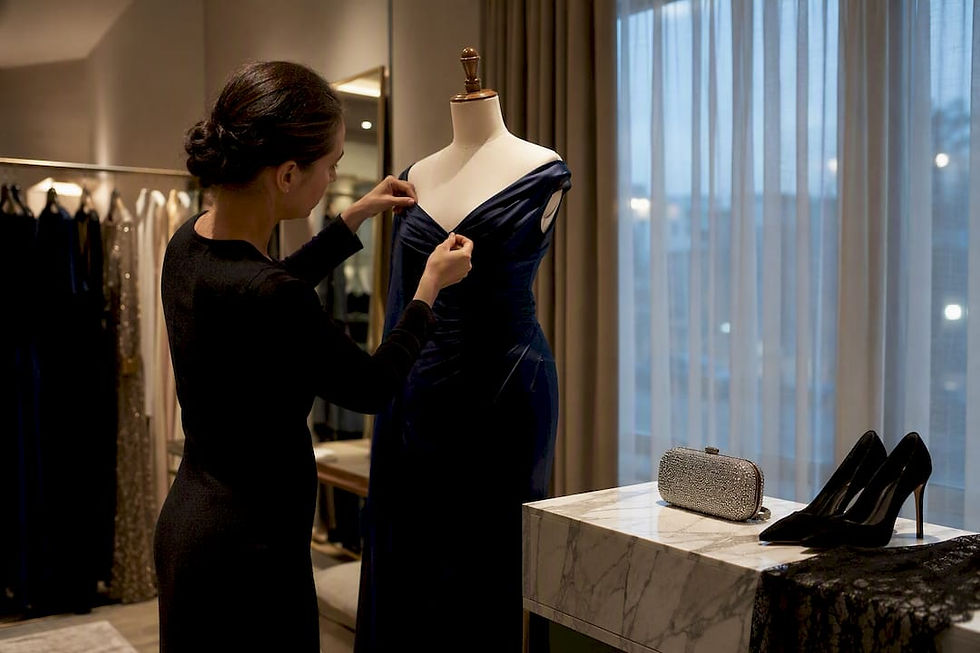
The pattern across all six is clear: each designer solved a problem of dress in a way that was both culturally specific and universally legible, and each used Paris as the platform from which that solution reached the world.
What institutions gave Paris its lasting structural advantage?
Creative genius alone does not sustain a century of global influence. Paris’s durability rested on a set of non-design structures that amplified, protected, and exported its aesthetic authority.
The Chambre Syndicale de la Haute Couture is the most important of these. Founded in 1868, it sets the legal criteria for what may be called haute couture, controls access to Paris Fashion Week’s official calendar, and lobbies for intellectual property protections against copying. Its membership list is a register of the world’s most prestigious fashion houses. You can read more about how these legal protections work in Vivienlauren’s explainer on understanding haute couture.
Paris Fashion Week operates four times a year (Haute Couture in January and July; Ready-to-Wear in February and September) and draws buyers, press, and celebrities from every major market. Its calendar position, closing the international fashion month after New York, London, and Milan, gives Paris the last word each season.
The fashion press played an equally formative role. French Vogue, launched in 1920, gave Paris a dedicated editorial voice that shaped international taste for decades. Vogue’s role in amplifying Parisian fashion extended far beyond France: its photography, its cover choices, and its seasonal trend reports were consumed by editors, buyers, and readers across Europe and the Americas.
Museums have also served as institutional anchors for Paris’s prestige. The Victoria and Albert Museum (V&A) in London and The Museum at FIT in New York have both mounted major exhibitions on French couture, treating Parisian fashion as a subject of serious cultural scholarship. The FIT’s “Paris: Capital of Fashion” exhibition, supported by curator materials that describe Paris’s aura as deliberately constructed, is among the most authoritative institutional treatments of the subject.
Statistic callout: The GeoStyle study (CVPR 2020) analyzed 7.7 million images across 44 major world cities and identified Paris as a central node in measurable visual style diffusion networks, a quantitative confirmation of what institutional history had long suggested.
Legal mechanisms reinforced all of this. French copyright law extended to fashion design earlier than in most other markets, giving maisons recourse against copyists and preserving the commercial value of their creative work. Export networks, initially through department store buyers and later through licensing agreements, carried French aesthetics into markets that would never see a runway show.
How did French style actually travel from Paris to the world?
The diffusion of French fashion influence followed a cascade logic: elite adoption at the top of the social pyramid, imitation by the marketplace tier below, and eventual mass-market integration at the base. Each stage required a different mechanism.
Runway shows and buyers: From Worth onward, seasonal presentations attracted professional buyers who placed orders and carried designs back to their home markets. A silhouette shown in Paris in February could appear in a London department store by April.
Fashion press and photography: Magazines translated runway abstraction into wearable images. A photograph of a Dior gown in Harper’s Bazaar reached readers who would never visit Paris but who understood immediately what the silhouette meant.
Celebrity and film: Audrey Hepburn in Givenchy, Grace Kelly in Hermès, Catherine Deneuve in YSL. Each pairing attached a French maison’s aesthetic to a face that millions recognized, making the brand’s values legible across language barriers.
Trade and licensing: Licensing was the 20th century’s most powerful diffusion engine. Dior alone had licensing agreements across perfume, hosiery, and accessories by the 1950s, seeding his aesthetic into everyday consumer goods.
Colonial and trade networks: France’s historical trade relationships, and the movement of textiles, artisans, and fashion publications through those networks, carried Parisian taste into markets across Africa, Southeast Asia, and the Americas.
Immigrant artisan networks: Paris’s ateliers drew skilled workers from across Europe and beyond. This cosmopolitan workforce, documented in H-France Salon scholarship, meant that Parisian techniques were carried back to home countries when workers returned or corresponded.
Digital and social media: Instagram and TikTok have compressed the diffusion timeline from months to hours. A look shown on the Paris runway on a Tuesday morning can be analyzed, discussed, and replicated by independent designers in Seoul or São Paulo by Wednesday.
The StreetStyle framework, which applies automated analysis to millions of public photos, demonstrates that style clusters are both city-specific and globally pervasive, and that spikes in style popularity can be linked to specific social events, including fashion weeks. This is measurable evidence of the cascade dynamic that fashion historians have described qualitatively for decades.
Statistic callout: The GeoStyle dataset’s 7.7 million images, covering 44 cities, show that visual style diffusion follows quantifiable influence networks, with Paris consistently appearing as a central node from which aesthetic signals propagate outward to secondary and tertiary cities.
How does Paris compare to London, Milan, New York, and Tokyo?
Paris did not shape global style in isolation. Its authority was partly defined by contrast with other centers, each of which contributed something distinct to the global fashion conversation.
The Harvard University Press analysis of the Paris–New York exchange frames the relationship precisely: Paris supplied artistic vision and cultural prestige; New York focused on mass production, marketization, and sportswear. The two cities needed each other. American department stores were among the most important buyers at Paris shows; Parisian maisons depended on American licensing revenue to sustain their ateliers.
Fashion Capital | Era of Peak Influence | Signature Contribution | Mechanism of Spread | Enduring Legacy |
Paris | 17th century–present | Haute couture system, seasonal silhouette, maison heritage | Runway shows, press, licensing, luxury conglomerates | Global benchmark for luxury and taste |
London | 1960s | Youth culture, mod aesthetic, punk deconstruction | Street culture, music press, boutique retail | Subculture-to-mainstream pipeline |
Milan | 1973–present | Luxury ready-to-wear, leather goods, industrial craft | Trade fairs, department store buyers, brand licensing | Italian craftsmanship as luxury signifier |
New York | 1947–present | Sportswear, pragmatic dressing, mass-market scale | Department stores, licensing, mass media | Casual luxury; accessible elegance |
Tokyo | 1980s–present | Deconstruction, avant-garde silhouette, street fashion | Paris runway (Yamamoto, Kawakubo), subculture media | Conceptual fashion as global influence |
Paris retained symbolic authority through several mechanisms that other cities could not easily replicate. Its legal infrastructure (the Chambre Syndicale, couture’s protected status) gave it institutional credibility. Its historical depth, stretching from Versailles to the present, gave it a narrative that newer fashion capitals lacked. And its capacity to absorb talent from everywhere, Worth from England, Balenciaga from Spain, Yamamoto and Kawakubo from Japan, meant that “Parisian fashion” was always a distillation of global creativity, not a parochial product.
London’s youth movements and Milan’s industrial craft each challenged Paris at different moments, but neither displaced it as the symbolic center of the luxury fashion world. The Bloomsbury scholarship on Paris as capital of fashion argues that this durability was not inevitable; it was the product of sustained, strategic promotion through exhibitions, press, and institutional prestige.
What does French fashion look like in the 21st century?
The contemporary French fashion industry operates through structures that would be unrecognizable to Charles Frederick Worth, yet the aesthetic values he helped establish remain surprisingly intact.
LVMH (Moët Hennessy Louis Vuitton) and Kering are the two dominant holding groups. LVMH’s portfolio includes Louis Vuitton, Dior, Givenchy, Celine, Loewe, and Fendi, among others; Kering owns Gucci, Saint Laurent, Balenciaga, Bottega Veneta, and Alexander McQueen. Together, these groups set global campaigns, control distribution, and make investment decisions that shape what luxury fashion looks like across every major market, including the UK.
Streetwear crossovers: Collaborations between heritage maisons and streetwear brands (Dior x Air Jordan, Balenciaga’s Demna era) have introduced couture aesthetics to audiences who would never enter a flagship store. The crossover runs both ways: streetwear’s emphasis on cultural authenticity has pushed luxury houses toward more transparent storytelling about craft and origin.
Sustainability pressures: French fashion houses face growing scrutiny over supply chain transparency, material sourcing, and overproduction. LVMH and Kering have both published sustainability commitments, though critics note that the luxury model’s emphasis on exclusivity and craftsmanship is, in some respects, inherently more sustainable than fast fashion’s volume-driven approach.
Digital media and influencer culture: Paris Fashion Week is now as much a content event as a trade event. Brands manage their own social channels, seed looks to influencers before shows, and use digital campaigns to reach consumers directly. The traditional press intermediary still matters, but it no longer holds a monopoly on taste-making.
Globalized production: Many pieces carrying French labels are manufactured outside France, in Italy, Portugal, or Asia. The maison’s value increasingly resides in its design direction, its heritage narrative, and its quality standards rather than in the geography of its production.
For the luxury women’s fashion reader, this means that French fashion’s influence is now diffuse and pervasive rather than concentrated in a single city or season. The principles, proportion, craft, restraint, and investment in quality, are available in collections from Paris, Milan, and London alike, and in the work of independent designers who have absorbed those principles without ever showing on an official calendar.
How can you apply French fashion principles to your own wardrobe?
French fashion’s historical authority translates into a set of practical principles that are as useful for building a personal wardrobe as they are for understanding cultural history. These are not rules about copying runway looks; they are structural values that produce elegance regardless of trend.
Prioritize fit above all else. French couture’s central obsession was the relationship between garment and body. A dress that fits perfectly in the shoulders and waist will always look more considered than an expensive piece worn in the wrong size.
Invest in craft, not quantity. The maison model was built on the idea that one exquisite piece outlasts ten mediocre ones. When choosing between a well-constructed Italian leather bag and three trend-driven alternatives, the former will serve you longer and age more gracefully. Vivienlauren’s collection of luxury fashion pieces reflects exactly this philosophy, with handcrafted Italian leather goods and timeless dresses designed to transcend seasonal cycles.
Build around seasonless staples. The Chanel suit, the little black dress, the silk scarf: these endure because they are not anchored to a single season’s color palette or silhouette. A wardrobe built on such pieces requires fewer additions each year.
Choose proportion deliberately. If a top is voluminous, balance it with a narrow skirt or tailored trouser. French dressing is an exercise in visual proportion, not in matching.
Finish with one considered accessory. La Parisienne’s signature move is the single, well-chosen addition: a silk scarf, a structured bag, a pair of understated earrings. Explore Vivien Lauren ’s fashion accessories for scarves and finishing pieces that carry this sensibility.
Resist the impulse to over-explain. Restraint is not timidity. A monochrome outfit with one point of interest, a textured fabric, an architectural silhouette, communicates more than a look assembled from multiple competing elements.
Treat occasion dressing as an extension of your daily aesthetic, not a departure from it. French couture’s greatest legacy is the idea that dressing well is a continuous practice, not a performance reserved for special events. A beautifully cut occasion dress should feel like an amplified version of how you dress every day, not a costume.
Pro Tip: When shopping for a piece with French sensibility, ask yourself whether it would still look right in five years. If the answer depends on a trend cycle, it probably isn’t the right investment. The best French-influenced pieces are the ones that feel slightly ahead of their moment when you buy them and perfectly of their moment a decade later.
What does the research and scholarship actually show?
The claims made throughout this article rest on a combination of large-scale data analysis, museum scholarship, and historian commentary. Each source type illuminates a different dimension of French fashion’s influence.
Quantitative evidence comes primarily from two image-based research frameworks. The GeoStyle study (CVPR 2020) analyzed 7.7 million geotagged images across 44 cities and mapped the propagation of visual style attributes between urban centers. Paris appeared consistently as a central node in those networks, meaning that style attributes associated with Paris tended to appear in other cities after a measurable lag, a pattern consistent with the historical diffusion mechanisms described above. The StreetStyle framework complements this by showing that automated analysis of public photos can identify style clusters, forecast trend trajectories, and link spikes in style adoption to specific social events, including fashion weeks.
Statistic callout: The StreetStyle framework identifies both highly localized style clusters (city-specific, low space-time entropy) and globally pervasive ones (items like the black T-shirt, which appear with high frequency across all cities). This distinction helps explain why some French-origin styles, the little black dress, the trench coat, became universal staples while others remained Parisian signatures.
Museum and curatorial scholarship provides the interpretive framework. Valerie Steele, director of The Museum at FIT and one of fashion history’s most cited scholars, frames Parisian fashion’s “aura” as a constructed blend of art and commerce, a reputation deliberately cultivated through exhibitions, press, and institutional promotion rather than simply earned through creative output. This perspective, developed in Bloomsbury’s Paris: Capital of Fashion, is essential for understanding why Paris retained authority even during periods when its creative output was challenged by London, New York, or Tokyo.
Curator and scholar Olivier Saillard has argued that couture’s invention by non-French designers, Worth being the most prominent example, reveals French fashion’s fundamentally cosmopolitan character. The H-France Salon scholarship built on this point suggests that “French fashion” is best understood as an international creative project that used Paris as its platform, not as an expression of French national identity in any narrow sense.
Historian Véronique Pouillard, whose work informs the Harvard University Press volume on Paris and New York, positions the history of fashion as a negotiation between art and commerce. Her analysis of the Paris–New York exchange explains why the shift from couture to prêt-à-porter was not a retreat from quality but a strategic adaptation: maisons needed to scale revenue without diluting their prestige, and ready-to-wear lines offered exactly that.
The methodological note worth making here is that image-based analysis and historical archival research answer different questions. Data science can measure where style attributes appear and how quickly they travel; it cannot explain why a particular silhouette carried cultural meaning or why a designer’s work resonated with a specific moment. The two approaches are complementary, and the most complete account of French fashion’s global influence requires both.
Why French fashion’s legacy matters more than you might think
There is a version of this story that presents French fashion’s global authority as natural, even inevitable: Paris was simply the most creative city, and the world followed. That version is flattering but incomplete.
What the historical record actually shows is that Paris’s dominance was constructed, maintained, and occasionally rescued by deliberate institutional effort. The Chambre Syndicale was not a spontaneous expression of creative community; it was a trade body designed to protect commercial interests. French Vogue was not launched because Paris needed a mirror; it was launched because the fashion industry needed a press organ that could codify and export its seasonal output. The FIT’s Paris: Capital of Fashion materials are explicit on this point: the city’s aura was cultivated as much as it was earned.
This matters for how we think about fashion authority today. The luxury conglomerates that now own most of the great French maisons, LVMH and Kering foremost among them, are engaged in exactly the same project of deliberate prestige construction that Colbert began in the 17th century. They fund museum exhibitions, sponsor fashion weeks, and manage brand narratives with the same strategic intent that the Chambre Syndicale brought to couture’s legal protections.
What I find genuinely moving about this history, and what connects it to the work we do at Vivienlauren, is the persistence of craft as the foundation beneath all the institutional machinery. Worth’s innovation was not just the seasonal collection; it was the insistence that a garment should be made with extraordinary skill and signed by its maker. Chanel’s revolution was not just the jersey suit; it was the argument that a woman’s comfort and freedom of movement were worth the same attention as her decorative appearance. Dior’s New Look was not just a silhouette; it was a statement that beauty and abundance were worth defending even in difficult times.
These are not merely historical positions. They are the values that inform every piece we curate at Vivienlauren: the belief that a well-made garment is a form of respect, both for the craft that produced it and for the woman who wears it. French fashion’s greatest contribution to global style was not any single silhouette or technique. It was the argument, made repeatedly and with extraordinary conviction over more than three centuries, that how we dress is worth taking seriously.
Discover the French fashion legacy at Vivien Lauren

At Vivien Lauren, we curate women’s fashion that carries the values this article has traced through three centuries of French couture history: exquisite craftsmanship, timeless proportion, and the quiet authority of a garment made to last. Our collections draw on Italian artisan traditions, handcrafted leather goods, and occasion dresses designed to feel as relevant in ten years as they do today.
Whether you are building a wardrobe around seasonless staples or searching for one exceptional piece that embodies the French principle of studied elegance, explore the full Vivienlauren collection and discover what it means to dress with intention.
Free UK shipping on qualifying orders. International shipping free on qualifying orders with customs duty paid at checkout (shipping DDP to the EU and other qualifying destinationcountries).

Sources
The following sources informed this article and offer deeper reading for anyone who wants to go further into French couture history, global style diffusion, or the institutional structures behind Paris’s authority.
FAQ
Why is France considered the birthplace of modern fashion?
France formalized the fashion system through institutions no other country created first: the Chambre Syndicale (1868), the seasonal couture show, and the designer label, all originating with Charles Frederick Worth in the 1850s Paris. French Vogue (1920) then gave that system a global press organ.
How has French fashion evolved over time?
French fashion moved from Versailles-era court dress to haute couture formalized in the 1860s, through the postwar New Look (1947), into prêt-à-porter democratization in the 1960s, and now operates through luxury conglomerates like LVMH and Kering whose global campaigns reach every major market.
What is the French style of fashion?
French style is defined by proportion over decoration, investment in craft and fit, studied nonchalance (la Parisienne ideal), and a preference for seasonless staples over trend-driven pieces. It values restraint as a form of sophistication rather than absence of effort.
Why does Paris retain fashion authority despite competition from London, Milan, and New York?
Paris’s authority rests on institutional depth (the Chambre Syndicale, protected couture status, Paris Fashion Week), historical narrative stretching from Versailles to the present, and a capacity to absorb international talent that makes it a global creative platform rather than a national one.
What is the 3-3-3 rule for clothes?
The 3-3-3 rule is a wardrobe capsule framework (definitions vary by source) that typically involves selecting a small number of garments, often three categories of three pieces, to create a focused, versatile wardrobe. It aligns with French fashion’s emphasis on curated restraint over volume, though it is not a term originating from French couture tradition.
Recommended - The role of French Fashion in the evolution of global style
This fashion article on 'The role of French Fashion in the evolution of global style' - has been authored and brought to you by Chloe. For Vivien Lauren. Vivien Lauren. Luxury. Craftsmanship. That's Proudly Italian. Vivien Lauren. Proud To Style.


