
Why invest in designer bags? Style, value, and returns
Updated: Apr 27

Young and upcoming designer brands bring surprising value for most.
Designer handbags from top brands like Hermès and Chanel can appreciate significantly over time.
Successful investments depend on choosing iconic, rare, and well-maintained pieces in timeless colors.
Bags offer emotional and personal value alongside potential financial gains, but are less liquid than stocks.
Most of us have been told, at some point, that a luxury handbag is a splurge, a beautiful indulgence that loses value the moment you carry it out of the boutique. That assumption, it turns out, is strikingly incomplete. Hermès Birkin bags have averaged 14.2% annual appreciation over 35 years, quietly outpacing the S&P 500’s average of roughly 9 to 10 percent. That single fact reframes everything. A well-chosen designer bag is not merely a statement of personal style; it can be a genuinely appreciating asset, one you carry on your arm while it quietly grows in value. This article will walk you through the financial evidence, the emotional rewards, and the practical wisdom behind investing in designer bags.
Table of Contents
Key Takeaways
Point | Details |
Top brands outperform | Hermès and Chanel bags can appreciate more than stocks or gold if chosen wisely. |
Select for style and value | Opt for timeless designs, classic colors, and proven resale records when investing. |
Consider passion and practicality | Designer bags offer emotional and lifestyle rewards in addition to financial potential. This is also where emerging smaller designers like Vivien Lauren come into play. |
Smart buying requires research | Focus on blue-chip bags, understand cost-per-wear, for those big designer names you may need to settle for pre-owned for better returns. Whereas younger designer brands like Vivien Lauren offer you the exciting quality with timeless classics at brand new. |
The financial case: Do designer bags really appreciate?
The idea that a handbag could rival a stock portfolio once seemed almost whimsical. Today, it is a position supported by serious data. The key word, however, is select, because not every designer label earns a place in the same conversation.
At the very top of the market, timeless elegance and value converge in ways that feel almost poetic. Hermès leads the category with extraordinary consistency. According to the Rebag 2025 Clair Report, Hermès averages 138% value retention across its range, with the Kelly Mini II reaching a remarkable 282% and the Birkin Sellier at 183%. Goyard follows at 132%. These are not marginal gains; they represent genuine, compounding appreciation over time.
Contrast those figures with contemporary or trend-driven brands, where bags can depreciate 20 to 30 percent almost immediately after purchase. Even storied houses like Gucci and Prada, outside their most iconic pieces, can see value erode rather than grow. The distinction between what specialists call “blue-chip” bags and the rest of the market is decisive.
“Only select blue-chip bags appreciate in value. Most designer bags do not.” — Rebag Clair Report, 2025
Here is a comparison of how major asset categories and designer bag tiers have performed:
Asset | Avg. annual return / retention | Liquidity | Personal utility |
Hermès Birkin | ~14.2% annual appreciation | Low | Very high |
Chanel Classic Flap | ~10-12% (selective) | Low to medium | Very high |
S&P 500 index | ~9-10% historical avg | Very high | None |
Gold | ~7-8% historical avg | High | None |
Gucci / Prada (non-iconic) | Flat to negative | Low | High |
Fast fashion accessories | Depreciates rapidly | Very low | Short-lived |
The numbers reveal something important: it is not designer bags as a category that outperform. It is a small, carefully curated tier of icons from a handful of houses. Knowing the difference is where financial savvy and fashion sensibility must work together.
What makes a designer bag investment-worthy?

Understanding what drives appreciation helps you choose the right bag for both style and value. The qualities that make a bag beautiful to carry are often the same qualities that make it financially enduring, and that harmony is part of what makes this category so compelling.
Only select blue-chip bags appreciate in value, which means intentionality is everything. When evaluating a potential purchase, consider these five defining traits:
Brand heritage and prestige. Hermès and Chanel have built reputations over generations. That institutional trust translates directly into sustained buyer demand on the secondary market.
Iconic, timeless silhouette. The Birkin, the Kelly, the Classic Flap. Shapes that are instantly recognizable and have not changed in decades command a premium that seasonal designs simply cannot.
Rare leathers and limited editions. The Himalaya Birkin, crafted from Nile crocodile skin, achieves a compound annual growth rate that places it among the most remarkable alternative assets anywhere. Scarcity and craftsmanship are inseparable here.
Neutral and classic colors. Black, gold, and natural tones hold broader appeal across time and geography. Bold seasonal colors can be exquisite, but they narrow your future resale audience considerably.
Condition, provenance, and completeness. Original dust bags, receipts, and authentication cards matter enormously to serious buyers. A bag presented with its full history commands meaningfully higher prices.
When you’re choosing bags from luxury brands, it is worth remembering that craftsmanship is not incidental to value; it is the value. Italian and French ateliers spend hundreds of hours on a single piece, using techniques passed through generations. That investment in making is why certain bags endure while others fade.
Pro Tip: Buying pre-owned from a reputable source often gives you the same appreciation potential at a lower entry price, which improves your effective return from day one. Keep an eye on handbag trends for 2026 to understand which classic pieces are gaining fresh cultural momentum.
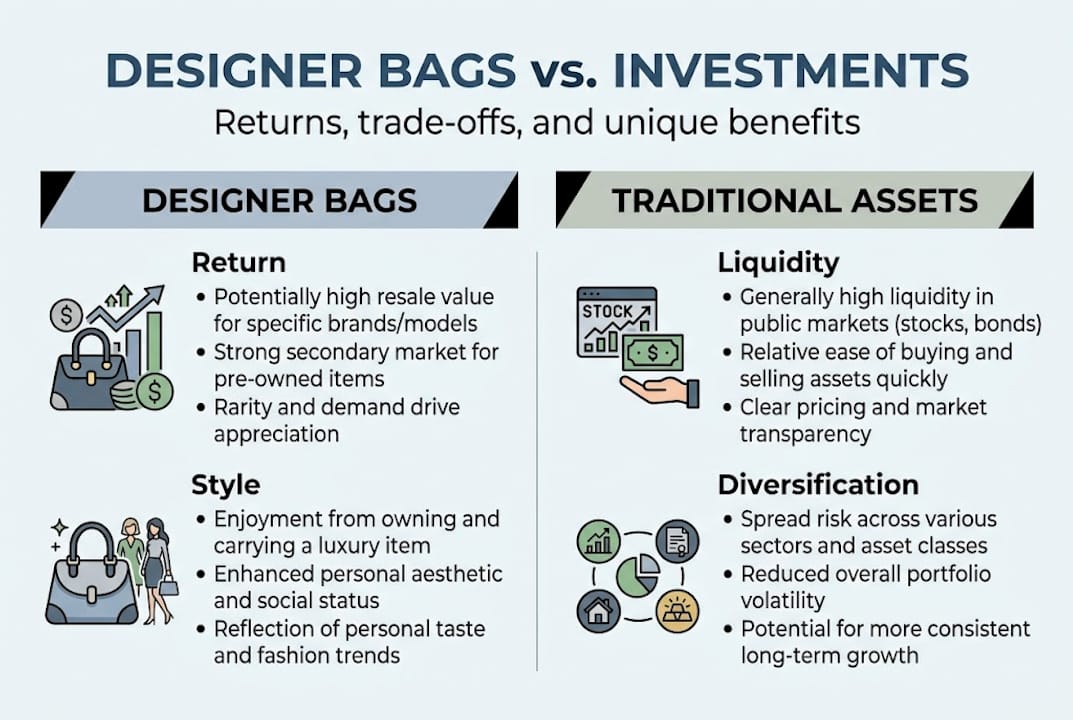
Designer bags vs. other investments: Benefits and trade-offs
Now let’s weigh bags against traditional investments and see what makes them uniquely appealing. A useful concept here is the “passion asset,” a term used by financial analysts to describe items such as fine art, vintage cars, rare wine, and luxury bags, assets that carry both monetary and deeply personal value.
A certified financial planner (CFP) interviewed for a CNBC analysis offered an important distinction: bags are best approached as “smart purchases” for long-term personal enjoyment rather than pure financial speculation. The emotional rewards, wearing something exquisite, expressing your identity, carrying a piece of artisanal history, are real returns that simply do not appear in a brokerage statement.
Yet the limitations are equally real. Designer bags are illiquid: you cannot sell them in seconds the way you can a stock. Their market is influenced by cultural taste, brand strategy, and condition in ways that are harder to model than equity markets. As one Bloomberg analysis notes, high returns are not guaranteed and the asset class carries genuine risk for the average buyer who lacks deep market knowledge.
Factor | Designer bags | Stocks | Gold | Real estate |
Potential return | High (selective) | Medium-high | Medium | Medium |
Liquidity | Low | Very high | High | Low |
Personal utility | Very high | None | None | Medium |
Entry cost | Medium to very high | Variable | Variable | Very high |
Emotional value | Exceptional | None | None | Some |
For investing in a black leather handbag or any classic piece, this table frames the honest trade-off: you accept lower liquidity and some market uncertainty in exchange for an asset you genuinely enjoy every single day. That is a trade millions of discerning women make with their eyes wide open.
Maximizing your returns: Practical strategies for investing in bags
Equipped with context and comparisons, let’s drill down into actionable steps and strategies for your own collection. The difference between an impulse purchase and a smart investment often comes down to a few deliberate choices made before you buy.
Research the brand tier first. Confirm whether the house and specific model you are considering has a track record on the secondary market. Hermès and Chanel’s flagship styles are the safest starting points.
Prioritize timeless designs and neutral colors. A black or gold bag in an iconic shape will appeal to buyers in five, ten, or twenty years in ways that a trendy seasonal color simply will not.
Calculate cost-per-wear. Designer bags last 10 or more years, while reselling at 50 to 110 percent of the original price, reducing the effective annual cost to under $200 even for a $5,000 bag. That math transforms a luxury purchase into a financially rational one.
Buy from reputable sources and keep everything. Dust bags, authenticity cards, receipts, and original packaging all add measurable resale value. Never discard them.
Consider pre-owned as an entry point. The guide to designer handbags under $500 shows that curated pre-owned pieces offer genuine appreciation potential while reducing financial risk.
Invest in care and maintenance. Professional cleaning and proper storage extend the life and condition of your bag, directly protecting its future value.
Pro Tip: Explore the world of quiet luxury essentials if you want pieces that age with impeccable grace. Understated, refined designs tend to hold appeal far longer than anything closely tied to a specific season or trend cycle.
Sustainability is another reward worth naming. Choosing a pre-owned bag extends its lifecycle, reduces demand for new production, and aligns your purchasing with a philosophy of slow fashion, exactly the kind of thoughtful, intentional elegance that defines a truly refined wardrobe.
Our take: The overlooked value of investing in bags you’ll love
We have spent a great deal of this conversation focused on percentages, retention rates, and resale platforms, and rightly so. But there is a dimension of this conversation that financial reports cannot fully capture, and it may be the most enduring return of all.
A designer bag tells your story. It sits with you through career milestones, celebrations, and quiet ordinary Tuesdays that somehow become the ones you remember most. We think of the finest bags as wearable heritage, objects that carry both craftsmanship and personal meaning forward through time. For women 25 to 45, the advice to invest in timeless classics in neutral colors from Hermès or Chanel is sound financially. But the deeper truth is that the most satisfying investment is one you reach for every morning with genuine pleasure.
The timeless fashion selection process has always rewarded those who buy with both heart and mind. ROI matters. But so does joy, identity, and the quiet confidence of carrying something truly beautiful. We believe the two are not in conflict; they are, in fact, inseparable.
Elevate your style and investment journey with Vivien Lauren
Ready to experience the blend of style and value? Here’s where to begin.
At Vivien Lauren, we curate collections with precisely this balance in mind, pieces that honor the tradition of exquisite craftsmanship while offering enduring personal style. Whether you are drawn to elegant accessories that complement a considered wardrobe or looking to anchor your look with timeless dresses that speak to the same quiet sophistication, our collection is shaped around longevity and beauty in equal measure.

Discover the full Vivien Lauren collection and find the pieces that will accompany your story, today and for years to come. Each selection is an invitation to invest not just in fashion, but in yourself.
Frequently asked questions
Which designer bags hold their value best?
Hermès, Chanel, and Goyard bags, especially iconic models in classic colors, historically hold and grow in value. The Hermès Kelly Mini II reaches 282% value retention, with the Birkin Sellier at 183% according to the 2025 Rebag Clair Report.
Can you lose money investing in designer bags?
Yes, many brands depreciate significantly and it is crucial to research styles and conditions before buying. Non-iconic pieces from brands like Gucci or Prada can see annual losses of 5 to 30%, making brand selection the most critical variable.
Is buying pre-owned designer bags a good investment?
Buying pre-owned lowers your entry cost without sacrificing appreciation potential, and is also a more sustainable path into luxury. Pre-owned retains appreciation potential while extending the life of a beautifully crafted piece.
What is the cost-per-wear approach for evaluating designer bags?
The cost-per-wear method divides the total price by estimated uses over the bag’s lifetime, revealing its true annual cost. With resale values of 50 to 110% of the original price and a lifespan exceeding ten years, even a $5,000 bag can cost less than $200 per year effectively.
Are designer bags a better investment than stocks?
Some iconic bags have outperformed stocks historically, but they are illiquid and carry meaningful risk. Financial planners suggest treating them as smart purchases for enjoyment rather than replacements for a diversified investment portfolio.
Recommended
This fashion guide has been written for you by Chloe. On behalf of Vivien Lauren. Vivien Lauren. Luxury. Craftsmanship. That's Proudly Italian. Vivien Lauren. Proud To Style.

